
I Stopped Listening to What People Say. These 3 Silent Signs Tell Me Who They Really Are
Watch them wait, laugh, and speak. The truth shows up in the gaps.
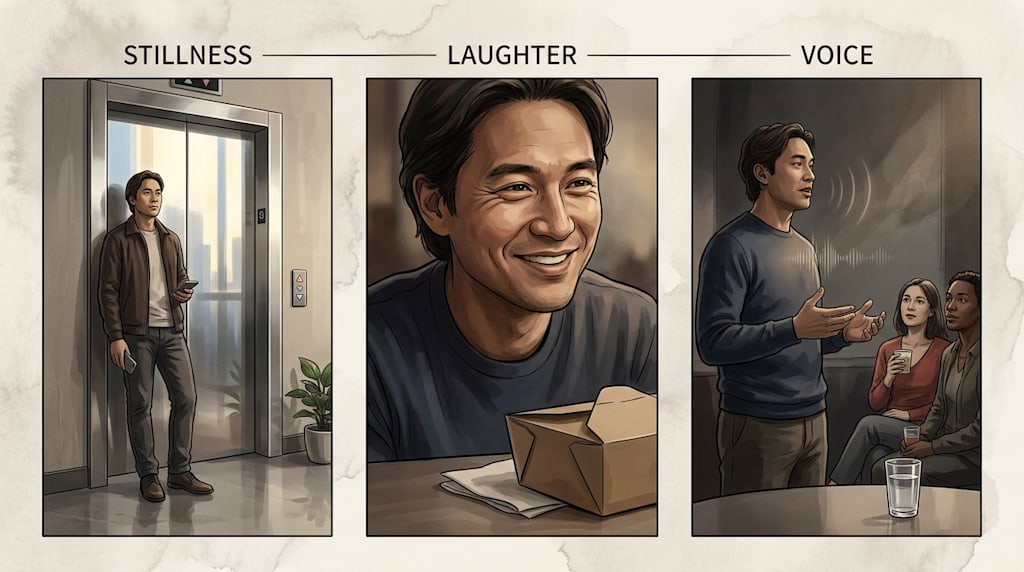
To read people, don’t only watch them at the conference table. At the table there are lights, topics, and other people’s eyes. Watch them waiting for the elevator. Watch them after they laugh. Watch the half-second before they speak.
The Zhongyong says: “The gentleman is cautious and watchful over what he does not see, and fearful and apprehensive about what he does not hear. Nothing is more visible than what is hidden; nothing is more manifest than what is subtle. Therefore the gentleman is cautious even when alone.” At low-monitoring moments, a person is most at ease and closest to his default settings. Still presence, laughing presence, and voice presence are three low-monitoring slices.
1. Still Presence: What He Does While Waiting for the Elevator
To see still presence, watch him waiting for the elevator.
When the elevator doesn’t come, some people scroll on their phones. Some shake their legs. Some tidy their hair in the reflective stainless-steel door. Some press the button every three seconds, then look at the floor number. The number doesn’t move, so they press again. Some stand in the corner, phone face down in their palm, thumb still. When the elevator arrives, they let others go first. They go in last, stand on the right, and don’t lean on the handrail. Their eyes don’t chase the floor numbers. They only lift when the door opens.
At a moment like that, you can’t tell how much money is in his bank account. You can see where his attention lives. Is it on himself, or in other people’s eyes?
The eyes are the hardest thing to hide in still presence. When a person is alone or silently working, if his gaze is inward and focused, if he doesn’t blink excessively, if his eyes don’t chase every nearby movement, his inner order is still intact. He doesn’t rush to explain. He doesn’t rush to prove. When you talk to him, he looks at the bridge of your nose, not at your phone. When someone nearby laughs, he raises the corner of his mouth slightly. His gaze doesn’t follow it.
The opposite type is different. His eyeballs dart left and right. When he talks to you, his gaze flickers. Every so often he steals a look at your phone screen. You lock it. A moment later he looks again. You reply to a message. His neck stretches forward. This kind of person is usually hollow inside, anxious, deprived, full of small calculations. He may not be bad. His attention is always on other people, always afraid of missing something.
People with bulging eyes, often carrying a fierce or greedy look, lose control of their emotions easily. People with dull eyes and cloudy whites usually have messy lives and schedules. Talk to him for three sentences, and he yawns twice. His gaze is unfocused. He may not look down on you. His inner drive has stalled.
Then look at the lips. A person whose lips close naturally, with a clear lip line, has strong boundaries. He doesn’t open his mouth easily. He doesn’t make promises easily. After takeout, he folds the napkin and presses it under the box lid. He leaves no grease spots on the table. A person whose mouth hangs slightly open at rest lacks central qi and has weak willpower. He may have just said, “I’m going to sleep early,” then turn around and open another bag of chips. A person whose mouth corners droop year-round usually has high cortisol and a heavy victim mentality. Tell him something. His first reaction isn’t to solve it. It’s “Why me again?”
Complexion can also show a lot. A forehead covered with acne often accompanies long-term anxiety and insomnia. Darkness or redness between the eyebrows suggests a stubborn, combative, overly serious nature. Recurring hard cystic acne around the mouth and chin points to overthinking and rumination. A whole face that looks gray, dull, and darkened means the nervous system has been overdrawn for a long time. The body-mind is in a trough. Treat this as an observation of state, not a medical diagnosis. Whether a person has been doing well lately: his face is often more honest than his mouth.
Sitting posture and body shape are the same. If he sits down and his back is naturally straight, his lower body stable, his hands free of unnecessary small movements, his kidney qi is sufficient. His bone strength is strong. He finishes what he starts. If the chair is unstable, he doesn’t complain. He just plants his feet. If he starts moving things around on the table, shaking his leg, picking at his fingers as soon as he sits down, that is chronic anxiety. His stress threshold is low. His adaptability is poor. He may want to be steady. His body leaks the tension for him.
Still presence shows a person’s default setting when no one is watching. No audience. No interest. No lines. What state is he still in? That is his most effortless, most real, hardest-to-fake appearance.
2. Laughing Presence: The Moment After the Laugh Shows the Heart
Laughing presence is even more accurate than still presence. The instant a person laughs, the rational defenses of the cerebral cortex briefly stall. The underlying neural circuits and true nature cannot hide.
The first type is the smile without the eyes. The corners of the mouth pull wide. A row of teeth shows. The muscles around the eyes don’t move at all. The gaze is still calmly sizing you up, as if waiting for your quote. This kind of disconnected facial smile is a tool for evaluating interest. He isn’t laughing because he’s happy. He’s laughing because he needs you to see him laugh. You have dinner with him. The atmosphere is warm. After it ends, you’re left with nothing.
The second type is the crooked smile, one corner of the mouth lifting. This person is subconsciously arrogant and proud, carrying a trace of contempt. When he smiles, he isn’t accepting you. He’s looking down at you. An occasional crooked smile is fine. When it becomes a habit, it means he has a hard hierarchy inside: few people he respects, even fewer he treats as equals.
The best smile is the Duchenne smile. The smile starts from the eyes first. The eyes curve slightly. The aegyo-sal rises naturally. Only then do the corners of the mouth relax. This kind of person is open-hearted, deeply empathetic, and carries no hidden malice. People who smile well and are highly agreeable often have better luck and receive help from benefactors. Their smile isn’t taking. It’s releasing. The smile invites. It does not perform. Others unconsciously relax around them.
Laughter can also reveal the qi of the organs. Laughter that is loud, round, and comes from the chest and abdomen means the lungs and kidneys are full. The person is open and calm. He has strong resistance to pressure. When this kind of person laughs, the whole room brightens. Laughter squeezed from the throat, thin and short, belongs to a narrow-minded person who panics and envies easily. A dry laugh snorted through the nose, “tch, hmph,” belongs to someone who habitually nitpicks and finds fault. He is heavy with negative energy. Laughter with a wheeze or a sigh at the end belongs to someone with deep pessimism and inner friction. He laughs and laughs, as if laughing himself tired.
There is one more detail that is easily overlooked: how the laugh stops. Watch how a person returns to his original state after laughing.
If the laughter recedes like water, the warmth in the eyes slowly sinking, the facial muscles naturally transitioning back to calm, this person’s emotions are coherent, sincere, and stable. His laugh is real. Its ending is real. Emotion is like a river: it has a source and a destination.
But if one second he is laughing loudly, and the next the corners of his mouth snap shut, his face instantly frosty and expressionless, this kind of person who cuts off laughter abruptly is cold. He is good at using emotion as a performance tool. He turns face quickly. He is calculating. You can almost see a switch on his face, click, cutting from noise to cold silence. His emotions only serve his purpose.
Laughing presence shows the heart’s method. Especially how it ends. How a person laughs only shows how he expresses himself. How he stops laughing shows how he handles his relationship with others.
3. Voice Presence: The Half-Second Before He Speaks, His Qi Has Already Leaked
Voice comes from the lungs and is rooted in the kidneys. It is the most truthful physical vibration of inner qi. A person can control his expression and design his smile. It is hard to disguise the texture, rhythm, and breathing of his voice over time.
The best voice comes from the dantian. It resonates through the chest. It is full of central qi, round and steady, and carries natural resilience and leadership. This kind of person doesn’t necessarily speak loudly. Every sentence lands on solid ground. When you listen to him, you unconsciously quiet down.
A voice squeezed entirely from the throat is restless and sharp. The person panics easily when things happen. A voice as thin as a mosquito’s, broken and intermittent, belongs to someone passive, withdrawn, and lacking responsibility. He may not be bad. His energy is not enough to support a complete sentence. It is hard to expect someone who cannot even send his voice out to stand up and carry things in a critical moment.
The rhythm of speech is also a study. A person who speaks calmly, with natural breathing gaps between sentences, has high mental bandwidth and strong control of the room. He isn’t afraid of silence. He doesn’t rush to fill every second. The gap is spare capacity in his mind.
A person who speaks fast, machine-gun style, interrupting and grabbing the conversation, is usually insecure, impatient, and impulsive. He is afraid others won’t listen. He is afraid the topic will be stolen. He is afraid he isn’t important. The faster he speaks, the more he exposes his inner crowding.
There is also a major taboo in voice presence: qi leakage. Unconscious noise.
In a quiet environment, someone who always makes fine whistling or shushing sounds has fragmented attention. He is restless. He seriously lacks boundaries. Someone who frequently sighs heavily or snorts for no reason has liver qi stagnation. He has deep resentment and powerlessness stored inside. Someone who loudly clears his throat or coughs before speaking has hidden inferiority and passive aggression. He tries to seize the room with noise. Someone who smacks his lips or chews with his mouth open while eating has poor self-control and weak awareness of rules.
These sounds are small, so small the person himself may not notice. This involuntariness reveals the most. The body speaks for the subconscious.
Voice presence shows qi. It shows whether a person has a sense of safety, a sense of boundaries, and the ability to keep his energy steadily inside his own body.
4. Seeing Them Together: Stillness Shows Stability, Laughter Shows the Heart, Voice Shows Qi
Put still presence, laughing presence, and voice presence together. A person becomes three-dimensional.
In stillness, watch the stability of the eyes and the lips and jaw. In movement, watch the laughter and how it ends. In speech, listen to the voice and the qi of the breath. When the three confirm each other, you can basically see a person’s underlying character and his scope and structure. This is not a verdict. It is a probability observation.
To read people, at least four calibrations are needed.
First, baseline. Some people naturally blink a lot, breathe through their mouths, have rhinitis, social anxiety, ADHD, facial paralysis, or vocal cord disease. You have to know what they are normally like before you judge whether they have deviated from their baseline in a specific situation.
Second, context. Interviews, dates, meeting a boss, cultural norms: all of these change gaze, posture, laughter, and speed of speech. A person who is usually steady may fumble when he sees someone he likes. A person who is usually cold may laugh like a child in front of close friends.
Third, state versus trait. Acne, complexion, hoarse voice, frequent sighing: these may simply be from recent late nights, illness, or stress. Don’t misread “recently tired” as “this is his fate.”
Fourth, confirmation bias. The more you believe in this system, the more you remember the cases that fit and forget the ones that slapped you in the face. The most dangerous thing in reading people isn’t misreading them. It’s getting it right once and then thinking you will always be right.
If you add one more dimension, add anger presence and interest presence. Watch him in conflict, around money, under time pressure, when offended, and how he treats the weak, service workers, and people with no vested interest to him. Still presence, laughing presence, and voice presence can all be acted. Under conflicting interests, it is hardest to act. Smiling at a boss is instinct. Smiling at a waiter is cultivation. Being steady in good times is normal. Being steady in bad times is ability.
A more stable method is: first establish a baseline, then repeat across many scenarios, then look at consistency, and finally look at behavioral consequences. Does he keep promises? Does he own mistakes? Does he respect the weak? One observation is only intuition, not a verdict.
The three courts and five mountains of traditional face reading show a wider life structure: upper, middle, and lower courts corresponding to early, middle, and late fortune. That is difficult. It depends heavily on the life experience and judgment of the person reading the face. When the sample is larger, I’ll share more.
Still presence, laughing presence, and voice presence: these three slices are already enough for daily use. They are not mystical. They are not far away. They are in every silence, every laugh, every opening of the mouth.
Next time you see someone waiting for the elevator, phone face down, thumb still, letting others in first, you can look again. But don’t rush to conclude. Look three times. See how he treats a waiter, an error, an interest. Then look at yourself: when you wait for the elevator, where is your phone, and what is your thumb doing?
About the Creator
Jin
Writer of reamstories
https://reamstories.com/jin
Enjoyed the story? Support the Creator.
Subscribe for free to receive all their stories in your feed. You could also become a paid subscriber, letting them know you appreciate their work.
Comments
There are no comments for this story
Be the first to respond and start the conversation.