
I Stopped Letting an Unanswered Text Vote on My Worth
A five-column worksheet, a glass of water, and the slow work of taking value back from the outside
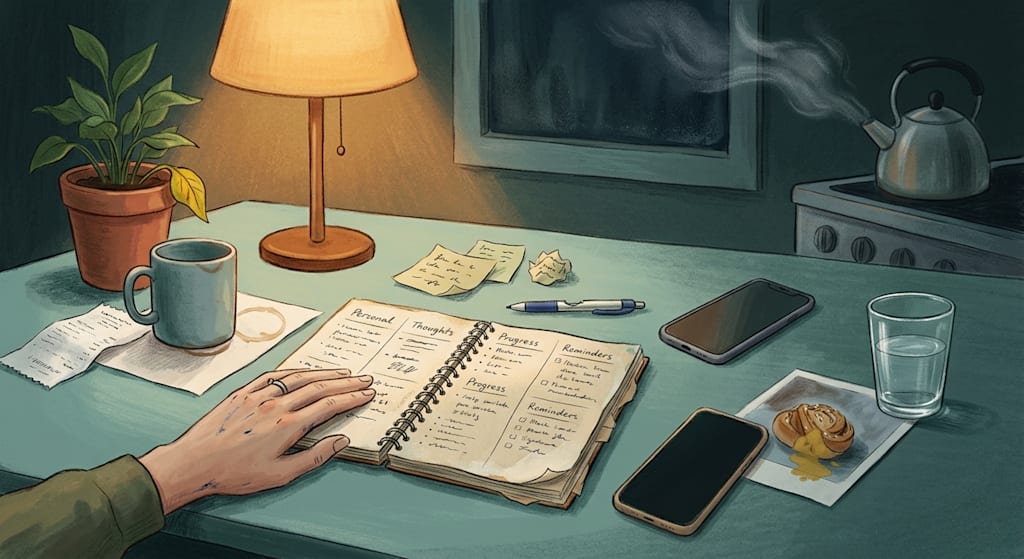
The message sat in the draft folder for eleven minutes. Nora changed “Hey” to “Hi,” deleted a question mark, added it back. Priya had not replied to the last message. It had been short: “Can we move Thursday?” Three hours. No answer. Nora opened Priya’s profile, closed it, opened it again. On the desk: a cold cup of tea, a receipt, a small green plant with one yellow leaf.
At 9:40, a sentence arrived with the speed of a delivery notification: Priya is done with me. Nora picked up a pen and wrote it down. The sentence had arrived like a fact. She put it next to the event. Left column: “No reply for three hours.” Right column: “I am unwanted.” The pen hovered. She added a third column: “Other factors.” Mine: I asked a short question during work hours. Theirs: meetings, commute, sleep, a phone left in a bag. World: bad signal, a busy week, the general mess of schedules. The sting stayed. The column made it smaller than the whole room.
The second exercise was harder. Nora wrote “My part” on a sticky note, then “Their part,” then “The world’s part.” For the no-reply: my part was a vague question sent at a bad time. Their part was unknown. The world’s part was Thursday traffic and a full inbox. She added two more words under the note: “Control” and “No control.” Under control: send a clearer message tomorrow. No control: Priya’s mood, Priya’s phone, Priya’s reply. Responsibility asked what could be done next. Self-blame wrote a sentence about the whole person. Nora underlined “whole person” and drew a line through it.
Then the old voice: “You always do this. You are too much and not enough at the same time.” Nora’s jaw tightened. She caught the sentence before it finished, put a hand on her chest, and said aloud, in the flat voice she used for her friend’s voicemail: “This is hard. It makes sense that it is hard.” She drank water. The water was warm. She wrote on the corner of the page: “Glass of water before the next step.” The sentence sounded too neat. She crossed out “before the next step” and wrote: “Glass of water. That is all.”
On a sheet of paper, Nora drew five columns. Fact. My explanation. My part. Their part. The world’s part. At the bottom: “Next small step.” The paper looked like a school worksheet. She kept it anyway. It gave the next ten minutes a shape.
The next morning, the phone stayed face down while she made coffee. The kettle clicked off. Steam fogged the window. She did not check the screen. At 10:15, she sent Priya a different message: “I saw the bakery near your office. Did you try the cardamom bun?” It was specific. It did not ask for reassurance. She put the phone in her coat pocket and went to a meeting. During the meeting, she wrote “I am bad at this” on the corner of her notebook after she stumbled over a sentence. Then she wrote under it: “That is another scorecard.” She tore off the corner and used it to mark a page.
The evidence exercise happened on a Tuesday, at the kitchen table, with a pen that had a chewed cap. The conclusion: “No one wants to spend time with me.” Evidence for: two unanswered messages, one canceled dinner, a weekend alone. Evidence against: a colleague asked her to lunch last week and she said no because of a deadline; her cousin sent a photo of a dog with a broken ear; she had declined two invitations in the past month. Other explanations: deadlines, winter, a friend’s new baby, the way plans move in groups. Nora read the list. The conclusion stayed. It lost its grip. She wrote at the bottom: “Feeling, not fact.” The sentence was plain. It stayed.
The values question came later. Nora wrote: “What kind of person do I want to be?” The answer was not “confident” or “successful.” It was “someone who keeps in touch without keeping score.” The first action was small: send one specific message to one person, with no request for a reply. She sent it. Priya replied two days later with a photo of the cardamom bun and a mustard stain on her sleeve. Nora laughed once. She put the phone down and went back to her report. The report was due at five. She finished it at five forty.
The failure came on a Thursday. Nora tried the self-compassion script and heard her own voice sound fake. She wrote: “I am bad at self-compassion.” Then she saw the scorecard. She wrote: “This is another performance review.” She did not fix it. She put the paper under a mug of tea. The mug left a ring on the paper. The ring stayed there.
External praise still worked. A client sent an email with “great work” in the subject line. Nora read it twice. Her shoulders dropped. An hour later, the same client asked for a revision. Her shoulders went back up. The email moved her afternoon. She wrote the revision and ate a late lunch. The lunch was a sandwich with too much mustard. She ate it anyway.
The old habit did not disappear. Nora still checked the phone when a message went unanswered. She still wrote “I am too much” on bad days. The pause had a shape: a pen, a column, a hand on the chest, a glass of water, a specific message, a small step. The pause was short. Sometimes it lasted ten seconds. A bad afternoon stayed a bad afternoon.
On Sunday, Nora cleaned the desk. She found the five-column sheet under the receipt. The tea ring had dried. She read the “Next small step” line from the week before: “Send Priya the bakery question.” She had done it. Priya had replied. The reply was a photo and a stain. Nora put the sheet in a folder. The folder went in the drawer with the receipts.
The phone buzzed. A new message from a different friend: “Are you free next week?” Nora looked at the screen. The old sentence started to form: “They are only asking because…” She stopped. She wrote on a sticky note: “Event: an invitation. Story: not yet.” She put the sticky note on the edge of the laptop. She typed: “Tuesday or Thursday after 6. I can do either.” She sent it. The phone stayed face down on the desk. The kettle clicked off. Steam rose. Nora got up to pour the water.
About the Creator
Jin
Writer of reamstories
https://reamstories.com/jin
Enjoyed the story? Support the Creator.
Subscribe for free to receive all their stories in your feed. You could also become a paid subscriber, letting them know you appreciate their work.
Comments
There are no comments for this story
Be the first to respond and start the conversation.