
I Put My Phone Down at 11 P.M. and Realized I’d Lost Three Hours
One moved app icon, one blank notebook, and the small choices that decide who gets your attention.
What’s Left in Your Head When You Put Down the Phone
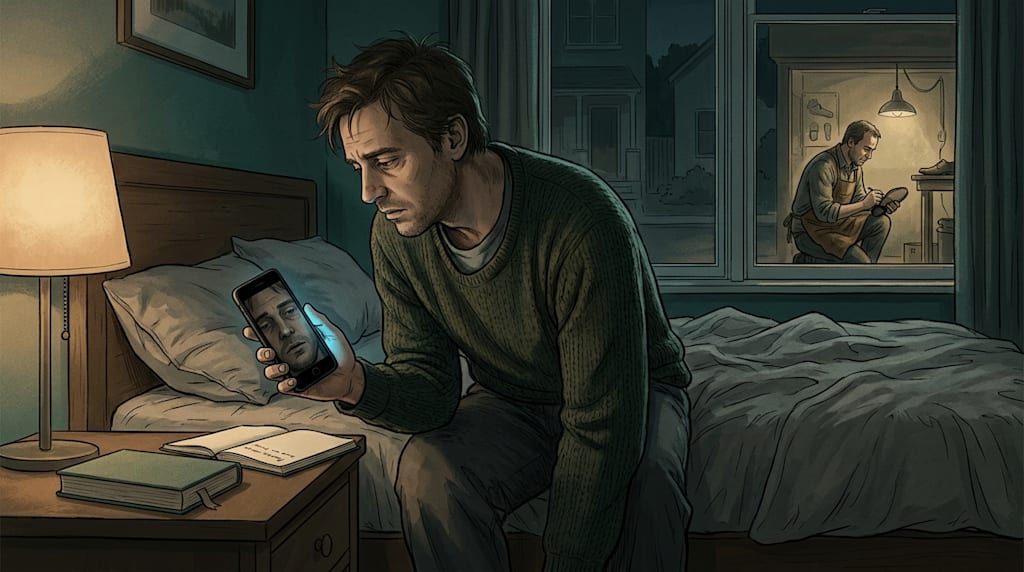
At eleven at night, he closed the short-video app. The screen went black and reflected his face. He couldn’t remember what he had watched for the past three hours. Not “a few things were fuzzy.” He couldn’t piece together one complete image. His finger still hovered over the screen, as if he had just let go of something he’d held for a long time.
It wasn’t the first time. But it was the first time he stopped to ask: whose three hours were those?
Attention works that way. You don’t feel it when you spend it. You feel it when you settle the bill. Short videos aren’t the problem. The problem is that they’re too effortless. So effortless that you don’t need to decide “should I watch this.” Your finger has already swiped. Thinking requires you to stop first, to decide “do I want to think about this.” Something that requires no decision beats something that requires a decision. The result isn’t hard to guess.
Later he did one small thing. He moved the short-video icon from the first screen to a folder on the third screen. He didn’t uninstall it. He added one step. With that extra step, sometimes he didn’t tap it. Not through willpower. Through the extra half second.
He had a college classmate. The year they graduated, the two had a meal. He went to a small company in a big city. His classmate went back to their hometown for an easy job. At the time, the classmate said, “What are you hustling for? Mine is so stable.” He said, “I’ll try it first.”
Three years later they had another meal. He said he’d been learning paid traffic lately. His boss had let him try managing a small ad account, spending two hundred yuan a day, seeing if he could get it profitable. His classmate said their workplace had adjusted salaries again this year. A raise of four hundred. As he said it, he picked up a bite of food with his chopsticks and didn’t look up.
He didn’t respond. It wasn’t about who was right or wrong. The ground under their feet had become different. One place made you think every day “how do I get this profitable.” The other made you think every day “don’t make a mistake.” Different things to think about. Three years later, different things you could do.
Most choices come down to which kind of hard you’re willing to eat. The hard in a big city is visible: rent, commuting, competition. The hard in your hometown is hidden. One day you realize no one around you is discussing “how to do this better,” and you don’t know who to discuss it with either. Both kinds of hard have to be eaten. It depends on which one you’re willing to eat.
He wrote on a WeChat public account. The first thirty posts never got more than two hundred views. The thirty-first was about why the shoe repair stand at the entrance of his neighborhood never lacked customers. For that piece, he spent three afternoons hanging around. He wrote down the shoe repairman’s exact words, sentence by sentence. The man said, “People come to me not because their shoes are broken, but because they can’t bear to throw them away.” He put that sentence into the article unchanged. That piece passed ten thousand views.
Someone asked him how he’d suddenly learned to write. He said it wasn’t sudden. In the first thirty posts, he was practicing one thing: replacing “I think” with “what I saw.” People read the shoe repair piece not because of any principle he wrote. They read it because he wrote the action of the man squatting down to look at the sole, and that line “can’t bear to throw them away.”
Whether you can make money depends on whether you can take one specific person’s specific problem and say it clearly in words they can understand. School doesn’t teach this. School teaches “generalization.” Society wants “specifics.” No matter how well you generalize, it’s not as good as squatting down once to look at a sole.
At an internal company meeting, for the first time, he said, “I see this proposal differently.” After he said it, his palms were sweaty. After the meeting, two people messaged him privately and said, “You were right, but I didn’t dare say it.”
Later he thought about why he hadn’t dared speak before. It wasn’t that he had no thoughts. He was afraid of saying something wrong. But that day he realized he was afraid of the wrong thing. He was afraid of “saying it wrong.” In fact no one remembered what he’d said wrong. People only remembered what he’d said. You don’t wait until you’ve thought it through perfectly before you open your mouth. You open your mouth, and the thinking happens in public. You speak ten times. The ninth may still be bad. By the tenth you know where to pause and where to press.
He had a friend in sales. Before every client meeting, the friend wrote out what he wanted to say three times and cut it down to five sentences. The friend said, “It’s not that fewer words are always better. Every sentence has to be something this person will actually hear.” None of those five sentences was “our product is great.” All of them were “That problem you mentioned last time. I went back and thought about it for three days. I have a clumsy idea. Try it.”
He knew he should do reviews. He saved forty articles on “how to do a review” and bought three notebooks. The first page had a date. The rest was blank.
It wasn’t that he didn’t want to review. Every time he sat down, the first thought in his head was “there doesn’t seem to be much to review today.” As soon as that thought appeared, the notebook closed.
Later he changed his approach. He didn’t write “what I did right and wrong today.” He wrote one line: “What made me pause today.” Sometimes it was “At three in the afternoon I was revising the proposal. By the fifth draft I realized the first draft’s direction was right, but I hadn’t dared stick with it at the start.” Sometimes it was “At dinner with a client tonight, he said something and I didn’t catch it. Only on the way back did I think of how to respond.”
One line. Thirty seconds. After two months, he looked back and saw a pattern. Every time he got stuck, it was because he wanted to “wait until he was ready before moving.” He didn’t reflect his way to that discovery. It surfaced on its own from those lines.
A review takes something you’ve been through once and runs it through again. It lets it stay in your head a little longer. If you only eat and don’t digest, your body will have problems. If you only experience and don’t review, experience stays experience. It isn’t yours.
He later did one more thing. He turned off all push notifications on his phone for “watching others embarrass themselves” and “celebrity gossip.” Not out of superiority. He did the math. He couldn’t change those things. After watching, he had nothing more than a few extra bits of conversation. But for the thing on his own desk, “how to get the ad account profitable,” one more case study read meant one more bit of grip.
Time has a price. You pay it by spending it on things you can change or things you can’t. Things you can change are usually not pretty to look at. Things you can’t change usually are. Pretty things are free because your attention is the price.
Back to that night at the beginning.
Later he still put down his phone at eleven at night. But sometimes after putting it down, he’d pick up a thin book nearby and read three pages. One day he read three pages, closed the book, and typed one line in his phone’s notes: “Didn’t understand that sentence on page three. Read it again tomorrow.”
No “from then on he kept reading.” No “his life began to change.” Just that one line.
The next night at eleven, he picked up the book again. He turned to page three. The sentence was still there. He read it once. He still didn’t fully understand it. But he moved the bookmark forward one page.
About the Creator
Jin
Writer of reamstories
https://reamstories.com/jin
Enjoyed the story? Support the Creator.
Subscribe for free to receive all their stories in your feed. You could also become a paid subscriber, letting them know you appreciate their work.
Comments
There are no comments for this story
Be the first to respond and start the conversation.