
I Only Meant to Watch Ten Minutes
125 minutes later, the stop button was still not in my hand.
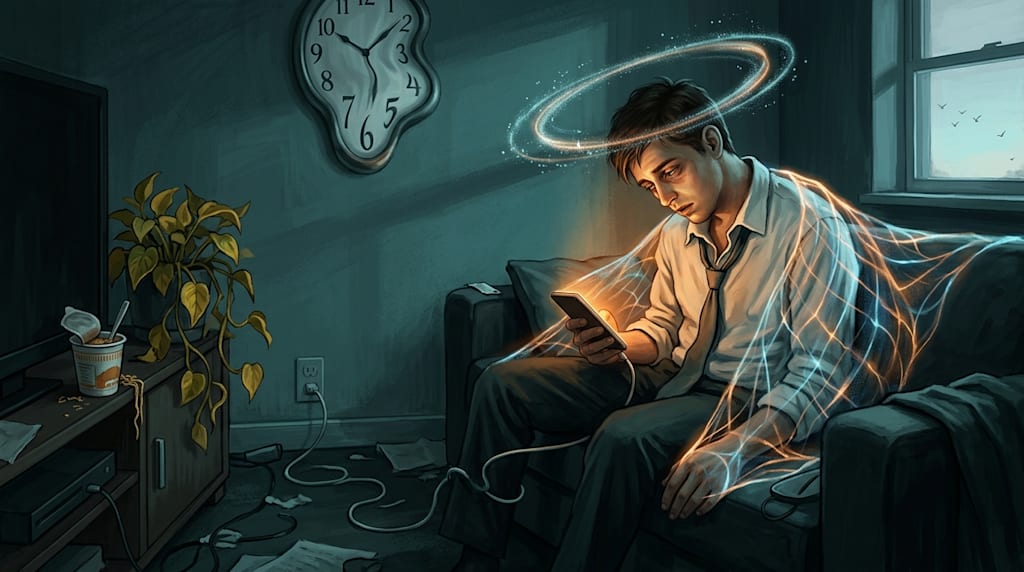
125 Minutes: A Worker’s Late Night with Hongguo
21:47, he turned off his computer.
On the subway, people packed in tight. He held the strap with one hand and pulled out his phone with the other. The screen lit up. The Hongguo icon sat in the second row of his home screen, separated from Douyin by one folder. He opened Hongguo not because he particularly wanted to watch short dramas. Douyin got tiring after a while. WeChat had no new messages. Long-form video required a membership. Hongguo was free.
The first episode played automatically. Three seconds in, a woman was pushed down the stairs. Ten seconds in, she was reborn at her wedding. Twenty seconds in, she raised her hand and slapped the groom. The corner of his mouth moved. It looked like the looseness of finally having one thing after work that did not require his brain.
22:15, he got home. The takeout had not arrived yet. He collapsed onto the sofa and swiped his thumb upward. Episode two. Episode three. Episode four. At the end of each episode was a countdown: 3, 2, 1. The next episode began automatically. He had never pressed “continue,” but he had also never pressed “stop.” The choice had been outsourced. All he had to do was lie there. The algorithm would decide what he watched next.
According to the Report on the Creation and Communication of Premium Chinese Micro Dramas (2026), as of July 2026, Hongguo Short Drama had 168 million daily active users. That was more than the combined daily active users of iQIYI, Youku, Tencent Video, and Mango TV. Hongguo users spent an average of 125 minutes per day on the app, up 33 minutes year over year. Douyin’s average daily use per user was about 112 to 120 minutes. WeChat’s was about 82 to 85 minutes. Hongguo and Douyin were part of the same company. Douyin owned 100% of the operating entity behind Hongguo. More than half of Hongguo’s new users came from Douyin traffic. In May 2025, ByteDance merged the business teams from both sides to form a “short drama copyright center.” By 2026, the service platforms were further merged into a “short drama creator center.”
He knew none of these numbers. He only knew the takeout had arrived, and he ate while watching. Braised pork over rice. Grease dripped onto the phone screen, and he wiped it with his sleeve. Episode 12: the male lead pinned the female lead against the wall and said, “You are mine.” He knew the line would be ridiculous in real life. He still did not swipe away. The next second, she kissed him. Emotion was compressed into thirty seconds. No buildup. No logic. Just the hit.
23:02, autoplay reached episode 18. His thumb hovered over the screen. His stomach felt bloated, so he went to get stomach medicine. The pothos sat on the TV cabinet, its leaves a little yellow. He had not watered it in a long time. He remembered he had a weekly report due tomorrow. His finger had already tapped the next episode. He wanted to stop. The stop button was not in his hand. Autoplay, swipe up and down, next-episode countdown: the decision of whether to keep watching had been outsourced to the product. Long-form video had ending credits. Short drama had no stopping point. He thought he was choosing. He was only not actively resisting.
23:40, he came across an AI animated short drama. Fantasy, xianxia, apocalypse, rebirth. The visuals were not refined. The characters’ movements were occasionally stiff. The plot had hard seams. But he could keep watching. His tolerance for AI was higher than for live action. He had long grown tired of live-action short dramas where people stood still and performed an entire series. AI short dramas could be supplied in low-cost batches. Settings could be infinitely large. Scenes did not need to be shot for real. As long as the reversals were dense enough and the hooks sharp enough, it worked. In the second week of July 2026, four of the top five on Hongguo’s hit chart were AI animated dramas. Seven of the top ten were AI animated dramas. Only three were live-action short dramas.
00:30, he finished all available episodes of an AI short drama. The screen showed “No more content.” He exited. The homepage recommendation immediately swapped in a new batch. He opened one. It was rebirth and revenge again. He knew the formula. He still watched. The algorithm had already precisely captured every pause, completion, save, and like. He glanced at revenge once, and it recommended a hundred revenge stories. He paused on a sweet romance clip, and it decided he needed sugar tonight. The filter bubble was not a dirty word. For a wage earner after work, it was a comfort zone. After a day of being rubbed back and forth by managers, clients, KPIs, and commuting, the thing he wanted most was to return to the cocoon the algorithm had carefully built and relax comfortably for an hour.
01:45, his eyes were dry. He decided to sleep after this episode. At the end of the episode, the female lead was kidnapped, and the male lead rushed into a fire. Countdown 3, 2, 1. The next episode began automatically. The male lead carried her out and said, “I won’t let you get hurt again.” He knew she would get hurt again in the next episode. He still did not close it. The Zeigarnik effect. Unfinished tasks are more memorable than finished ones. Leaving a cliffhanger at the end of each episode creates a sense of incompletion. You turn off the screen. Your mind still hangs on “Did she get her revenge?” “Is he really the CEO’s son?” That tension pushes you to tap the next episode.
02:10, the phone was hot. He plugged in the charging cable and continued. Episode 37. He no longer remembered the plot. He only remembered that it kept reversing. Sunk cost. He had already watched 30 episodes. Ten more did not matter. He had already spent 20 minutes. Ten more did not matter. The longer it went, the harder it was to quit. Micro-decision fatigue. Users did not want to choose, so the platform chose for them. Autoplay, personalized recommendations, next-episode countdown: all of them made decisions for you. All you had to do was lie there. The algorithm would push you to the next episode.
02:45, he finally turned off the screen when the ending song played. The room was very quiet. Birds were calling outside. It was not yet light. He lay there, heart beating a little fast, mind empty. He remembered he had originally only wanted to watch ten minutes. He opened WeChat. Someone in his Moments had posted about running. Someone about books. Someone about working overtime. He closed WeChat and opened Hongguo again. The homepage recommended a new drama: conflict in three seconds, reversal in ten. He opened it.
03:00, he put the phone by his bed and closed his eyes. Tomorrow’s alarm was set for 7:30. He heard his own breathing, the sound of the air conditioner’s outdoor unit, the convenience store downstairs closing. He turned over and picked up the phone again. His willpower was not the problem. The product had made “unable to stop” the default. The opponent was a system made of algorithms, products, content, and psychology. The short drama was only the surface.
07:30, the alarm rang. His eyes were dry, his head heavy. On the subway, he opened Hongguo again. Autoplay continued. Last night he had reached episode 41. Today he started from episode 42. He watched while typing today’s tasks into his notes app. The train reached his stop. He turned off the screen and walked into the office. At lunch, he opened Hongguo again. After work, he went home and repeated it.
125 minutes. Two hours and five minutes. In a year, 760 hours, about 31 days. A person who spends an average of 125 minutes a day on Hongguo will spend an entire month of each year on that screen. He was not sleeping or working. He was not with family. He was watching short dramas. Hongguo’s average daily use surpassing Douyin mattered because two products inside ByteDance had combined forces to reallocate time from long-form video platforms, WeChat, and sleep. Douyin found him. Hongguo kept him. The algorithm learned what he liked. AI supplied more of it. Free access removed the barrier. Ads paid for it. He supplied the attention.
He had tried turning off autoplay. He lasted three days. On the fourth day, he found that he had turned autoplay back on. He had not forgotten. He was too tired after work to make any choice. He had tried moving Hongguo off his home screen. A week later, he typed “Hongguo” into the search bar. He had tried setting a timer. The timer went off. He dismissed it and kept watching.
Later, he left his phone charging in the living room and went back to the bedroom. He lay down and heard a message notification from the living room. He did not move. The next day, he brought the phone back to the bedroom. The third day, he left it in the living room again. Back and forth. No epiphany. No transcendence. Only the charging cable plugged into the living room outlet. The phone screen lit up once, then went dark.
Birds called outside the window. He turned over and pulled the blanket over his head. In the living room, Hongguo’s autoplay was still going. Next-episode countdown: 3, 2, 1.
About the Creator
Jin
Writer of reamstories
https://reamstories.com/jin
Enjoyed the story? Support the Creator.
Subscribe for free to receive all their stories in your feed. You could also become a paid subscriber, letting them know you appreciate their work.
Comments
There are no comments for this story
Be the first to respond and start the conversation.