
I Lost Ten Illusions. Now I Walk With a Breeze.
How a man broke himself apart and rebuilt something that can't be shattered.
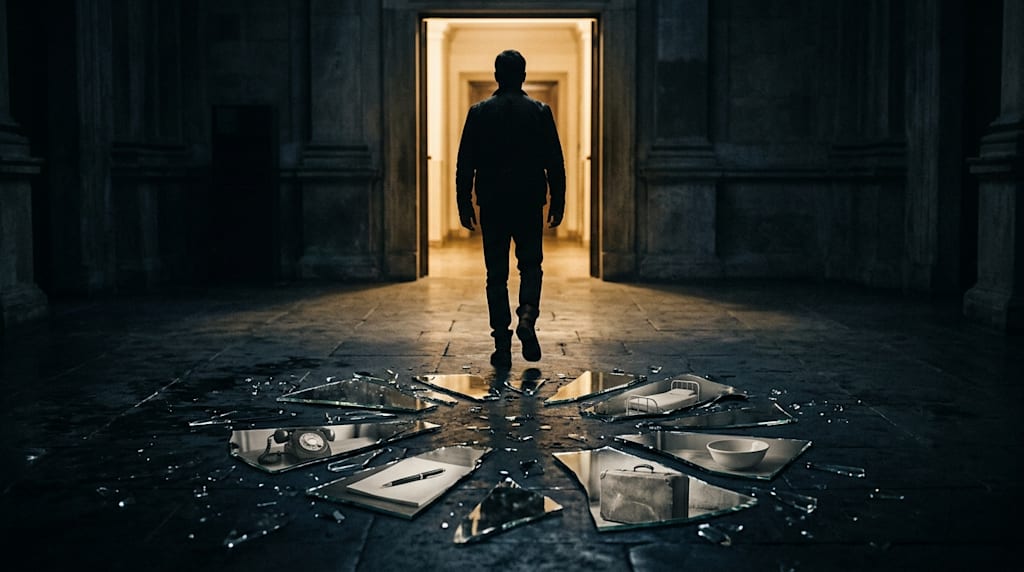
You first noticed that kind of person in a conference room.
The room was in chaos. Two departments were pointing fingers at each other. Someone had slammed the table. And there, in the corner, that person quietly turned a page of their notebook. The motion was slow; their fingertip glided across the paper, as if confirming something. When everyone had finally worn themselves out shouting, they spoke. Softly. Not many words. But the room went quiet.
Later, you came to realize that people like this share one thing in common: their silence isn't empty. It's full. Like a cup that once held boiling water, still warm to the touch, but you know it can never be scalded again.
How did they become this way? You asked one of them once.
He thought for a moment and said, "Nothing special. I just lost a few illusions, one by one."
The first illusion he lost was that someone would catch him.
He used to believe that as long as he asked, someone would reach out. He scrolled through his contacts from top to bottom and saw every name as a safety net.
Then he fell.
The debt collection text came in at midnight. He sat on the living room floor and dialed the first number. The other person said they were busy and would call back tomorrow. He dialed the second. No answer. The third rang to voicemail. The fourth picked up, chatted for two sentences, then changed the subject, awkwardly, like someone turning sideways to squeeze through a narrow gap.
He called every name in his contacts. When the last call ended, it was 4 a.m. He placed his phone face-down on the floor, his knuckles white.
"I didn't stand up the entire night," he said. "Not because I didn't want to. My knees just wouldn't hold me."
At dawn, he got up and went to the bathroom. The person in the mirror was still alive. He stared at that face for a long time, then turned on the faucet.
He replaced his SIM card later. The new one had only three numbers saved: his mother, building management, and the office front desk.
"What's the point of saving more?" he said, snapping the old card in half and tossing it into the trash. He did it without any expression, like disposing of an expired membership card.
"You know what," he said at last, "that morning I squatted by the trash can, picked up the broken pieces, and tried to fit them back together. Couldn't do it. And suddenly I thought, this whole thing is actually pretty simple."
He smiled and tucked his phone back into his pocket. That was the first time he'd ever smiled while telling that story.
The second illusion he lost was that true heart buys true heart.
He had a business partner. They started in a basement, with a secondhand printer and paper used on both sides. The partner used a pen whose cap had a small sticker on it: a cartoon rabbit that he'd peeled off a red envelope one Spring Festival and given as a joke.
By the third year, the company had taken off. When the partner slid a document across the table, he was still using that same pen. The rabbit sticker was worn white at the edges, but it was still there.
He looked at that pen for three seconds.
The document was asking him to step down. The terms were laid out clearly; every line rhymed. Not with words, but with calculation. One link after another, designed so he had no room to fight back.
He didn't argue. He flipped to the last page and signed with that pen. The ink flowed smoothly. As he wrote, he even thought: This is a pretty good pen.
"Why didn't you fight?" someone asked him later.
"What was there to fight about?" he said. "He handed me the pen to sign with. I gave him that pen. He used it for three years, wore the edges white, and kept using it. In that moment I realized… things are more complicated than I thought. He's not a bad person. He just decided that keeping those things mattered more than keeping me."
He paused, peeled an orange, and held it out. "You want some?"
He changed the subject. But the orange was real.
The third illusion he lost was that explanations help.
The worst time, someone accused him of taking kickbacks. There were over three hundred people in the group chat, and he was @‑mentioned more than a dozen times.
The first time he saw it, his hands were shaking as he typed. Type, delete, type again. What he finally sent was: "I'll post the purchase orders and transfer records. Please take a look."
No one looked.
The next day, someone else @‑mentioned him, saying they'd looked into it and it did seem like a misunderstanding. But no one apologized. That clarification message drifted like a leaf into a river, bobbed twice, then sank.
His friend said, "You should demand an apology."
He was tossing a bowl of noodles at the time, slowly, coating each strand with sauce. When he finished, he said, "And then what? They apologize today, and tomorrow they'll be in another group chat saying something else. I can't exactly rip my heart out and stuff it into each of their mouths one by one."
He picked up the bowl and took a bite. "No more explaining. Wastes noodles."
His friend was stunned into silence by the joke. He kept eating without looking up.
After that day, when people @‑mentioned him, he'd reply with at most one character: "Oh."
In Wubi input, that character takes four keystrokes. He typed it with perfect evenness.
The fourth illusion he lost was that there's always later.
The lights in the ICU hallway were white, so white they made you uneasy. He signed the critical condition notice; his pen paused on the paper, and a small blot of ink bled outward.
The monitor beeped all night.
At 3:47 a.m., the line went flat. He stood by the bed as the monitor emitted one long, unbroken tone. He didn't know how long he stood there. Then he looked down at his own wrist. His pulse was still there, a steady beat under his fingertip, like raindrops on tin.
He counted seventeen beats. Then he stepped aside for the nurse.
When he walked out, the sky was brightening. A gray‑blue light stretched across the east. He stood outside the hospital entrance for a while, then crouched to tie his shoelaces. They weren't loose, but he retied them anyway. When he stood up, his knees cracked.
After that day, he realized that as long as you remember to eat, you can endure anything. He used to think that was a cliché. Now he knew: that was the whole truth.
"You've changed," a friend said.
He didn't deny it. "I used to think a lot of things were huge. Now I think they're all pretty small."
He was peeling a boiled egg as he spoke. The shell cracked evenly. He peeled it slowly, like he was doing something important.
The fifth illusion he lost was that effort alone is enough.
He'd worked on the project for eleven months. On the last day, he stayed up all night revising it for the 47th time. His hands were shaking when he sent it, from exhaustion.
At 7 a.m., the other side replied with three words: Policy changed.
He read the email word by word. Then he shut down his computer. His face on the screen went dark, like a lamp being switched off.
Half a cup of coffee sat on the desk. He picked it up and drank it. Cold. The bitterness was straightforward, no detours. After finishing it, he washed the cup and placed it upside‑down on the drying rack.
He slept that afternoon. Woke at 6 p.m. to the smell of cooking oil from the floor below. He lay in bed and smelled it for a long time, until his stomach growled. He got up and made noodles. When the frying oil splattered onto the back of his hand, he flinched but made no sound.
He started using the phrase, "Do your best in the cause, let the result take care of itself." But he never said it aloud in front of anyone. Every time he started something, he'd write the character for "cause" in his notebook. When it ended, he'd write the character for "result." Many of those "result" characters had a cross through them.
"Do you still believe in effort?" someone asked him.
"Yes," he said. "But between effort and success, there's something else. I don't give it a name anymore."
He was watering a pothos plant as he spoke, very slowly, letting the water seep through the soil. The vine had grown long enough to trail on the floor.
The sixth illusion he lost was that it's all their fault.
He made a list once.
On the left side, he wrote What they did wrong: his parents never cared about him; his first boss withheld three months of salary; his ex‑girlfriend broke up with him when he was unemployed; his partner kicked him out at the company's peak…
On the right side, he wrote What I should have done but didn't.
He couldn't write the first line. He bit his pen cap for two minutes.
Then he wrote it. Seven lines in total. All small things: he'd noticed irregularities in his partner's books but never asked; he'd sensed his ex‑girlfriend growing distant but never spoke up; he'd known he needed to learn new skills but kept putting it off.
He crossed out the entire left column, pressing so hard the pen tore through the paper. Then he looked at the right column for a long time, folded the page, and put it in his drawer.
"That was the hardest afternoon of my life," he said. "But after that, the sound of my walking changed. I used to drag my feet, you know. Never dragged them again after that day."
He took two steps to demonstrate. He was indeed lifting his feet.
He didn't explain why. But you could see it.
The seventh illusion he lost was that it only counts if someone's watching.
For eight months, he didn't post a single thing on social media. He'd changed jobs, moved to the other side of the city, and rented a ten‑square‑meter room.
Every day he went to the same breakfast place, sat at the same table against the wall. Egg pancake, extra spicy, light sauce, hot soy milk. In the eighth month, one day before he could even order, the owner said, "The usual."
He nodded.
That day he sat at the table a little longer. The place was noisy: delivery riders rushing orders, someone crying on the phone, a kid blowing bubbles through a chewed‑flat straw. He sat in the corner and calmly finished his pancake, drank his soy milk, flattened the paper cup, and threw it in the trash.
"What did you do during those eight months?" someone asked him later.
"Nothing much. Just did the same thing every day. Finished them."
"Weren't you lonely?"
"Lonely?" He thought for a moment. "For a while, yes. But then I realized: when you're doing something that only you know about, and you keep at it long enough, that feeling is more solid than being seen."
He looked down at his hand as he spoke. A thin callus had formed on the side of his index finger, worn down by writing every day.
The eighth illusion he lost was that I can't hold this.
His father collapsed. His mother's voice trembled on the phone: "Come back, now."
He was on a plane that same night. In the airport restroom, he splashed cold water on his face and said something to himself in the mirror. He never told anyone what it was, only that when he walked out, his pace had changed.
On the third day at the hospital, the doctor asked to speak with him. Coming out of the office, he sat on a bench in the hallway, pulled a pen from his pocket, and scribbled a few words on the back of a prescription pad.
That was the first time he signed a document that wasn't his own.
After that, he signed every document with extra force. The pen was new; it left a faint white groove on the paper, so he traced over it again. Every word from then on was written heavily. One document took him seven tries before he was satisfied. A nurse said, "You don't need to press that hard. The carbon paper will go through."
He said, "That's fine. Let it go through."
His father was discharged later. He kept that stack of signed documents in a folder and didn't throw it away. When someone asked why, he said, "To keep. When something comes up and I feel like I can't handle it, I take them out and look at them."
"Does it work?"
"It works. I signed every one of them. Every time, I thought I couldn't sign it. But I did."
He was folding a shirt as he spoke. The creases were sharp, like tofu cut with a knife.
The ninth illusion he lost was that I'm nothing without these things.
He lost his job. Lost his relationship. Lost his apartment. All that remained was one suitcase.
On moving day, he threw away six boxes of things: books, clothes, an old computer, jars and bottles from the kitchen that had sat unused for three years. What was left fit entirely into a single suitcase.
Halfway through zipping it, the zipper got stuck. He sat down and spent twenty minutes fixing it, his fingers rubbed raw by the teeth. When it was done, he propped the suitcase against the wall.
That suitcase stayed in the corner for three months. He never opened it once.
"What's inside?" someone asked, curious.
"A heavy coat, two changes of clothes, three books, a charger, and an umbrella."
"That's it?"
"That's it." He thought for a moment and added, "The umbrella is a long one. Short ones get lost too easily."
During those three months, he ate no more than five types of food every day: rice, eggs, vegetables, soy sauce, and occasionally a packet of pickled vegetables. He lost six pounds, but his mind was clear.
"Aren't you afraid of having nothing left?"
"I was afraid," he said. "Then I realized that a person's baseline is much lower than you'd think. A bowl of noodles, a bed, a long umbrella. That's enough."
As he spoke, it started raining outside. He stood up, walked to the corner, took that umbrella, and pushed the door open.
When it opened, it made a loud pop.
The tenth illusion he lost was that everything will be fine once I get there.
The money arrived. The number was twice what he'd expected.
When the text notification came, he was in the kitchen. His phone was charging in the living room. He heard the chime but didn't rush to check it. Only after the water boiled and he'd dropped the noodles in did he walk over and glance at the screen.
He glanced. Locked the screen. Went back to the kitchen.
The noodles were ready. He added an extra egg.
As he ate, he looked at the lights outside the window: in the building across the way, someone was hanging laundry, someone turned off their TV, someone was on the phone laughing loudly. He finished the noodles and drank all the broth. The warm water ran over his fingers as he washed the bowl.
"What did you feel that day?" someone asked later.
"Nothing much," he said. "I just realized that getting there is exactly that: getting there. It's not bad. It's just different from what you imagined."
"Then what kept you going after that?"
He thought for a moment. "One rainy day, I put a bowl on the windowsill. The raindrops hit it: tap, tap, tap. Very slow. I watched for a long time. After that, I put a bowl out there every day when it rains. Not to catch the water. Just to hear the sound."
"Is the bowl still there?"
"Yes. When it rains, I put it out."
He looked up at the window after saying this.
That day, you finished listening to his story.
You thought for a moment, then asked one last question: "Now that all ten illusions are gone, what are you still afraid of?"
He was silent for a while.
"Hot water," he said. "I don't drink hot water. It burns."
It was a joke. But you couldn't laugh.
He stood up to leave. After two steps, he turned back and said:
"Oh, and don't feel sorry for me. Those ten illusions, I lost them myself. One less illusion, a little lighter. Now I walk with a breeze."
He left. For real this time. His steps were steady, his feet lifted and placed with clarity. There was no extra friction between his soles and the ground.
You sat where you were, watching him walk away. As he reached the door, the light from outside fell across his profile, and you saw that he was smiling. Very faintly, the temperature of water that's been left to cool.
You remembered then: the only thing he'd drunk all afternoon was a glass of water. Room temperature. No ice. Nothing added.
About the Creator
Jin
Writer of reamstories
https://reamstories.com/jin
Enjoyed the story? Support the Creator.
Subscribe for free to receive all their stories in your feed. You could also become a paid subscriber, letting them know you appreciate their work.
Comments
There are no comments for this story
Be the first to respond and start the conversation.