
I Left the Jelly Orange on the Table
My teenager didn’t need a snack. He needed me to stop asking.
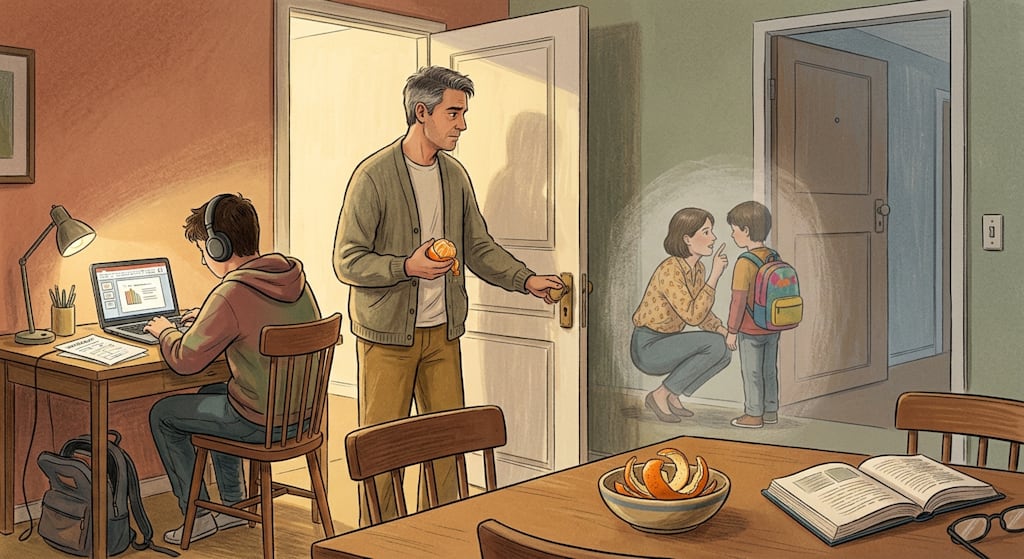
At night, I knocked on my older son’s door and asked if he wanted a jelly orange. A small voice said, “I don’t want one.”
I stood with my hand on the doorknob. I had already supplied his reasons: school lunch had fruit, but he skipped it to finish homework; homework took brainpower; fruit would help. So I said, “Just eat some. I peeled it for you.”
This time his voice was clearer: “I said no. Stop bothering me.”
I sighed, put the orange on the dining table, and said, “I’ll leave it here. If you want it, come get it.” Then I sat down to read. I read a few pages and kept replaying the scene. It looked like my mother and me years ago.
In middle school, I dreaded my mother’s nagging. At meals she hurried me. When I finished, she sent me to the living room. When I saw her finish and come over with tea, I went back to my room. When she knocked, I said I was doing homework. I treated her care as something I didn’t need. That way I didn’t feel managed.
The orange got eaten. My son came out for it and said little. The next day he told me it was good and asked for another. Later I changed my method. I put the orange on the table, said one sentence, and walked away. He was easier around me.
That small scene stayed with me. Teenagers hear care as control for reasons that have little to do with ingratitude.
1. He wasn’t rejecting the orange
From my side, the orange was nutrition and worry. From his side, he was doing homework or relaxing, and his need was simple: don’t interrupt me.
We call a child’s no backtalk, rebellion, rejection, ingratitude. He has his own logic and clock. He thinks: I’m not hungry. I’m busy or resting. Don’t push the orange.
My younger son peels oranges and cuts apples for me. If I insist he eat something, he won’t. I can call it nutritious and good, give it in the name of care, and he still won’t take it.
We know to feed a cat fish and a dog meat. With children we hand over love they didn’t ask for.
2. He needs to confirm “my time is mine”
Teenagers hear care as control because this stage is about boundaries and autonomy. He keeps checking: my room is mine, my time is mine, my body and choices are mine.
When parents persuade or decide for him at the wrong moment, care feels like management. “Stop bothering me” can mean “I’m guarding my space,” not “I’m sick of you.” Care is fine until its timing and manner cross the boundary.
“Just eat some, I peeled it” and “I’ll leave it outside” are small sentences. Teenagers hear the expectation underneath. If he says no and I sigh and remind him again, he learns he can’t say no.
We moralize the no: you don’t eat it, you’re ungrateful; you close your door, you’re rebellious; you say stop, you appreciate nothing. Escalate a snack into a verdict and he runs. He is resisting being defined, arranged, and told to obey.
3. My love had my anxiety in it
Parents have worries. We worry about nutrition, pressure, distance, and whether we are doing the job. The worry adds one more question and one more push. The child may hear “You don’t trust me to take care of myself.”
A friend’s son smashed his grandmother’s pipa and left a hole in the floor. She had been after him about homework. He came back from tutoring with unfinished work, then did homework on the toilet the next morning. Habits don’t form in a day. Nagging doesn’t fix them. Stop nagging.
Parents are not the only ones who talk too much. Some music apps now run preachy ads. Children get a full day of schooling and come home to more schooling. That is a lot of talking.
4. Between care and control are three words: the right to choose
Care gives resources. Control demands obedience.
Care respects no. Control treats no as a problem.
Care looks at what the other person needs now. Control looks at what I think they need.
So when I put the orange on the table, said one sentence, and walked away, I gave the choice back. Support should be available, not mandatory.
It can be lighter. Ask, “Do you want me to peel one? If not, fine.” Let no stand without a follow-up lecture. Keep a fixed snack spot. Knock less. Talk about new things. Exercise together. When the relationship is good, care lands.
When he asks for help, help. Don’t say “I told you so.” A new topic can pull a teenager in. A soccer star said something outrageous, and we talked about it. Both of my kids decided he had read too little and had no culture.
Treat a child as someone to control and pressure meets resistance. Treat him as a friend and offer advice and reference, and he may trust you.
5. Every attempt is how he learns the world
Parents get it backwards. When the child doesn’t need help, we offer it. When he asks, we get sarcastic or cold: “Didn’t I tell you?” “I knew it.” “You should have listened.” Anyone would hate that, especially a teenager.
Let him try. If it works, say so. If there is a problem, help and finish it. Every attempt teaches him how the world works. A parent’s route is simple and safe, but it keeps him from forming judgment and plans.
Grades will not be the only comparison. Can he think? Does he have methods? Does he start things? Parental control can become a stumbling block.
Most parents watch grades. School leaders told us to watch emotions and feelings. Teenagers need that support. Breakfast, school, homework, sleep looks normal. We should still ask, “How was your day?” “Are you okay today?” He may not say much. Our care can be care, not control.
When he is upset, talk. When he fails a test, a hug and “I’m here” help. When he is tired, soup or a small dessert helps.
Be a workout partner. Exercise together and share the good mood. A friend runs marathons. His son plays on the school soccer team and scored a goal with an injured foot. In summer, the father posts photos from the sports field. Both are sweaty and smiling. Another father I follow bikes with his child while he runs. Parents who want a better relationship can sweat with their kids.
6. Keep some love for yourself, and let the child carry responsibility
If a child will miss us after he leaves, the reason will be a good relationship. He will not run from your love. Keep some love. Don’t give it all away. Let him bear responsibility. That is what teenagers want.
When my son’s foot was injured, he held my hand to walk. His hand was already so big.
I put the orange on the table and said, “If you want it, get it.” Then I walked away. The orange sits there. When he takes it, and whether he takes it, is his business. I put it within reach and go do my own things.
About the Creator
Jin
Writer of reamstories
https://reamstories.com/jin
Enjoyed the story? Support the Creator.
Subscribe for free to receive all their stories in your feed. You could also become a paid subscriber, letting them know you appreciate their work.
Comments
There are no comments for this story
Be the first to respond and start the conversation.