
He Lived Alone in a Lighthouse. She Was a Kid from Chicago. What Happened Next Changed a Town.
A quiet, unexpected friendship between a solitary Vietnam veteran and a little girl, carried by a bottle cap, a motorcycle, and the click of a trash can lid.
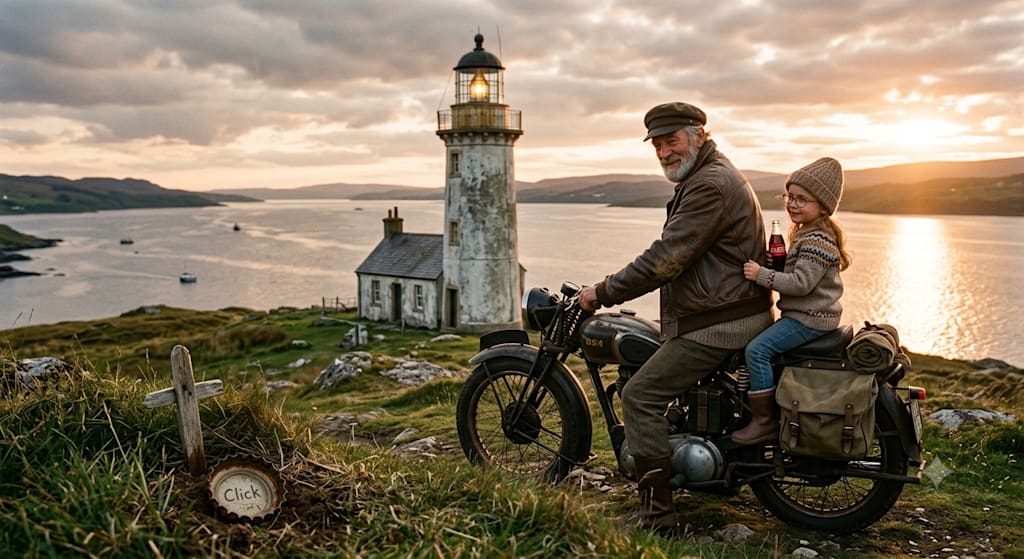
Everyone in town knew Old Harry, but few could say where he came from. He was in his sixties, lived alone in a small house built onto the shell of the old lighthouse — the walls a faded grey-white, the green paint on the window frames peeling away in patches, like a worn flannel shirt. He kept no dog, took no newspaper, and went to the supermarket once a week, always at three o'clock on a Thursday afternoon, when the store was emptiest.
The children used to call him "Ghost Harry." The adults said he'd been in a war, or lost his family, or was just born solitary. Nobody bothered to verify any of it; those labels were enough to satisfy a small inland town's entire imagination of what an outsider could be. Old Harry never corrected them. He didn't even show that he knew the talk existed. If you greeted him on the street, he would give the faintest nod and keep walking — the angle of that nod calibrated precisely to acknowledge your goodwill without ever opening an entrance to a longer conversation.
It wasn't until the out-of-town girl named Maya appeared that the people in town first saw something in Old Harry they couldn't name.
Maya was seven. She'd moved from Chicago with her mother into the blue house next door, a house that had sat empty for three years. Her mother had found work at the town clinic and often worked night shifts, so Maya spent a lot of time alone on the porch steps, drawing patterns with crayons that only she could explain.
Old Harry noticed her for the first time on a Thursday evening. He was walking back from the supermarket carrying a brown paper bag with a loaf of bread, some cans of soup, and two boxes of decaf tea. Passing the blue house, he saw Maya kneeling on the grass, staring at an overturned trash can. Rubbish was scattered everywhere — raccoons had been through it, coffee grounds and eggshells mixed with torn paper napkins.
She wasn't crying, and she hadn't called for anyone. She was just kneeling there as if she were working on a math problem that wouldn't solve itself.
Old Harry stopped. He set his paper bag down by the roadside, walked over, crouched, and began picking the trash up piece by piece, putting it back into the can. Maya watched him. She said nothing. He said nothing.
Once the can was upright, Old Harry fetched the hose and rinsed the remaining stains off the grass. When he straightened up, he spoke. "Your trash can — the lid has to click shut. You need to hear the click."
Maya blinked. "Click?"
"That's right. Raccoons can't open a lid that's clicked shut."
It was the first time he'd spoken more than ten words to anyone in town. Later, Maya told her mother that the old man next door had "taught her how to negotiate with raccoons." Her mother smiled and corrected her — it wasn't negotiation, it was prevention. But Maya insisted on the word negotiate. She couldn't say why; she only knew that the old man felt different from the adults around her. He wasn't teaching her so much as telling her a thing he had verified, a method that worked.
Autumn came, and something happened.
Maya had a hamster. She called him Cinnamon and kept him in a blue wire cage. One Saturday morning she found Cinnamon still. Not sleeping — the kind of still that even a child can recognize at a glance, a stillness that is absolute.
She carried the cage and knocked on Old Harry's door.
Old Harry opened the door, looked down at the cage, then looked at Maya. Her face was dry, but her lip was trembling — not the trembling of crying, but the blank tremor of someone who hasn't yet decided how to react.
He took the cage and set it on the table. He did not say "he's gone to a better place." He did not say "it's only a hamster." He examined Cinnamon's body, confirmed there were no signs of a struggle, and said to Maya, "He died of old age. Two years is a long life for a hamster. This one was well looked after."
Maya asked, "Did it hurt?"
"No. It was quiet. Like falling asleep and not waking up."
Maya was silent for a moment. Then she said, "Can I bury him in your yard? The ground at my house is too hard."
Old Harry nodded. He found a small trowel and chose a spot on the slope behind the lighthouse, where you could see the lake. While he dug, Maya took Cinnamon out of the cage and wrapped him in an old checkered handkerchief. Through the whole thing, she did not cry.
As they were filling in the hole, Maya asked suddenly, "Have you buried someone?"
Old Harry's hand paused — just a moment, not a freeze, just a pause like a clock hand skipping a nearly invisible tick. Then he went on shovelling and patted the last handful of earth firm.
"I have," he said.
He didn't say who. Maya didn't ask. But in that instant, the seven-year-old girl understood something dimly. It was the kind of understanding she hadn't yet learned to put into words, but her body had already received the signal: the way this old man did the work of burying was too practised. Practised to the point where each movement carried a ritual certainty, as if it wasn't his first time, or his second, but many times.
She didn't know what that meant. But she knew it must mean something.
Deep winter came, and Maya's mother had an accident.
Not a car crash, not a terminal illness — something more ordinary and, in its own way, more cruel. A drunk man had burst into the clinic during her night shift, waving a knife. She had fallen while trying to get away and hit her head on the corner of a filing cabinet. Her life wasn't in danger, but the concussion and the neck injury meant she would be bedridden for at least two months.
The problem was that she couldn't work. No work meant no paycheck. No paycheck meant the rent on the blue house was suddenly uncertain.
The town began to murmur. Some of it was well-meaning; some of it was that particular kind of curiosity that wears the mask of sympathy. Someone suggested a collection at church. Someone phoned Maya's grandmother — an old woman in a Florida retirement home who needed a carer herself. Nobody said any of this directly to Maya, but she heard it. Children always hear the most at the exact moments adults think they aren't listening.
That Saturday, Maya knocked on Old Harry's door again.
This time she wasn't holding a cage. She stood in the doorway, snow settling on her bare head, beginning to melt.
"Can you teach me," she said, her voice light as the snow itself, almost weightless, "how to negotiate with fear?"
Old Harry looked at her for a long time. Then he stepped back half a pace, making room.
"Come in. It's cold outside."
He made her a cup of hot chocolate. Not the instant kind — cocoa powder and milk heated on the stove, with a pinch of cinnamon stirred in. She held the cup, steam fogging her glasses. She didn't take them off.
Old Harry sat down across from her with a cup of the same. He was quiet for so long that Maya began to think he wasn't going to answer.
Then he spoke.
"When I was twenty years old, I went to a place called Khe Sanh," he said. "Not a holiday. A war."
Maya gripped her cup and didn't move.
"I had a friend. Donovan. We'd been together since boot camp. He was from Montana, a town even smaller than this one — the whole place had one gas station. He was missing a front tooth. His brother knocked it out with a baseball, and Donovan never got it fixed. Said it was good luck."
"During the battle at Khe Sanh, we were in the same foxhole. A mortar round came down. I walked away. He didn't."
He didn't say "I was heartbroken." What he said was: "For a long time after that, I couldn't sleep in a bed. A bed felt too soft. Like a betrayal."
Maya set her cup down. "Where did you sleep?"
"On the floor. On the floorboards, in the hallway, sometimes next to the wardrobe. Then one night, lying on the floor, I suddenly remembered something Donovan once said. He said his hometown had winters that lasted forever, and his only hope as a kid was that after the spring thaw, he'd ride his dad's old motorcycle down to the gas station and buy a Coke. He said it came in a glass bottle, and when you opened it, the fizz would rush up and, before you even drank, the sound alone made you believe summer wasn't far off."
"When I remembered that, I got angry. Not at God. Not at the officers. At myself. Because I had lived, and here I was, sleeping on the floor. He wanted so badly to live, to go back and drink one damn bottle of Coke, and he never got to. And I was wasting every minute he didn't get to have."
He paused and took a sip of the hot chocolate, which had gone cold.
"The next day, I bought a glass-bottle Coke. I opened it, took a drink, and said to him, wherever he was: 'That one's for you.' I've slept in a bed ever since."
Only the crackle of the fire filled the room.
Maya said, suddenly: "Cinnamon."
"What?"
"My hamster. The one you helped bury. The way you looked when you were burying him — I remembered it later. It was the way someone looks when they're putting a person into the ground. Not the first time."
Old Harry didn't deny it.
"The day Cinnamon died, you asked me if I'd buried anyone. I said I had." He watched the flames in the hearth, his voice neither rising nor falling, as ordinary as talking about the weather. "I buried Donovan. Not really buried — he was cremated. But when I scattered the earth onto his grave, I used my own hands. That was the moment I learned there are some things you have to do with your own hands. Nobody else can do them for you. Burying a bone. Burying a hamster. Burying a memory. It's all the same."
Maya stood up and walked over to him.
"So that's why you're not afraid, isn't it? Not because you have answers. Because you know there aren't any answers, but you can still do something."
Old Harry looked up at her. The seven-year-old girl in front of him didn't look like a child. She didn't look like an adult. She just looked like a person, someone who had just figured out something very important.
"You understood it many years earlier than I did," he said. "It took me most of a lifetime to get here. It took you seven."
After Maya's mother recovered, they didn't move away. The town managed to scrape some money together — not a charity collection exactly. Somebody found her an at-home bookkeeping job. Somebody else fixed the drafty windows on the blue house. Others left a pot of stew on the porch every weekend.
Old Harry did only one thing.
On the first weekend after the spring thaw, he turned up on an old motorcycle he'd repaired from who-knows-where, and he rode Maya fifteen miles to the only gas station that still sold Coke in glass bottles. They got one each and sat on a stack of old tyres beside the station, drinking as the sun went down.
When they opened the bottles, the fizz rose, and Maya said the sound really was like a preview of summer.
Old Harry lifted his bottle and tilted it west. He didn't say who he was toasting, but Maya no longer needed to ask.
On the ride back, Maya sat on the rear seat, holding onto his wind-bellied jacket. She called out suddenly, "Did you ever think that maybe Donovan is somewhere, drinking one for you?"
Old Harry didn't turn around. The wind pulled his voice behind him.
"No. But he might say, 'Old buddy, you've been drinking them for me long enough. That's about plenty.'"
The motorcycle slowed and rounded a bend. The lake appeared on their right, the sunset shattering it into pieces of gold.
"Then can you live your own life for him now?" Maya asked.
Old Harry pulled the bike to a stop. He killed the engine, kicked the stand down, and turned his head.
"Still learning," he said.
After that, the town noticed a change in Old Harry. Not that he talked more, or became friendlier — it was something invisible, a shift in density. When he nodded at people on the street, the angle had widened by half a finger. He no longer kept rigidly to his Thursday supermarket rule; sometimes he showed up on a Saturday morning, moving among parents with children and old folks buying vegetables. He even bought a stick of cotton candy at the town fair once. Didn't eat it, just carried it around. Somebody asked if it was for someone, and he said, "It's for me."
Only Maya knew what the cotton candy was about. Donovan had once mentioned that when they were kids at the fair, they could never get enough of the stuff. Old Harry offered no explanation, but Maya didn't need one.
Another year passed, and Maya's mother decided to move back to Chicago. Her injuries had healed completely, and there were better jobs. When Maya came to knock on Old Harry's door, she was holding something.
It was a bottle cap from a glass Coke. The edges were a little rusty; she'd sealed it with a coat of clear nail polish.
"This is for you," she said. "In case you ever need someone to drink for you, and you can't find anyone."
Old Harry took the cap and turned it over. On the inside, in very small letters, she had written a single word in marker: Click.
He smiled. It was the first time anyone in town had seen Old Harry smile — not a laugh, but the kind of smile where the corners of the mouth lift and the eyes crease along with them, the whole face clicking over from winter time to summer time.
"I'll remember," he said. "Lid clicked shut."
On the day Maya left, Old Harry didn't come to see her off. Not because he wouldn't, but because Maya had told him not to. "If you're standing there, I'll want to run back. I don't like running."
So Old Harry stood on the slope behind the lighthouse and watched from a distance as the blue-grey station wagon rolled down the lakeside road, turned onto the ramp for the interstate, and shrank to a dot that vanished into the afternoon heat.
He crouched down and began clearing a small patch of weeds at his feet. He pulled a few, then stopped. He took the bottle cap from his pocket and placed it on Cinnamon's grave. Fine blades of grass had grown over the mound of earth. The cap rested there like a tiny, rustless medal.
Then he stood and turned back toward his little house.
After a few steps, he stopped.
"Donovan," he said, not loudly but not particularly quietly either. "Thanks. I'll handle the rest myself."
The wind swept in from the lake and carried his words away. No one heard.
But that didn't matter. Some words are not meant to be heard by anyone. Their only purpose is to mark a moment — the moment when you finally stop wearing the old key on your belt, and instead put it in a drawer, and know, with certainty, that it won't get lost.
Old Harry pushed open the door of his small house, stepped inside, and pulled it closed behind him.
Click.
Shut tight.
About the Creator
Jin
Writer of reamstories
https://reamstories.com/jin
Enjoyed the story? Support the Creator.
Subscribe for free to receive all their stories in your feed. You could also become a paid subscriber, letting them know you appreciate their work.
Comments
There are no comments for this story
Be the first to respond and start the conversation.