
Everyone wants peace. Almost no one is willing to pay for it. Here's what the journey actually looks like.
Every person who has truly found stillness walked through fire to get there. I spoke to the ones who made it out.
A few years ago, I met a psychotherapist friend who had been practicing for over a decade. During a casual conversation, she said something I've never forgotten.
"After all these years, I've noticed an iron rule. Not a single person who has truly achieved 'inner peace' was carried there by favorable circumstances. Every one of them was kicked off a cliff by life, and crawled back up from the bottom on their own."
She said this while unconsciously twirling a pen. Later, she told me that every time she traced this pattern in her session notes, she would fall silent for a long while. Because it points to a chilling truth: peace is never something you can "cultivate" through meditation, deep breathing, or emotional management techniques.
It is a logical inevitability, not a goal you can pursue.
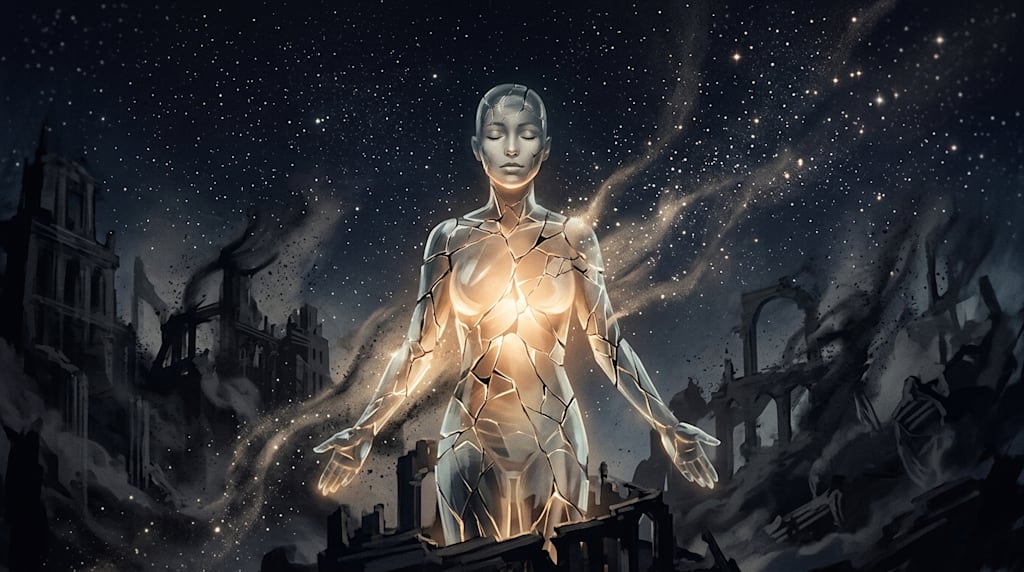
It requires you to burn things down with your own hands. It requires you to watch, helplessly, as your once-solid world crumbles like a sandcastle. It requires life to back you into a corner until you can no longer use any external crutch—career, relationships, others' opinions—to escape from yourself.
No one chooses this road willingly. But only after walking that pitch-dark night to its end do you earn the right to knock on another door.
Layer One: Surrender
At the root of most people's anxiety lies a pathological attachment to control.
You want to steer your career, stabilize your relationships, manage your health, and even calibrate exactly how you appear in others' eyes. As long as everything stays on track, you mistake that for a life of peace. The moment something derails, anxiety sprouts like weeds in a downpour.
The irony is that control and anxiety feed each other in a hidden spiral. The more you try to control, the more you need to repeatedly confirm that control, and the more anxious you become. The more anxious you become, the tighter you clench your fists, trying to force the chaos back into its cage. Many people spin in this dead loop for their entire lives. The only difference is whether the circle is large or small.
True peace begins when that loop breaks. And the break almost always comes from a total loss of control.
My friend mentioned the case of a senior executive. He had absolute faith in his mastery over life until his company restructured and his entire department was eliminated. Not only did he lose his job, but he also discovered, with horror, that his former halo had greatly depreciated in the new world. Two years of wandering followed: rejection letters flooding his inbox, savings slowly draining to zero, and himself thrashing in a quagmire of self-doubt.
In the end, he didn't fight his way back to his former class. He pivoted to a completely new field, at half the income.
But in his final interview, he said this:
"Waking up now feels different. Before, the first thought was always 'what must I get done today.' Now, I just wake up, and I get up, naturally. I know there will still be problems ahead, but I no longer feel that every problem has to be crushed by my own hand."
This is re-anchoring after loss. When you've lived through losing everything and discovered that the sky didn't fall, your grip on control starts to loosen. You are no longer so afraid, and so you no longer need to cling so desperately to anything. The relaxation that seeps through after that release is the earliest shape of peace.
But first, you have to verify one thing with your own life: those losses really can't kill you.
Layer Two: Forced Confrontation
This layer points to a different kind of inferno.
In ordinary days, we have countless ways to avoid facing ourselves. We numb ourselves with busyness, fill the void with socializing, project our attention endlessly outward. As long as that machine called "life" keeps rumbling, we never have to shut it down for an internal inspection.
But extreme hardship has a brutal violence: it can sever all your escape routes in an instant.
Unemployment takes away your eight-hour daily anchor. A breakup strips away the person with whom you shared your attention. Illness robs you of your freedom to move. When these things are peeled away layer by layer, all that remains is a naked version of you.
When you have nothing, you can only face a self that has nothing. You can no longer use achievements to prove you're fine, no longer use helping others to dodge your own issues, no longer call upon any external feedback to confirm your existence. You can only sit there, staring straight at the soul you've hidden for so long.
This process is unbearably hard. The buried things surface one by one: fear, anger, shame, resentment, unacknowledged desires, unprocessed trauma. All the things you once pushed away, suppressed, pretended didn't exist. They close in, in that deathly stillness.
My friend said many of her clients drop out at this stage. They can't bear this naked confrontation, so they flee in panic toward anything that can fill the time, even if it's poison dressed as medicine.
But those who endure will find, at some ineffable tipping point, that the encircling emotions have quietly receded. It's not that they have been resolved. It's that they have been seen. Under that long, inescapable gaze, their oppressive weight has been diluted.
In that moment, it's as if you recognize someone in the mirror.
That someone is yourself.
The new state rarely arrives in some solemn, cinematic moment. It comes on an ordinary morning, when you suddenly realize that the heavy stone pressing on your chest for so long has somehow, without your noticing, disappeared.
Layer Three: Shorting Emotion
After you've emerged from that place, you'll notice a subtle shift: your reactions have become "duller."
Things that once thrilled you now feel merely "not bad." Things that once enraged you now seem "unnecessary." Things that would have kept you up all night with anxiety now merely prompt a quiet "let it be."
Outsiders might call this numbness. But you know it's an irreversible steadiness that comes after reaching the end.
The reason is simple: someone who has stared into the abyss is rarely tripped up by a puddle. You've seen fear in its most hideous form, measured its boundaries, and experienced its destructive power. Every wave that comes afterward falls in the shadow of that ultimate storm. It can never breach the threshold you've already stretched to its limit.
In physics, there's a term: amplitude compression. You short a portion of your sensitivity in exchange for systemic stability. You won't be elated all day over a small achievement, but you also won't lose an entire night's sleep over a single failure. The ups and downs of life narrow. But that string that was perpetually taut finally relaxes.
Whether this trade is worthwhile is a matter of personal accounting.
But for those who prefer tranquility over turbulence, they trade a portion of life's intensity for predictability and steadiness in every ordinary day.
Layer Four: The Return of the Subject
One step deeper.
Before that upheaval, most people's sense of existence was externally mounted. Others' approval made you feel you were growing; others' neglect made you feel you were thinning. Without realizing it, you handed over part of your definition of "who I am."
But when that pitch-dark road reaches its end, this dependency is brutally severed. Because on that journey, external feedback has long since dropped to zero. No applause, no recognition, no one to point the way. Your only coordinate system is yourself. Your only judge is your own perception of yourself.
When this "unsupported" self-affirmation is repeated hundreds or thousands of times, it slowly internalizes into an operating system that no longer needs to reach outward. You no longer need others' eyes to weigh your worth, no longer need worldly achievements to prove you have value, no longer need to be chosen by anyone to confirm you deserve to exist.
My friend said she could tell who had reached this stage by one thing in later sessions: a shift in language structure.
They stopped saying "they think," "others believe," "I should." They started using "I think," "I decide," "I know." The subject returned to themselves, clean and bare, needing no adornment or attachment.
This is the ultimate form of peace: solidity. A structure that can stand without external support. When the storm comes, it merely sways a little. It does not fall.
Layer Five: The Sieve
The final layer concerns where the cost ultimately lands.
After you become peaceful, you'll notice that some once-warm human connections are quietly fading. Those friendships sustained by emotional resonance loosen as your amplitude drops. Those relationships that demanded your high-frequency feedback, now that you no longer provide instant emotional validation, naturally see the other person's gaze drift away.
This isn't quite loss, but it feels very much like being separated by a pane of glass.
You may go through a period of social vacuum. Conversations that feel comfortable become rarer; connections that touch the soul become harder to find. Because peace itself carries an inward gravity. It no longer hungers so much for external validation and resonance, and so it silently closes many channels that were once wide open.
The gaps left by those closed channels won't be filled immediately. You'll spend some time in that "empty" space, simply being still, doing nothing. This feeling is unfamiliar to many, even a little unsettling. But it is part of the transition. New relationships will seep in at a different density and rhythm. Just not as frequently or as loudly as before.
My friend later transitioned into training. Once, a former client came back for a chat. Near the end of the conversation, the client said something that stayed with her for a long time:
"I used to think peace was something you could pursue. Then I found out it's not. It's just a period of time when you do nothing, prove nothing, and need to solve nothing. And then you realize you seem to be able to 'stay' in yourself better than before."
Closing: Peace Is Not Bought. It Is What Remains.
Why is the cost so heavy?
Because peace is not something you buy. It is what remains.
It is like the ash left after a fire. You cannot keep the fuel in its original shape and still receive the warmth of its burning. You must let that pile of firewood called your "old self" be burned clean by the great fire of life.
The heavy price you pay is not the "money" used to purchase peace. That pile of burned wood itself is the identity, the labels, the attachments you once held so dear.
The fire dies. The smoke dissipates. On the ground remains a handful of warm, still ash. That is peace.
A person doesn't become this way for no reason. Before they truly settle, something must have come along and dismantled, one by one, the old pillars they relied upon. And then they must wait there, alone, allowing the new form to slowly take shape on its own.
And the taste of that waiting?
Perhaps long. Perhaps lonely.
The only thing you need to do is to make no deliberate effort. Especially, don't rush back to climb over those ruins that have already collapsed.
Because that final mirror you arrive at reflects the sky and the earth and all things. But it no longer reflects the person who once fretted over gains and losses.
About the Creator
Jin
Writer of reamstories
https://reamstories.com/jin
Enjoyed the story? Support the Creator.
Subscribe for free to receive all their stories in your feed. You could also become a paid subscriber, letting them know you appreciate their work.
Comments
There are no comments for this story
Be the first to respond and start the conversation.