
1,118 Men Named Kong Took a DNA Test. They Weren’t All Descendants of Confucius.
A study from Qufu shows why a shared surname can be a social contract while the Y chromosome tells a different story.
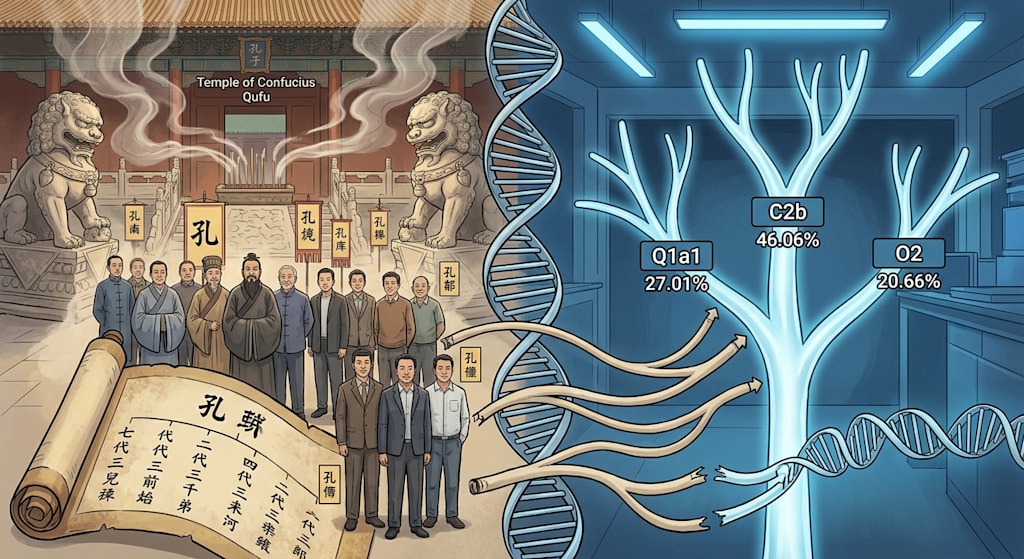
In Qufu, outside the Temple of Confucius, some people sell jianbing, some guide tourists, some have come from Quzhou to honor ancestors. Many are surnamed Kong. They can recite the generation characters. They can call themselves descendants of Confucius. Y-chromosome testing does not put them all in one paternal line.
“Five hundred years ago we were one family” is a social phrase. Useful. Not precise.
A surname is an institution. A Y chromosome is a biological marker. A surname can be changed, bestowed, assumed, taken through uxorilocal marriage, adoption, or a mother’s line. A Y chromosome travels only from father to son. The two sometimes match. They often do not.
A study looked at Y-STR loci in 1,118 Kong men from Qufu. It found at least three high-frequency haplogroups:
C2b, formerly C3, downstream marker C-MF1920: 46.06%.
Q1a1, downstream marker Q-MF30796: 27.01%.
O2, formerly O3: 20.66%.
Together: 93.73%. The rest are low-frequency types.
If one surname meant one ancestor, these men should sit in one lineage. Their common ancestor should be close to Confucius, about 2,500 years ago. The data do not show that.
C looks most like Confucius. Texts call him a descendant of the Shang kings and an aristocrat of Song. C-MF1920 is linked to the Shang royal family and the ducal clan of Song. Among Qufu Kong men, it is 46.06%. The Southern Kong lineage in Quzhou also has it as its main branch. It fits the Confucius paternal story best. It is still less than half.
Q is 27.01%. It has a single-ancestor expansion. Some researchers once considered it a possible type for Confucius. Genetic tracing puts its common ancestor at about 960 years ago, in the Song dynasty. Confucius lived about 2,500 years ago. The gap is more than 1,500 years. This Q lineage more likely entered the Kong clan through adoption, uxorilocal marriage, surname change, or an assumed surname. Some writers link it to a replacement in the Duke Yansheng line. That claim needs more evidence. It does show that a clan can include people outside one paternal line.
O is 20.66%. O2 is common among Han Chinese men. Confucius was a Shang descendant, and the Shang royal family had deep ties to the Dongyi. O is often called a typical Huaxia or Han paternal type. It sits far from Confucius’s own paternal line. It may have entered the Kong surname through a bestowed surname, attachment, surname change, or lineage confederation. Han Chinese are a multi-origin population. “Typical” means common in frequency. It does not mean pure.
One surname can hold different Y chromosomes for several reasons. Surname change. Bestowed surnames. Naming taboos. Flight from disaster. Sinicization. Uxorilocal marriage. Adoption. A mother’s surname. Assuming a powerful surname. Ming and Qing genealogy projects that joined lineages and attached families to famous ancestors. Sage descendants like the Kong, Meng, Yan, and Zeng had status and tax exemptions. That made their surname attractive to outsiders.
Genealogy and genetics record different things. Genealogy records clan law, ritual, property, and status. In clan law, an adopted son is a son. An uxorilocal husband can enter the lineage. That is how the institution works. Genetics records paternal biological transmission. It can show whether two men share a recent paternal ancestor and roughly when. It cannot name that ancestor. It cannot prove a man is Confucius.
A shared surname does not guarantee a shared paternal ancestor. Go back hundreds of thousands of years, and all men trace to Y-chromosomal Adam. “Same clan” in the surname sense usually means the last few thousand years. On that scale, one surname can cover one paternal line or several.
Among the 1,118 Qufu Kong men, C-MF1920, Q-MF30796, and O2 each form their own branch. They can worship Confucius together. They can use the same generation characters. They can all be surnamed Kong. Their Y chromosomes do not merge because of the name.
Incense burns at the Temple of Confucius. A Kong taxi driver, a Kong guide, a Kong stallholder may all share the surname. Whether they share a paternal ancestor depends on the branch on the Y chromosome, not the plaque over the gate.
About the Creator
Jin
Writer of reamstories
https://reamstories.com/jin
Enjoyed the story? Support the Creator.
Subscribe for free to receive all their stories in your feed. You could also become a paid subscriber, letting them know you appreciate their work.
Comments
There are no comments for this story
Be the first to respond and start the conversation.