
Why Turkey Is Replacing “Central Asia” With “Turkistan”
From a 1931 textbook map to today's curriculum, Ankara's changing vocabulary draws on an old national story: the idea that Turkish origins extend far beyond the borders of the modern republic.
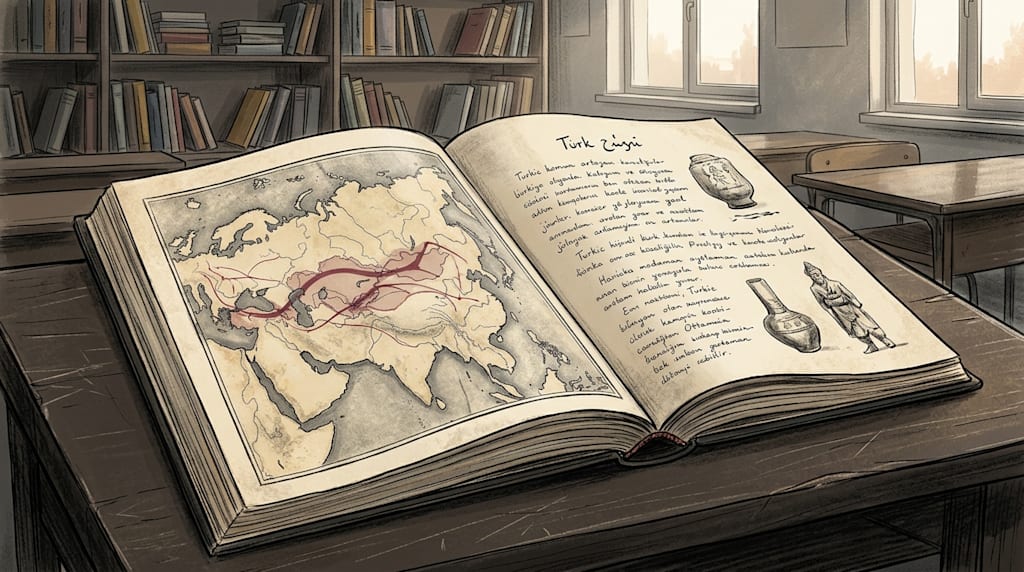
From a 1931 textbook map to today's curriculum, Ankara's changing vocabulary draws on an old national story: the idea that Turkish origins extend far beyond the borders of the modern republic.
In November 2025, Turkey's education minister announced a change that might look like a minor adjustment to a geography lesson. The government had replaced the term “Central Asia” with “Turkistan” in the national curriculum.
Yusuf Tekin explained that the change was intended to counter terminology he believed had been introduced to separate the Turkic world. He also referred to efforts to develop shared historical and educational materials among Turkic states. Anadolu Agency reported the announcement on November 18, 2025.
The announcement has a longer history behind it.
Nearly a century earlier, Turkish schoolchildren were already learning from maps that placed the ancestors of the Turks in the Asian interior, then traced their migrations towards China, India, the Middle East, Europe and North Africa. The maps appeared in the early years of the Turkish Republic, when the government was building a national identity distinct from the Ottoman imperial past.
Similar maps appeared in later textbooks. The vocabulary has changed, and the political circumstances are different, but the relationship between national origins and regional geography remains a recurring theme.
To understand the significance of Turkey's latest terminology change, it helps to begin with one of those older maps.
The map that put the Turks at the centre of ancient history
In 1931, the Turkish History Research Society published Tarih I: Tarihten Evvelki Zamanlar ve Eski Zamanlar, a history textbook covering prehistoric and ancient times.
Between pages 32 and 33 was a map titled Türklerin Anayurdu ve Göç Yolları, or “The Ancestral Homeland of the Turks and Their Migration Routes.”
Red hatching marked an expansive area of inland Asia. Red arrows extended from that region towards China, India, Western Asia, Europe and North Africa. The accompanying text connected environmental changes in Central Asia to population movements and the spread of civilization.
The map gave students a straightforward account of their ancestors' history. Their homeland was in Asia. They migrated across large distances. Their movements helped explain the rise of civilizations in other parts of the world.
Even the word anayurt reinforced the message. In Turkish, ana means mother, while yurt can mean home, homeland or the territory associated with a community. Together, the word refers to an ancestral homeland, a place understood as the starting point of a people's history.
That is a different proposition from simply identifying Central Asia on a map.
A geographical region can be studied through its peoples, languages, states and historical connections without assigning it to a single national ancestry. Calling it the ancestral homeland of the Turks gives the same space a particular relationship to modern Turkish identity.
The textbook then used migration to connect that homeland to much of the ancient world.
This was national history presented on a continental scale. Students did not encounter the origins of the Turkish nation as a story confined to the territory of the new republic. They were taught to look east, towards the Asian interior, and then follow the ancestors' routes across Eurasia.
In 1962, the story reached China
The theme survived the early republican period.
A 1962 edition of the lower-secondary History I textbook retained a chapter on “The Ancestral Homeland of the Turks and Their Migrations.” On page 18, it included this sentence:
“Our ancestors are regarded as the founders and leaders of Chinese civilization.”
The original Turkish reads:
Atalarımız, Çin medeniyetinin kurucuları ve önderleri sayılır.
The textbook described ancestors migrating into northern China, establishing settlements and becoming associated with the beginnings of Chinese civilization. Its account then followed other migration routes towards Mesopotamia, Anatolia and the Aegean.
The claim about China should be understood for what it is: a statement in a particular national history textbook, not independent evidence that Turkic peoples founded Chinese civilization.
Its significance lies in the way it organizes the past. China, Mesopotamia and the Aegean each have their own historical records, languages, political formations and archaeological traditions. The textbook places them within a wider account of Turkish ancestral migrations.
The ancestors become the connecting thread.
This gives the national narrative a much wider geographical reach. It also blurs distinctions that historians must examine separately. Evidence that a population migrated into a region does not establish that it founded that region's civilization. Linguistic connections do not automatically establish a shared national identity, and cultural contact does not demonstrate exclusive ownership of a historical legacy.
Those distinctions are especially important when a textbook presents the history of several civilizations through the achievements of one ancestral group.
The 1931 and 1962 textbooks show how this interpretation worked in practice. The first established a vast homeland and a set of migration routes. The second made the civilizational claims more explicit, linking the ancestors to the histories of regions far beyond modern Turkey.
Why a new republic needed ancient ancestors
The political setting of the 1930s helps explain the appeal of this narrative.
The Republic of Turkey was founded in 1923 following the collapse of the Ottoman Empire. Its leaders wanted to establish a modern national state with a political identity distinct from the imperial order that had preceded it.
An ancient national history offered a way to establish continuity across that rupture.
If the Turkish nation could be described as older than the Ottoman dynasty, then the fall of the empire did not have to mark the beginning of its history. The republic could present itself as the modern state of a people whose past extended thousands of years further back.
During the early 1930s, these ideas took shape in the Türk Tarih Tezi, or Turkish History Thesis. It presented the Turks as descendants of an ancient Central Asian population whose migrations contributed to civilizations across a wide region. Related arguments attempted to establish a deep connection between the Turks and Anatolia, the territory at the heart of the modern republic.
Archaeology became part of this effort. Research into ancient settlements and material remains was used in attempts to connect Anatolia's prehistoric societies with the national narrative.
Historian Çiğdem Atakuman examined this process in her 2008 paper, “Cradle or Crucible: Anatolia and Archaeology in the Early Years of the Turkish Republic (1923–1938).” Her research shows how archaeology was drawn into the construction of national origins and the effort to give the new republic a longer historical past. (Read the paper.)
The ambition was considerable. Anatolia had been home to many peoples and political formations long before the establishment of the Turkish Republic. Its history includes Hittite societies, Greek-speaking communities, the Roman and Byzantine worlds, and later Seljuk and Ottoman states.
The Turkish History Thesis attempted to bring this varied past into a national account that linked Central Asian origins to Anatolian antiquity.
That effort joined two separate questions. One concerns how the modern Turkish population and national identity developed. The other concerns the political foundations of the republic's sovereignty over its territory.
The first can be investigated through historical, linguistic, archaeological and demographic evidence. The second belongs to the history and law of modern state formation. An ancient population's presence in a region does not, by itself, establish a modern state's sovereign rights over it.
The distinction matters because the early republican narrative sought to give both the nation and its homeland an ancient pedigree.
The same map returned in 2019
A ninth-grade history textbook published in 2019 still contained a section titled “The Ancestral Homeland of the Turks.” Its subheading identified the region as Orta Asya, or Central Asia.
On page 118, another migration map marked an original homeland and areas of expansion in different shades of pink. It identified the Tian Shan, the Tarim Basin and the Gobi Desert, then traced routes away from the Asian interior.
The resemblance to the 1931 map is clear, although the textbooks belong to different educational and political contexts. Their terminology, explanations and treatment of ancient history should not be assumed to be identical.
What persists is the basic geographical sequence. Central Asia provides the point of origin. Migration connects it to other parts of Eurasia. Anatolia becomes the homeland of the modern republic, whose national history is placed within a much older story.
Research published by Hande Gür and Gül Çalışkan in Nations and Nationalism in 2025 examines how geography textbooks in 1930s Turkey helped establish national identity and define the imagined boundaries of the new state. Their analysis documents the role of school geography in linking the republic to a chosen account of the nation's past. (Read the study.)
The 2019 map does not prove that every element of the early Turkish History Thesis remains official policy. It does show that the language of an ancestral homeland and outward migration continues to appear in Turkish history education.
A national narrative can survive even when some of its original claims change. The central story remains available for later generations to reinterpret.
From “Central Asia” to “Turkistan”
This is the history behind the 2025 curriculum announcement.
“Central Asia” is a geographical term commonly used for the inland region of Eurasia. Its precise boundaries vary according to the discipline and context, but the term does not inherently identify the region with a single nation or linguistic group.
“Turkistan” has a different history. It has been used for parts of Central Asia associated with Turkic-speaking populations, although its geographical scope has varied across periods and sources. The related term “East Turkistan” is also used by some Uyghur groups to refer to Xinjiang in northwestern China.
The names overlap in some contexts, but they do not have identical histories or political implications.
When Education Minister Yusuf Tekin announced the curricular change, he described “Central Asia” as terminology that had been used to separate the Turkic world. He linked the revised vocabulary to efforts to strengthen the teaching of common Turkic history and the development of shared educational materials. The ministry's announcement provides the government's own explanation.
That statement makes the change more than a dispute about which geographical term is preferable. The government has explicitly connected the name to a desired understanding of historical and cultural belonging.
The limits of the evidence still matter. Replacing “Central Asia” with “Turkistan” does not establish that the Turkish government has formally claimed Xinjiang, Qinghai or Gansu as Turkish territory. Such a claim would require direct documentary evidence, including the relevant maps, curriculum passages or official statements.
The defensible conclusion is narrower: Turkey is promoting a geographical vocabulary that emphasizes the relationship between the republic and the wider Turkic world.
That shift fits a longer national project in which the country's history is presented through connections reaching far beyond its present borders.
What the history can prove, and what it cannot
The Turkic peoples have genuine historical connections across Eurasia. Turkic languages form a recognized language family, and the movement of Turkic-speaking populations contributed to the formation of states and societies across a large region.
Those connections do not make all Turkic-speaking peoples a single nation that has remained unchanged for thousands of years.
The historical Göktürk polities, Uyghur states, Seljuk realms and Ottoman Empire arose in different settings. Their political identities, social structures and relationships with neighbouring populations changed over time. Modern Turkish national identity developed through its own history, including the transformation of Ottoman society and the establishment of the republic.
Recognizing those differences does not require denying shared ancestry or cultural relationships. It requires distinguishing evidence of historical connection from claims about political identity.
The same rule applies to geography.
A migration route can help explain how people, languages and cultural practices spread across regions. It cannot serve as proof that every civilization along that route was founded by the same people. Nor does an ancient name automatically determine the borders or ownership of a modern state.
The 1931 textbook map placed the ancestors of the Turks at the centre of a vast geographical story. The 1962 textbook extended that story to Chinese civilization. A map in the 2019 curriculum preserved the ancestral homeland framework. In 2025, the Turkish government attached fresh political meaning to the name used for the wider region.
These episodes belong to different periods, but they share a concern with the relationship between national identity and historical geography.
For the early republic, the Asian homeland offered a past older than the Ottoman Empire. The link to Anatolia helped connect that ancient story to the territory of the new state. Today's curriculum places greater emphasis on a shared Turkic space beyond Turkey's borders.
Neither project can be understood simply by reading the names on a map. The accompanying explanations, the historical evidence and the political intentions behind the terminology all matter.
A map can show where a government wants students to look for their origins. It cannot settle what happened in every place it marks, or establish a modern state's rights over the territories crossed by its arrows.
That is why the history of these textbooks matters. It shows how a national origin story can persist for nearly a century, while the vocabulary surrounding it changes with the country's political priorities.
In Turkey's latest curriculum debate, the old question of ancestral origins has acquired a new geographical name. The underlying argument about where the Turkish nation belongs remains on the page.
About the Creator
Jin
Writer of reamstories
https://reamstories.com/jin
Enjoyed the story? Support the Creator.
Subscribe for free to receive all their stories in your feed. You could also become a paid subscriber, letting them know you appreciate their work.
Comments
There are no comments for this story
Be the first to respond and start the conversation.