
Why Ancient Soldiers Demanded Pay They Might Never Live to Spend
A mutiny over rotten food nearly ended the Tang dynasty. The real reason armies collapse without pay is darker than hunger.
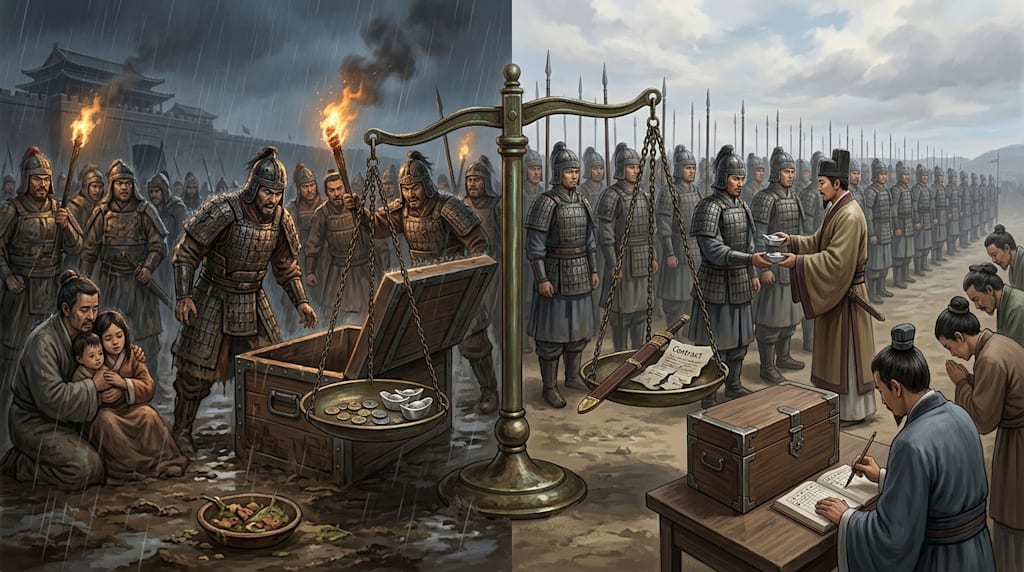
1. Cold rain in Chang'an
In 783 AD, five thousand Jingyuan soldiers passed through Chang'an. They were heading to Xiangcheng to put down a rebellion. They marched through cold rain and brought their families. They expected the court to reward them. At the very least, they expected a decent meal.
The mayor of Jingzhao, Wang Hong, gave them coarse, rotten food.
The soldiers turned on the city.
They shouted that they were about to die fighting and could not even eat their fill. Why should they stake their lives against bare blades? The Qionglin and Daying treasuries were full of gold and silk. Better to take it themselves.
So the army that was supposed to suppress a rebellion stormed Chang'an. Emperor Dezong fled. The Jingyuan jiedushi, Yao Lingyan, could not control his men. They dragged him along as their leader. He was killed in the chaos.
A mutiny over rotten food nearly ended the Tang dynasty.
2. Military pay was more than a wage
Ancient soldiers were not office workers. Military pay was not just compensation for time.
In troubled times, soldiering was a high-risk investment. A soldier staked his life. He had accounts to settle:
If I die, who supports my parents?
If I am crippled, who cares for my wife and children?
If I survive, can I get land, money, a way out?
If I earn merit, will it be stolen?
If I am wounded, will I be discarded?
The court might ignore these accounts. The soldier would not.
Military pay, rewards, pensions, and resettlement formed a risk contract. The regime said: Fight for me, and I will care for what happens after you. The soldier said: Then I will go.
When the contract breaks, the soldier recalculates. If I die, the court ignores my family. If I live, the court does not pay. If I am wounded, the court does not pension me. Why fight for you?
I can rob for myself.
So military pay is political before it is economic. It tells the soldier that his life has a price. His death has a price. His loyalty has a price.
The price need not make him rich. It must be stable, visible, and credible.
A soldier can accept death. He cannot accept dying for nothing.
3. Profit from one opening
The Guanzi describes “profit from one opening.” The state must control the channels of profit. If people want to get rich, they must use state-approved channels.
Military pay was the army’s version of that principle.
If soldiers can only get rich by charging, earning merit, and receiving rewards, courage has a premium. The man who takes an enemy head, climbs the wall first, or breaks the formation gets money and promotion. That is why men fight desperately.
If soldiers can loot freely, the logic flips.
Looting civilians is safer than charging.
Burning and killing is easier than standing in formation.
What you seize is yours. Why risk your life for military merit?
Once soldiers loot for themselves, the commander loses the power of reward and punishment. They no longer eat the court’s rice. They eat what they seize. Why obey you? If you cannot pay, your words mean nothing. Today you lead them to loot. Tomorrow someone else offers more. They cut you down and follow him.
That is how warlords are born.
Military pay monopolizes the returns from violence. It aims the army’s greed at the enemy, not the people. It locks the soldier’s dream of wealth into the merit roll, not the civilians’ coffers.
The one who pays has the right to command.
The one who controls reward and punishment deserves to be commander.
4. The three outcomes of arrears
When the court owes pay, the soldier does not see fiscal difficulty. He sees an employer breaking the contract.
After the breach, he usually has three choices.
First, flee.
In 1126, Zhong Shizhong led troops against the Jin. The Divine Arm Bow repelled the enemy. The archers should have been rewarded. The supply office had only a few thousand silver bowls. The clerk said there were not enough. The reward was canceled. The soldiers were resentful and dispersed. Zhong Shizhong later died in battle.
The soldiers were not naturally disloyal. The court told them their merit was worthless. Why stake their lives?
Second, loot.
The Jingyuan Mutiny is the clearest example. The soldiers were supposed to go to Xiangcheng and die. Cold rain, families in tow, no reward, rotten food. All four together told them: You will die. Your families will not survive either. You cannot even eat.
Death was certain anyway. Better to seize the Qionglin and Daying treasuries.
The emperor fled. Chang'an fell into chaos. Emperor Dezong nearly lost everything.
Third, rebel.
Yunzhou garrison soldiers mutinied over withheld pay. They killed the defense commissioner Duan Wenchu and made Li Keyong their leader.
Deng Jingshan, jiedushi of Hedong, was killed by his subordinates in 762 for harsh and inquisitive rule.
Lifei Yuanli, jiedushi of Anxi, was killed by his men for withholding pay and beating soldiers at will.
During the Ningyuan Mutiny of 1628, soldiers on the Liaodong front had been owed four months of pay. Thirteen battalions responded. They tied up and beat the governor, Bi Zisu. Bi later killed himself.
In the Qing dynasty, the Xiang Army’s Gelaohui stirred up pay riots. In 1869, pay for Liu Songshan’s and Gao Liansheng’s troops had not arrived. Gelaohui members used the opportunity to mutiny. Gao Liansheng was killed. After the Taiping Rebellion was crushed, the Xiang Army was owed five million taels. It could not pay severance. The Gelaohui rioted over pay. The Qing court was forced to provide grain and money and pay part of what was owed. Many Xiang Army soldiers who did not get paid joined the Gelaohui after discharge and became an anti-Qing local force.
In the Eastern Han, the Liangzhou rebellion began when Huangzhong Yicong Hu cavalry were sent to suppress a rebellion. Their pay and treatment were not settled. They killed the Protector of the Qiang and rebelled. A pile of later troubles followed. It became a prelude to Dong Zhuo’s rise.
These are not isolated cases. They are the same chain:
Arrears → mutiny → killing officers → pushing up a new leader → warlordization → collapse of dynasty finances.
Normal pay does not make it into the history books. Arrears do. That is why soldiers demanding pay appear so often in history. They were not greedy. Arrears broke dynasties.
5. Why not let soldiers loot themselves?
Some people argue that if you cannot pay soldiers, you should let them loot. War is looting anyway. Whoever seizes it keeps it.
That idea is dangerous.
First, allowing looting means allowing the army to go into business. The army no longer eats the court’s rice. It eats what it seizes. That is how warlordization begins. Today they loot the enemy. Tomorrow they loot the people. The day after, they loot you.
Second, only by strictly forbidding looting can you achieve “profit from one opening.” If soldiers want to get rich, they can only do so by charging, earning merit, and receiving reward money. The brave get rewarded. The cowardly get punished. If they can loot freely, who will risk death in battle? Looting civilians is much safer than fighting for your life.
Third, extraction is a professional and delicate task. Administrators know how to distinguish the rich from the poor, requisition grain reasonably, and overfish sustainably. They can preserve the base. Soldiers only know how to burn and kill. They burn most and seize little. Efficiency is extremely low, and they lose the people’s hearts. The poor have no oil to squeeze, and you lose your source of soldiers. The rich, once desperate, move their assets. You are left with nothing.
Fourth, looting most easily causes internal conflict. If the spoils are divided unevenly, your own men start fighting. What unity is left?
So the armies that won in history all did this:
Grain collection was handed to professional administrators. They had guns behind them, but they did not run wild.
Soldiers were strictly forbidden to loot. The people could at least be stable slaves rather than people who could not even keep their lives.
Military funds were collected and given to the commander. Only then did he have the confidence to reward merit and punish failure.
What about armies that indulged looting?
Apart from low looting efficiency, internal brawls, no one willing to charge, and refusal to obey orders, how could they possibly win?
6. Can military pay guarantee that a soldier lives to spend it?
No.
But it can guarantee that the army survives as an organization.
The individual soldier may die the next day. He may never get to spend the money. But military pay is for the living to see. It is also for his family to see. It is for his comrades to see. Ancient armies had pay chests, grain offices, remittances home, postwar settlements, and silver merit medals. What soldiers demanded was often an account, not necessarily cash in hand. But when a debt is owed too long, it becomes waste paper. When there is too much waste paper, soldiers can only loot.
Military pay is not carried on the soldier’s back every day. It is a credit system.
If credit lives, the army lives.
If credit collapses, the army rebels.
So military pay cannot guarantee that a soldier lives to spend it, but it can guarantee that the army still behaves like an army.
7. Two hell jokes
A soldier in the Huanxiangtuan, the “Returning Home Corps,” discovered that while he was following outside landlords in a three-all campaign (kill all, burn all, loot all), his own parents and sisters had been three-alled as well.
A Japanese militarist soldier, while supporting the comfort women policy and thanking the emperor, went to a comfort station and ran into his own biological sister. He drew his pistol and shot himself.
The force that defeated these two armies raised the banner “Liberate China.” When it entered villages, it did not take a single needle or thread.
The question is: If you can make an army not touch a single hair of the people, what else you can make it do is something I do not dare imagine.
Restraint of violence is the strongest proof of control.
No pay means no combat effectiveness. If you do not pay, soldiers will rob for themselves. But to truly feed an army, you must send professional administrators to collect grain and raise funds. They do not need to be saints, or the troops really will starve. But the army itself must be restrained.
Not touching a single hair is organizational capacity. It is not a moral fairy tale.
Only if you can keep the army from looting are you worthy to let it die.
8. The dynasty’s underwear
Back to the original question: Why did ancient soldiers always demand military pay? Could it guarantee that they lived to spend it?
It could not guarantee the individual.
But military pay could guarantee that the army survived as an organization.
An army that does not need pay either starves or becomes bandits. It has never won.
An army that cannot stably get money and control violence has never won.
Military pay buys discipline, command, loyalty, and the valve of “profit from one opening.”
It concentrates violence on the enemy, returns profit to the regime, and locks the soldier’s dream of wealth into the merit roll.
So, you make men sell their lives and you dare not pay them? How many lives do you have to play with?
The Jingyuan Mutiny already answered:
If you do not pay, soldiers will not die for you, but they will loot for you.
After they loot your treasury, they will cut off your head.
Military pay cannot buy an individual’s life, but it buys the organization’s life.
And if a dynasty cannot even buy the organization’s life, then it is not far from being cut down by its own knife.
About the Creator
Jin
Writer of reamstories
https://reamstories.com/jin
Enjoyed the story? Support the Creator.
Subscribe for free to receive all their stories in your feed. You could also become a paid subscriber, letting them know you appreciate their work.
Comments
There are no comments for this story
Be the first to respond and start the conversation.