
When the Universe Learned to Speak Mathematics
Isaac Newton, the Principia, and the moment gravity, motion, and the heavens became one system of law

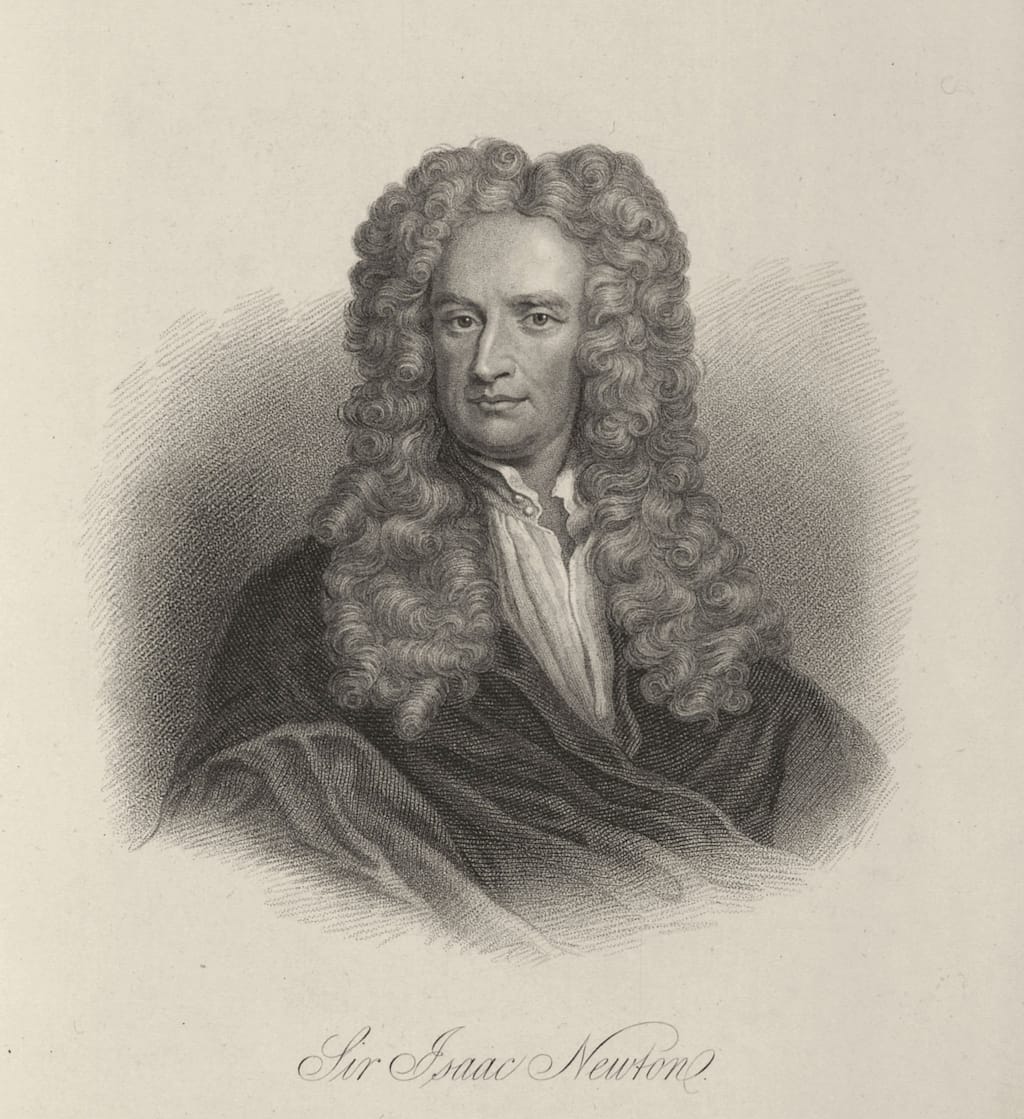
On July 5, 1687, a transformation in human understanding emerged through the publication of Philosophiæ Naturalis Principia Mathematica, known widely as the Principia. The author, Isaac Newton, presented a framework that described motion, force, and gravity through a unified mathematical structure. This work reshaped scientific thought by showing that the same principles governing objects on Earth extend throughout the cosmos, guiding planets, moons, and stars in predictable paths.
Newton originated in 1643 in Woolsthorpe, a rural settlement in Lincolnshire, England, at Woolsthorpe Manor. His early environment reflected modest rural life. His father had passed before his arrival, and his mother later remarried, leaving him under the care of his grandmother. The household belonged to the rural landholding class, giving Newton access to stability and basic resources along with opportunities for education. His early circumstances reflect simple beginnings rather than aristocratic privilege.
During childhood, Newton displayed strong curiosity and a deep inclination toward observation and problem solving. Early schooling exposed him to classical languages and mathematical thinking. Teachers observed his capacity for independent reasoning, a trait that shaped his later scientific achievements. His path toward advanced learning led him to Trinity College, Cambridge in 1661, where he entered an academic environment grounded in traditional philosophy alongside emerging scientific ideas.
At Cambridge, Newton encountered the intellectual transition taking place across Europe. Older Aristotelian views remained present in instruction, while newer mathematical approaches from thinkers such as Galileo and Descartes gained influence among students and scholars. Newton engaged deeply with these emerging ideas, spending extensive time in private study. His intellectual habits centered on solitary reflection, calculation, and experimentation.
A significant turning point arrived during the mid 1660s when a widespread plague caused the closure of Cambridge. Newton returned to Woolsthorpe and entered a period of intense intellectual productivity. During this time, he developed foundational concepts of calculus, explored the nature of light through prism experiments, and examined the forces governing motion. His investigations into gravity began during this period, guided by careful reasoning about everyday observations such as falling objects and lunar motion.
One widely known story describes an apple falling from a tree, inspiring contemplation about gravitational force extending beyond Earth. While simplified in popular retellings, this image reflects Newton’s broader inquiry into whether the same force influencing terrestrial objects also shapes celestial motion. His reasoning led toward the concept of a universal force acting across all distances, influencing both ground level events and astronomical systems.
Financial circumstances during Newton’s early academic life reflected scholarly dependence rather than inherited wealth. Scholarships and institutional support enabled his continued study at Cambridge. His later career introduced greater stability through academic appointment and public service. His role as Lucasian Professor of Mathematics at Cambridge provided recognition within scholarly circles, while later service at the Royal Mint contributed to long term financial security and administrative influence.
The path toward the Principia gained momentum through interaction with astronomer Edmond Halley during the 1680s. Halley engaged Newton on the mathematical description of planetary motion, particularly concerning orbital shapes produced under inverse square gravitational behavior. Newton responded with a complete mathematical solution describing elliptical orbits. This exchange revealed the depth of Newton’s existing theoretical work and encouraged formal publication.
Halley provided support that enabled the organization and publication of Newton’s findings. The resulting work, the Principia, presented a structured explanation of physical law across three volumes. The first volume established the laws of motion, describing relationships among force, mass, and acceleration along with principles governing inertia. The second volume addressed motion through mediums such as air and water, examining resistance and fluid behavior. The third volume applied these principles to celestial mechanics, explaining planetary and lunar motion through gravitational attraction.
Within this framework, Newton introduced a universal principle of gravitation describing attraction between all masses. This principle explained planetary orbits as the result of continuous gravitational interaction between celestial bodies and the sun. The same principle accounted for terrestrial phenomena such as falling objects and tidal behavior. The mathematical structure provided predictive power, allowing calculation of motion across a wide range of physical systems.
Newton’s approach combined mathematical precision with empirical observation. He relied on geometry and early calculus to describe continuous change. His work synthesized earlier contributions from scientists such as Galileo, who studied acceleration and falling bodies, and Kepler, who derived empirical laws of planetary motion. Newton’s contribution unified these insights into a single explanatory system governed by mathematical consistency.
The intellectual environment of the seventeenth century played a key role in shaping Newton’s thinking. Scientific inquiry during this period emphasized the search for natural laws expressed through mathematical relationships. Newton extended this approach by proposing that physical reality follows consistent rules across all scales. His work demonstrated that mathematical descriptions could explain both everyday physical events and large scale celestial motion with equal accuracy.
The publication of the Principia introduced a new scientific paradigm. Motion became understood through quantifiable relationships between force and acceleration. Space and time provided a structured framework within which physical events unfold. The universe appeared as a coherent system governed by universal principles rather than separate domains for Earth and sky.
Newton’s intellectual capabilities included strong abstraction, sustained focus, and precise mathematical reasoning. His work habits involved extended periods of concentrated study, during which he explored complex problems through incremental reasoning. He expressed a belief that natural phenomena follow orderly mathematical structures accessible through careful analysis.
His contributions extended beyond mechanics. Investigations into optics revealed that white light contains a spectrum of colors, demonstrated through prism experiments. These findings contributed to the broader understanding of light behavior and color perception. His scientific interests encompassed both theoretical frameworks and experimental validation.
The influence of the Principia extended across centuries. Engineers applied Newtonian mechanics to design structures, machines, and transportation systems. Astronomers used gravitational theory to predict planetary positions and explore celestial mechanics. Physics education incorporated Newton’s laws as foundational principles for understanding motion and force.
Later developments in physics expanded scientific understanding beyond Newtonian mechanics, especially in contexts involving extremely high speeds and microscopic scales. Even with these advances, Newton’s framework continues to describe everyday physical phenomena with high accuracy and remains central to classical mechanics.
Newton’s life reflects a progression from rural beginnings in Woolsthorpe to profound influence on global scientific thought. His intellectual journey demonstrates how sustained reasoning, mathematical innovation, and careful observation can produce frameworks that reshape understanding of nature. The Principia stands as a landmark achievement that established a coherent description of physical law across the universe.
The legacy of Newton continues through the enduring relevance of his ideas. Motion, force, and gravity remain foundational concepts in science and engineering education. His work established a vision of the universe governed by consistent mathematical principles, offering a structured way to interpret natural phenomena across time and space.
About the Creator
Tim Carmichael
Let your becoming be louder than your fear, and your smallest steps become the road you once thought impossible to walk. An Appalachian poet and cookbook author my book Beautiful and Brutal Things is on Amazon, Link 👇
Enjoyed the story? Support the Creator.
Subscribe for free to receive all their stories in your feed. You could also become a paid subscriber, letting them know you appreciate their work.
Comments
There are no comments for this story
Be the first to respond and start the conversation.