
When the Banana Peel Was No Joke
Monday Madness Edition

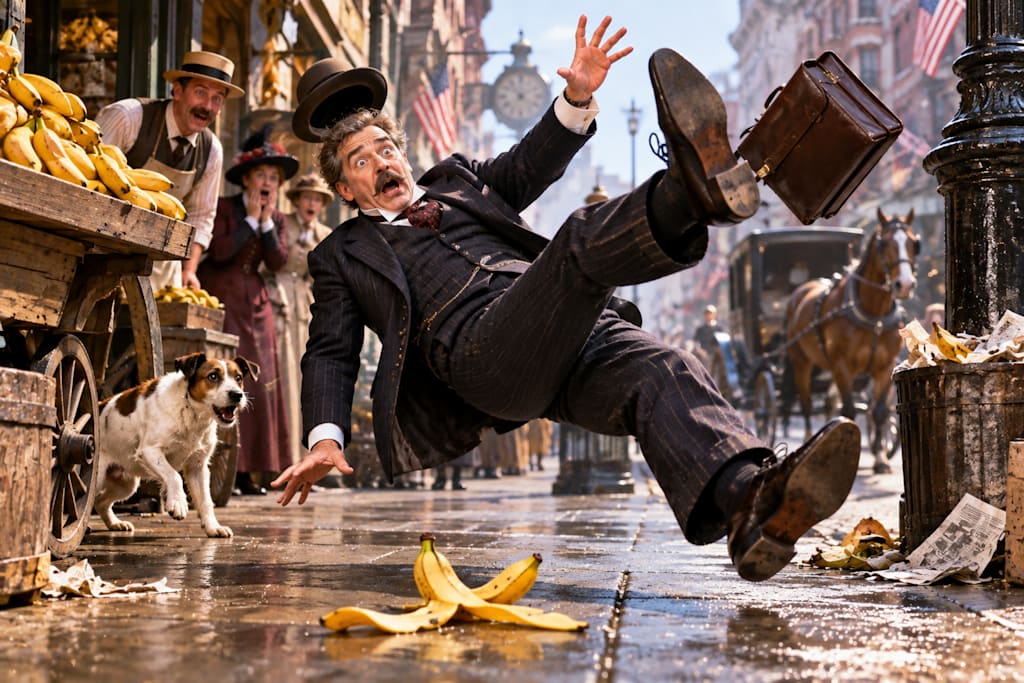
It is one of the oldest jokes in comedy...
A man walks confidently down a sidewalk. Perhaps he is wealthy. Perhaps pompous. Maybe he is carrying an important briefcase and has somewhere terribly important to be. Then the audience sees it: a banana peel. He doesn’t. One foot comes down, his legs shoot forward, and his dignity remains suspended in the air approximately half a second longer than the rest of him. And down he goes.
For generations, the banana peel has been such an obvious symbol of impending disaster that the joke barely requires explanation. Cartoons used it. Silent comedians used it. Vaudeville performers used it. Children who had never actually seen anyone slip on a banana peel still understood precisely what was supposed to happen. It seems like an absurd comedy invention. It wasn’t!
More than a century ago, discarded banana peels were considered a genuine nuisance on American streets, occasionally causing serious injuries, inspiring municipal regulations, and even finding their way into courtrooms.
There was no single "Great American Banana Panic of 1904," despite the wonderfully dramatic name sometimes attached to the story online. America’s banana problem developed gradually during the late nineteenth and early twentieth centuries. Once again, the real story is better.
Bananas had been known in the United States long before the 1900s, but improvements in shipping and an expanding international fruit trade transformed them from an exotic curiosity into an increasingly affordable food.
They were almost perfectly designed for city life. A banana required no cooking, no utensils, no plate. It came wrapped in its own biodegradable packaging. A customer could buy one from a street vendor, peel it while walking, eat it in a few minutes, and continue on his way. There was only one problem: the biodegradable packaging was now in his hand.
Today, most of us would look for a trash can. Plenty of nineteenth-century Americans apparently looked at the sidewalk and thought: close enough.
American cities were already struggling with enormous sanitation problems. Streets accumulated horse manure, household garbage, food waste, ashes, and other refuse. Modern municipal garbage collection was still developing, and littering was commonplace. Into this magnificent urban soup came the banana peel.
Fresh banana skins aren’t necessarily the instant friction-destroying devices portrayed in cartoons. But discarded peels deteriorate. They become dark, flattened, and slippery... particularly after being crushed and walked over. Suddenly a cheap, popular street food had produced a surprisingly effective pedestrian hazard.
Newspapers began warning readers about discarded fruit skins. Municipal authorities treated them as litter. Ordinances prohibited throwing banana and other fruit peels onto sidewalks and public places.
And even Theodore Roosevelt became associated with the battle. During his time as president of New York City’s Board of Police Commissioners in the 1890s, Roosevelt reportedly complained about the danger of banana skins discarded on sidewalks, which could cause pedestrians to fall violently onto the pavement.
Before the Rough Riders, the presidency, and the Panama Canal, Theodore Roosevelt had encountered another threat to civilization: bananas. The concern wasn’t entirely humorous. People really were injured. A fall onto a hard sidewalk could break bones or cause head injuries. Around railway stations and streetcar platforms, slipping at the wrong moment could become considerably more dangerous.
And that brings us to perhaps the greatest proof that the banana peel menace had become serious. Lawyers got involved.
In 1901, the Massachusetts Supreme Judicial Court considered Goddard v. Boston & Maine Railroad. A woman had slipped on a banana peel at a railroad station and sued the company. The problem was proving negligence.
The mere existence of a banana peel did not establish that railroad employees had done something wrong. Another passenger might have dropped it seconds before the accident. Employees could hardly be expected to discover every piece of litter instantaneously. The court therefore concluded that the evidence wasn’t sufficient to hold the railroad responsible. Reasonable enough.
But ten years later, another Massachusetts banana peel arrived in court. And this banana peel had a history. In Anjou v. Boston Elevated Railway Company, Helen Anjou slipped on a banana peel while walking through a railway station. Witnesses described the offending peel in remarkable detail: it was dry, flattened, gritty, and black. Those details mattered enormously...
Unlike the mysterious peel in Goddard, this one looked as though it had been lying on the platform for a long time and had been stepped on repeatedly. That meant employees might reasonably have had enough time to discover and remove it. The court allowed the case to proceed on that basis.
Think about this for a moment. The physical condition of a banana peel had become evidence before the highest court in Massachusetts. Attorneys were essentially asking: How old is this banana peel? How dirty is it? How many people have stepped on it? And most importantly: Should somebody have noticed the damned thing?
The principle behind the absurdity remains important today. Property owners generally cannot be expected to eliminate a hazard the instant it appears. But if a dangerous condition exists long enough that they reasonably should have discovered it, their failure to act can matter when determining negligence. Law students still encounter cases like these when learning about notice and premises liability. Somewhere in the foundations of American tort law sits a very old, very dirty banana peel.
Meanwhile, another group of Americans had discovered a different use for the same hazard: comedians. Banana-peel humor was appearing around the turn of the twentieth century. In a 1903 recording, entertainer Cal Stewart’s popular fictional character Uncle Josh encounters banana-peel slapstick during a visit to a department store. The joke worked because audiences already understood the premise.
That is the crucial detail. The banana peel wasn’t initially funny because it was ridiculous. It was funny because it was familiar. Comedy has always fed on everyday aggravations. The audience saw the peel before the victim did. They knew what was coming. The anticipation became part of the joke.
Then motion pictures arrived. For silent filmmakers, the banana peel was nearly perfect. It required no dialogue, no title card, no explanation. Show the peel. Show the pedestrian. Cut back to the peel. Everybody in the theater understands the next ten seconds.
Eventually, the gag became so familiar that comedians could joke about the cliché itself. Audiences didn’t merely recognize banana peels as slippery objects. They recognized them as comedy props. Cartoons inherited the tradition. Generations passed.
American streets became cleaner. Municipal garbage collection improved dramatically. Public sanitation became more sophisticated. Littering became less socially acceptable, and tossing your lunch onto the sidewalk stopped being considered an ordinary way to dispose of it. The banana peel gradually lost its position as a serious feature of urban life. But its fictional career was just beginning.
Animated characters slipped on them. Clowns slipped on them. Movie characters slipped on them. Video-game characters eventually weaponized them. The real-world nuisance had become immortal.
And strangely enough, modern science suggests the old reputation wasn’t entirely undeserved. Researchers studying banana-skin friction have demonstrated that the inside surface can produce extremely low friction under pressure, partly because tiny structures in the peel release a lubricating gel when crushed. In other words, after more than a century of jokes, lawsuits, and cartoons, science finally arrived with sophisticated equipment to announce: Yes. Banana peels actually can be slippery.
Which somehow feels like the perfect conclusion to the entire affair. The banana peel’s journey through American culture is easy to dismiss because we encounter it backward. We first learn the joke. Then, if we’re lucky, we discover the history.
But people living in American cities around the turn of the twentieth century experienced it in the opposite order. First came the bananas. Then came the garbage. Then came the falls. Then came the complaints. Then the ordinances. Then the lawsuits. And finally somebody looked at this irritating little piece of urban life and realized something important: it was funny.
Today, nobody sees a banana peel in a cartoon and thinks about municipal sanitation reform, Theodore Roosevelt’s New York, railway-station negligence cases, or filthy turn-of-the-century sidewalks. We simply wait for someone to step on it.
America eventually cleaned up its streets. The dangerous fruit skins became increasingly uncommon. The public-health problem faded. But by then, it was already too late. America had removed the banana peel from the sidewalk. Comedy had already picked it up!
About the Creator
The Iron Lighthouse
Where folklore meets freeway. A guide to the strange heart of the American backroads...
Enjoyed the story? Support the Creator.
Subscribe for free to receive all their stories in your feed.
Comments
There are no comments for this story
Be the first to respond and start the conversation.