
When Science Became a Problem: The Swedish Dentist Who Paid a Heavy Price for Questioning Refugee Ages
In 2017, Swedish dental hygienist Bernt Herlitz noticed something that did not fit the official records. Many young refugees registered as unaccompanied minors appeared, according to his dental examinations, to be fully grown adults. When he raised the issue with the authorities, the consequences were devastating.
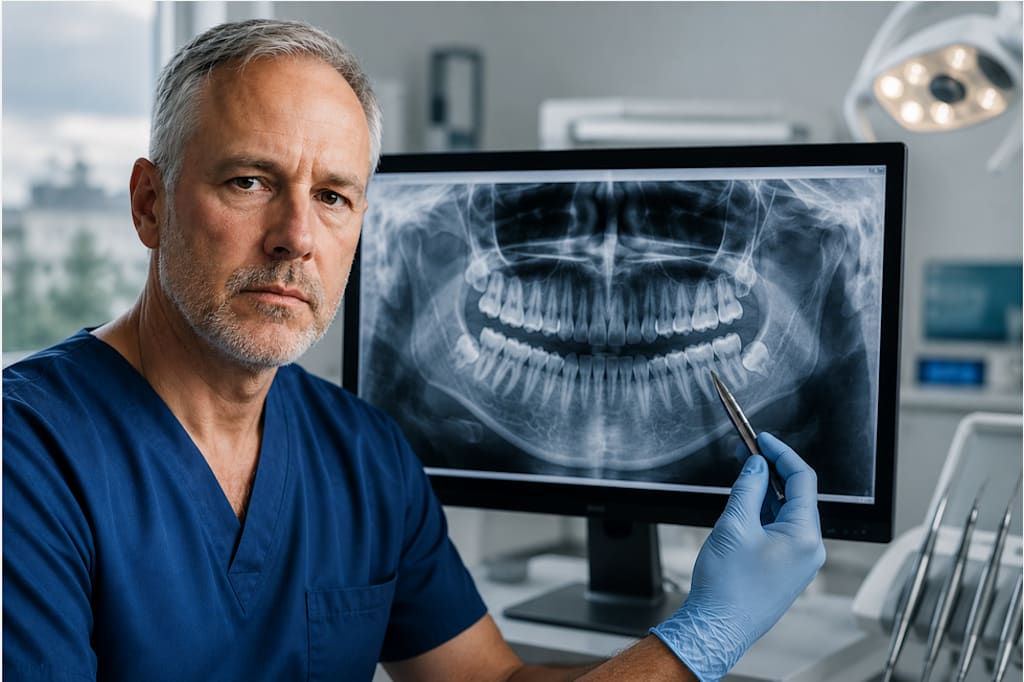
In 2017, Bernt Herlitz was working as a dental hygienist on the Swedish island of Gotland. His job was relatively straightforward: as part of the public healthcare system, he provided preventive dental care to young refugees arriving in Sweden without identification documents.
During routine examinations, however, Herlitz began noticing something that made him question the ages recorded in their official paperwork.
A surprisingly large number of patients who were officially registered as children appeared to have fully developed third molars — the teeth commonly known as wisdom teeth.
According to Herlitz, the finding was so frequent that he believed the authorities needed to take a closer look at the ages being reported by some of the asylum seekers.
When a dental examination contradicts an official document
Determining someone's exact age from dental development is not as simple as checking a birth certificate. Wisdom teeth, for example, do not erupt at exactly the same age in every person, and dental examinations cannot provide an infallible birth date.
Nevertheless, Herlitz believed the pattern he was seeing deserved investigation.
He reported his concerns to the Swedish Migration Agency. Rather than becoming the beginning of a broader investigation, however, the case soon turned against him.
Herlitz was dismissed from his position. His employers argued that he had violated medical confidentiality and improperly handled sensitive personal information.
What followed was a legal battle that attracted considerable attention in Sweden.
The dispute ultimately had devastating financial consequences for Herlitz. He was ordered to pay legal costs reportedly amounting to more than 445,000 Swedish kronor — a sum that placed enormous pressure on his family.
For an ordinary healthcare professional, the financial burden was potentially ruinous.
A career destroyed
The case became much bigger than one man's disagreement with his employer.
The question at its centre was uncomfortable: What should happen when a healthcare professional believes that what he sees in his patients does not match what the official documents say?
Herlitz maintained that he had simply reported what he had observed during his professional work.
Critics, however, questioned whether dental examinations could reliably establish the age of asylum seekers and warned against treating such methods as definitive proof.
The controversy also touched on a much wider political debate in Sweden concerning unaccompanied minors, age assessments and the difficulties authorities faced when asylum seekers arrived without reliable identity documents.
For Herlitz, the consequences were personal.
He found himself unable to continue his professional career in the same way, while the legal costs placed his family under enormous financial strain.
Eventually, ordinary members of the public came to his aid. A fundraising campaign circulated through social media and helped prevent the financial disaster from becoming even worse.
But money could not simply restore a career.
The controversy that refused to disappear
The most remarkable part of the story came later.
The question of how to establish the age of asylum seekers did not disappear. Swedish authorities continued to struggle with cases in which applicants claimed to be minors but had no documents capable of proving their age.
Dental examinations and X-rays became part of the wider discussion surrounding age assessments.
Over time, Swedish forensic authorities introduced medical methods for assessing whether an individual was likely to be above or below the age threshold relevant to the asylum system.
The science itself remained controversial. Experts repeatedly stressed that biological development varies from person to person and that no single examination can provide an exact date of birth.
Yet the methods that had once been heavily criticized became part of the official toolbox used when authorities had to assess the claimed ages of undocumented migrants.
And that is what makes the Herlitz case so fascinating.
When politics meets science
The story is not as simple as saying that one man was right and everyone else was wrong.
Age assessment is genuinely complicated. Teeth do not carry a person's date of birth, and even sophisticated medical examinations have margins of uncertainty.
But Herlitz's case raises another important question.
What happens when an employee notices something that does not fit the official narrative?
Should the observation be investigated, even if it is politically uncomfortable?
Or can the person who raises the question become the problem instead?
For Bernt Herlitz, the price of asking that question was extraordinarily high.
His story became a symbol for those who believed that political considerations had been allowed to overshadow scientific observation. Others saw the case as an example of why medical evidence must be handled carefully and why uncertainty should never be presented as absolute proof.
Either way, the controversy surrounding him did not disappear.
It became part of Sweden's much larger debate over migration, identity, age assessments and the difficult boundary between professional responsibility and political sensitivity.
And perhaps that is the real lesson of the Herlitz affair:
Science does not become less complicated simply because politics would prefer a simpler answer.
About the Creator
Enjoyed the story? Support the Creator.
Subscribe for free to receive all their stories in your feed.
Comments
There are no comments for this story
Be the first to respond and start the conversation.