
When Breakfast Came with a Toy...
(That Probably Wouldn't Pass Safety Tests Today)

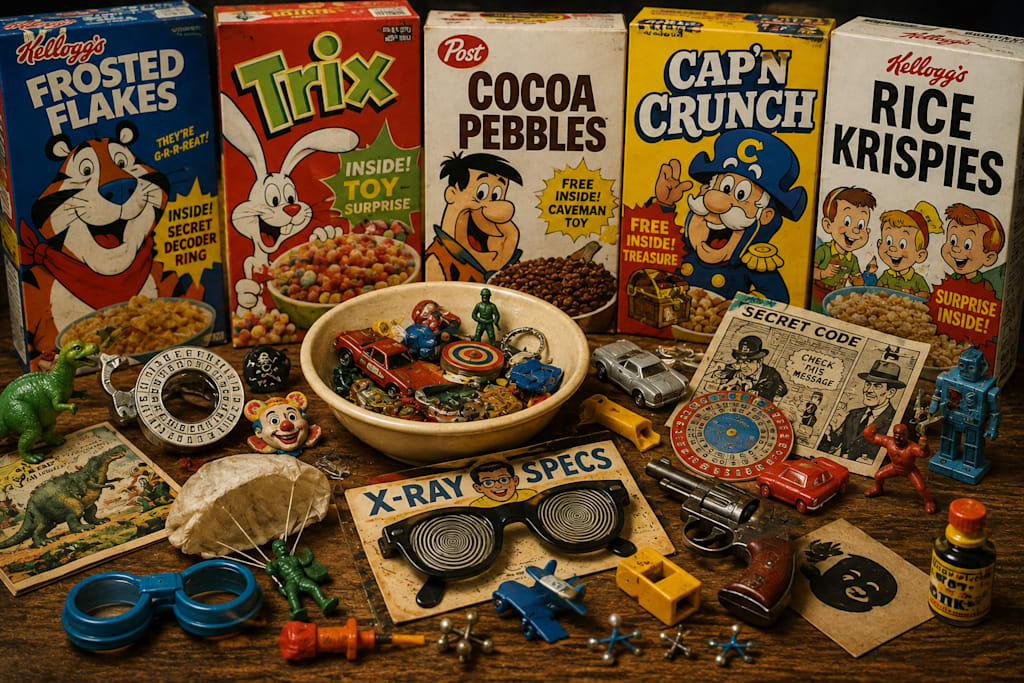
For generations of American children, breakfast wasn't the main event. The cereal was simply something standing between you and the real prize. Somewhere inside that colorful cardboard box, usually buried beneath a mountain of corn flakes or sugary puffs, was treasure. Sometimes it was a tiny car, sometimes a decoder ring, sometimes a plastic monster, and occasionally something that today would likely require three warning labels, a product recall, and an emergency meeting with a team of lawyers. Long before QR codes, downloadable games, and movie tie-ins, cereal companies fought for children's attention the old-fashioned way: they hid prizes inside the box. The strategy worked brilliantly.
Children begged their parents for one particular brand, not because of the cereal itself, but because of the mysterious surprise waiting inside. Entire advertising campaigns revolved around those tiny prizes. Some children even developed elaborate techniques for finding them before breakfast, carefully shaking boxes, peering through the cardboard, or turning the package upside down in hopes of locating the coveted toy. For millions of American kids, the cereal was almost an afterthought. The toy was everything. Looking back today, however, some of those prizes inspire a very different reaction… not nostalgia, but disbelief!
Take the humble decoder ring. Popularized through radio serials and later television tie-ins, these inexpensive plastic rings transformed ordinary children into secret agents. Young listeners eagerly waited for broadcasts containing coded messages, spinning tiny wheels to uncover hidden instructions that made them feel part of an exclusive club. It was harmless fun, mostly. Although more than a few disappointed children eventually discovered that the dramatic "secret message" often translated into something like: "Drink your Ovaltine." Still, decoder rings helped pioneer an entire generation of interactive marketing.
Then there were miniature vehicles, tiny die-cast cars, trains, airplanes, and trucks that frequently appeared inside cereal. They were detailed, durable, and endlessly entertaining. They were also roughly the size modern safety experts politely describe as "potential choking hazards." Today's toy packaging prominently warns parents about small parts. Decades ago? The tiny toy was literally mixed into breakfast.
Plastic parachute soldiers became another neighborhood tradition. Every child knew exactly what to do: climb onto the porch, stand on the roof of the garage, convince your older brother to throw it from the second-story window, and watch the tiny parachute deploy, or watch the entire thing plummet like a tiny green meteor before becoming permanently lodged in the tallest tree in the neighborhood. Entire suburban landscapes became accidental cemeteries for dangling plastic paratroopers.
Then came the age of the junior scientist. Mid-century America embraced science with infectious enthusiasm; space exploration, chemistry, engineering, and electronics captured the public imagination. Naturally, toy companies followed suit. Some cereal promotions included miniature science kits, crystal-growing experiments, simple chemical demonstrations, and magnetic gadgets intended to inspire future inventors. Most were perfectly safe. Some... stretched the definition of "safe" a bit further than modern parents might appreciate. The philosophy seemed refreshingly optimistic: give children real materials, let them experiment, hope nothing catches fire.
Speaking of things that would raise eyebrows today... some collectible toy soldiers were made from lead. Yes. Lead. The same material now carefully removed from paint, plumbing, gasoline, and countless consumer products was once molded into tiny military figurines destined for children's toy boxes. At the time, few people appreciated the long-term health risks associated with lead exposure. Today, the very idea feels astonishing. It serves as a reminder that safety standards evolve alongside scientific understanding.
Of course, not every prize tried to educate. Some simply encouraged kids to become detectives: invisible ink pens, fingerprint kits, secret code books, spy glasses, periscopes, plastic badges. One cereal aisle visit could apparently recruit an entire neighborhood intelligence agency.
Then there were the wonderfully strange novelties: fake monster teeth, googly-eyed finger puppets, miniature puzzles, optical illusion disks, tiny spinning tops, whistles, magic tricks, and rubber monsters. The prizes often cost only pennies to manufacture, yet they possessed an almost magical ability to convince children that one cereal brand was unquestionably superior to every other box on the shelf.
Perhaps no promotion captured childhood imagination better than X-ray Specs. Advertisements promised astonishing powers: see through solid objects, reveal hidden mysteries, become a scientific marvel! Children mailed away with visions of superhero abilities dancing in their heads. The reality proved... somewhat less impressive. The famous glasses relied on simple visual illusions created by feather patterns inside the lenses. They certainly did not grant X-ray vision, but that hardly stopped generations of youngsters from enthusiastically testing them on everything in sight.
Then came the era of licensed characters, comic books, Saturday morning cartoons, movie heroes, and television mascots. Cereal boxes became miniature billboards for America's growing entertainment industry. The prize inside wasn't merely a toy anymore; it was a connection to an entire fictional universe. Marketing had become storytelling.
Looking back, it is tempting to laugh at how easily children could be persuaded. Then again... modern cereal boxes feature QR codes leading to online games, fast-food meals still include collectible toys, digital loot boxes reward randomized purchases, trading card games encourage collecting, and video games offer cosmetic surprises. The strategy never disappeared; it simply evolved. Perhaps that is the most fascinating part of the story: the toy itself changed, the psychology didn't. Children have always loved surprises, and marketers have always understood that anticipation can be every bit as exciting as the reward itself.
Of course, modern toy safety regulations have transformed what companies can include inside food packaging. Sharp edges, small detachable parts for very young children, hazardous materials, potential toxins… many items once considered perfectly ordinary would never reach today's breakfast tables. That isn't evidence that earlier generations were careless; rather, it reflects decades of research into child development, toxicology, manufacturing standards, and product safety. Knowledge grew. Standards changed. The prizes changed with them.
Yet something was undeniably lost as well. There was a special excitement in pouring cereal into a bowl while listening for the faint rattle of plastic against cardboard. Children developed elaborate excavation techniques, determined to locate the treasure before the cereal escaped into the bowl. Some simply reached directly into the unopened box; others carefully shook the package until the prize migrated toward the top. A few impatient souls ignored the cereal altogether, earning predictable disapproval from parents who had, after all, purchased breakfast, not a cardboard treasure chest. The experience became part of growing up, turning an ordinary grocery purchase into an adventure. Perhaps that is why so many adults smile when they see vintage cereal boxes displayed in museums or antique stores. They aren't remembering corn flakes; they're remembering possibility. Every unopened box represented a mystery. Every breakfast held the promise of discovery. The prize might become a favorite toy for years, or it might disappear beneath the couch before lunchtime. That hardly mattered. For one glorious moment, before the cereal hit the bowl, absolutely anything seemed possible.
History often remembers great inventions, famous battles, and remarkable discoveries. Sometimes, however, the stories that stay with us are much smaller. A tiny plastic ring, a parachute caught in an oak tree, a decoder that revealed nothing more exciting than an advertising slogan. They remind us that childhood has always been shaped as much by imagination as by the objects themselves. And somewhere, tucked away in attics, junk drawers, and forgotten cookie tins across America, thousands of those tiny cereal-box prizes still survive, little pieces of plastic nostalgia. Tiny reminders that, for generations of American children, the greatest adventure of the day often began before the first spoonful of breakfast.
About the Creator
The Iron Lighthouse
Where folklore meets freeway. A guide to the strange heart of the American backroads...
Enjoyed the story? Support the Creator.
Subscribe for free to receive all their stories in your feed.
Comments
There are no comments for this story
Be the first to respond and start the conversation.