
What If Newton Died at Birth?
The most influential scientist in history almost didn't survive his first winter. Here's what would have happened to physics if he hadn't.
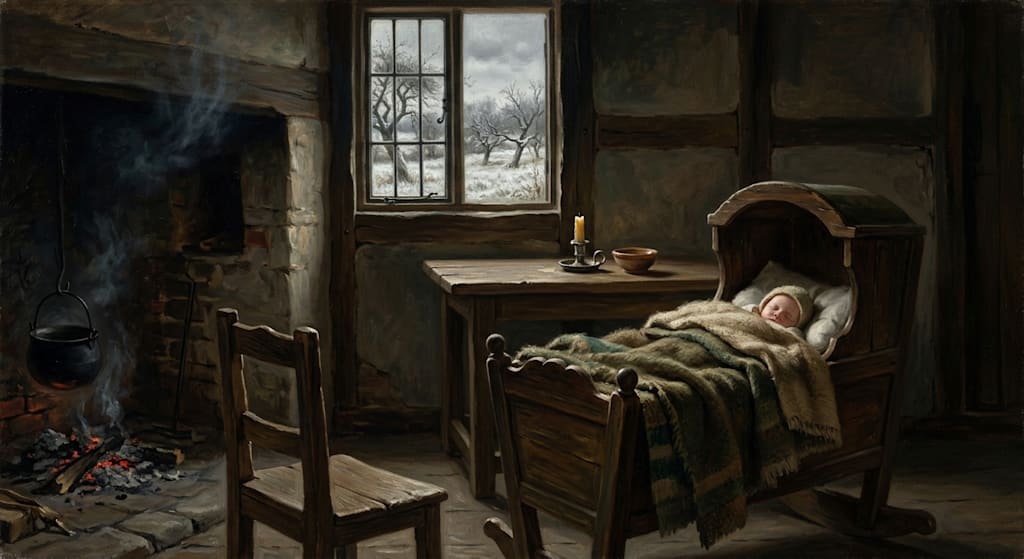
The morning of December 25, 1642, in Woolsthorpe-by-Colsterworth, Lincolnshire, a premature infant emerged from his mother's womb roughly the size of a quart pot. The midwives told Hannah Newton her son wouldn't last the week. He was so small the women could hold him in one hand. His father, a farmer also named Isaac, had died three months earlier. No one expected this sickly creature to see the new year.
But here's the thing about counterfactuals: they're useful not because they predict what would have happened, but because they reveal what we assume was inevitable. We treat Newton's existence as a fixed point in history. Remove him, and we imagine physics collapsing into darkness for centuries. That assumption says more about how we tell stories than how science actually works.
So let's take the thought experiment seriously. The infant dies before his first birthday. We bury him beside his father. Someone, in an act of thoroughness, cuts down every apple tree within walking distance of the house. No falling fruit. No revelation. No Principia.
Now what?
The standard narrative says we'd wait until 2687—a thousand years added to Newton's publication date of 1687. Or 11,687—Newton's date plus ten thousand. These numbers are jokes, of course. They assume Newton was the only person capable of solving the problem. They assume science waits for genius.
Science doesn't work that way.
By the time Newton published Philosophiæ Naturalis Principia Mathematica in 1687, the pieces of the puzzle were already scattered across Europe. Johannes Kepler had published his first two laws of planetary motion in 1609 and the third in 1619. His equations described how planets move but not why. Robert Hooke had written to Newton in 1679 proposing that gravity follows an inverse-square relationship—the force weakening with the square of the distance. Christopher Wren and Edmond Halley had discussed the same idea over coffee. Christiaan Huygens had published the formula for centrifugal force in 1673. Anyone with the right mathematical tools could combine these fragments and derive the elliptical orbit.
Hooke claimed he had already proven it. He refused to show anyone. That was Hooke's problem—he treated knowledge as leverage, not contribution. When Wren offered a book worth forty shillings to anyone who could deliver the proof within two months, Hooke stalled, Halley failed, and the prize went unclaimed.
Enter Halley. In August 1684, he visited Cambridge and asked Newton directly: what curve would a planet trace under inverse-square gravity? Newton answered immediately. An ellipse. He had calculated it years ago. Halley asked to see the derivation. Newton searched his papers and found nothing.
Three months later, Newton sent Halley a nine-page manuscript titled De Motu Corporum in Gyrum—On the Motion of Bodies in Orbit. That document became the seed of Principia.
But here's the point: Newton's ideas didn't emerge from nothing. They emerged from a conversation network that stretched across England and Europe. Remove Newton, and the network doesn't collapse. Someone else picks up the thread.
Hooke might have finally published his proof. He was capable, if erratic. Gottfried Wilhelm Leibniz had already published his calculus in 1684—the mathematical machinery existed. By 1710, the Bernoulli brothers were using calculus to derive orbital equations and prove that trajectories under inverse-square forces are conic sections. The solution would have emerged, piece by piece, through correspondence and argument and the slow accumulation of shared work.
What Newton contributed wasn't the idea of gravity. It was the synthesis. He took Kepler's laws, Hooke's intuition, Huygens's formulas, and his own calculus, and built a unified system that explained everything from falling apples to lunar orbits. He showed that the same force governs terrestrial and celestial motion. He made the invisible visible.
But synthesis requires someone to do the synthesizing. And synthesis requires the synthesizer to actually write things down.
Newton had a habit of sitting on his work. His Method of Fluxions—his version of calculus—was written in 1671 but not published until 1736, nine years after his death. His Opticks waited until 1704, the year after Hooke died. Newton withheld publication for strategic reasons, personal grudges, and simple inertia. He didn't need to publish; he knew he was right.
This is the vulnerability in the counterfactual. Remove Newton, and you don't just remove a mind. You remove a specific person with specific habits—a man who could solve the hardest problems but often refused to share the solutions. You remove the rivalries that pushed him to publish. You remove Halley, who cajoled and funded and edited and basically dragged Principia into existence.
The Royal Society had promised to fund Principia's publication. Then they spent the money on a lavishly illustrated book about fish—De Historia Piscium—which sold poorly and left the society broke. Halley paid for Principia out of his own pocket. He also accepted unsold copies of the fish book as partial payment for his salary. The most important scientific work in history was published because one man cared enough to make it happen.
Remove Newton, and you still have Hooke, who might have published. You still have Leibniz, who was already publishing. You still have Halley, who asked the right questions. The pieces were there. The synthesis might have taken a different shape—perhaps less elegant, perhaps more collaborative, perhaps published in fragments across decades.
But the synthesis would have happened. Not in 2687. Not in 11,687. Probably within fifty years.
This is the uncomfortable truth about scientific progress: it's not carried by individuals. It's carried by networks. Genius matters—Newton was undeniably brilliant—but genius without a network is just a person thinking alone in a room. The network ensures that ideas spread, get tested, get challenged, get refined. The network turns private insight into public knowledge.
Newton was born on Christmas morning, 1642, into a world that was already primed for his questions. Kepler had mapped the orbits. Galileo had measured falling bodies. Descartes had proposed a mechanical universe. Hooke had guessed the inverse-square law. The question was in the air. Newton answered it.
If he had died, someone else would have answered it. Maybe not as completely. Maybe not as elegantly. But the answer would have come.
The myth of the lone genius obscures the reality of scientific work. We tell stories about Newton because stories need protagonists. But the real protagonist is the network—the letters, the arguments, the rivalries, the collaborations, the slow grinding accumulation of shared knowledge.
The apple always falls. The question is who notices, and who writes it down, and who convinces the world to listen.
About the Creator
Jin
Writer of reamstories
https://reamstories.com/jin
Enjoyed the story? Support the Creator.
Subscribe for free to receive all their stories in your feed. You could also become a paid subscriber or give them a one-off tip, letting them know you appreciate their work.
Comments
There are no comments for this story
Be the first to respond and start the conversation.