
Were There Muslims on Columbus’s Ships?
Unanswered Question from 1492
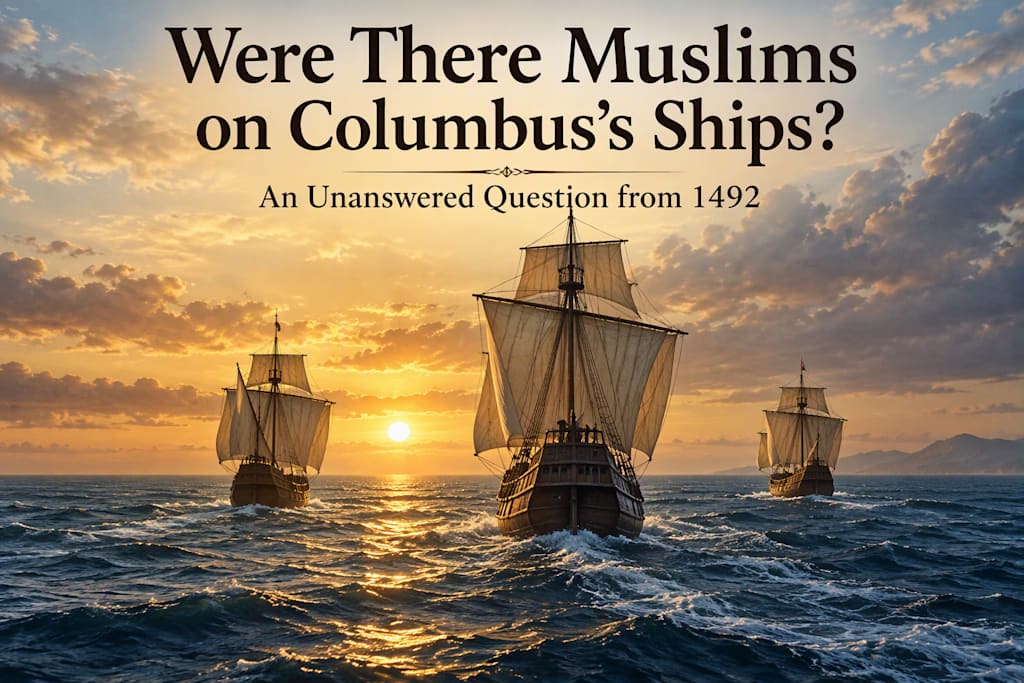
Before dawn on August 3, 1492, three ships slipped out of the harbor of Palos and disappeared into the Atlantic.
There was the Santa María, the flagship, a broad-bellied nao that carried Columbus himself. There was the Pinta, a swift caravel commanded by Martín Alonso Pinzón of Palos. And there was the smallest of the three, the Niña. About ninety men sailed aboard them.
The voyage of 1492 and the fall of Granada were not separate stories. They were twin events of the same year. As one world closed in Andalusia, another was opening across the Atlantic.
The world remembers the man who commanded the fleet. It remembers the ships and its names, the date, and the crowns that paid for the voyage.
But history is strangely silent about the men who stood beside him.
The Ship With a Family Name
Even the names of the ships hold a quiet clue. Today we say Niña, “the girl,” as if it were a pet name. But that was never her official name. She was baptized Santa Clara. Sailors of the time often gave ships nicknames drawn from their owners, and she became the Niña after the Niño family of Moguer, who owned her and sailed on her. Juan Niño was her master, and his brother Francisco served aboard as a sailor.
A third Niño was on the fleet’s flagship: Pedro Alonso Niño, the pilot of the Santa María.
Think about what that means. A large share of the leadership of this voyage came from one seafaring family of one small Andalusian port. The name of one of Columbus’s ships was, in effect, a family name. And Moguer was not a blank slate. It was a town on land that had been Muslim for centuries.
The Pilot Called “The Moor”
Among the most intriguing figures on the voyage was Pedro Alonso Niño, pilot of the Santa María. He was not an ordinary sailor. In an age when lives depended on navigation, the pilot was among the most skilled men aboard.
Later traditions associated Pedro Alonso Niño with Moorish or African ancestry. Some sources referred to him as el Negro, though historians continue to debate exactly what the nickname meant.
Yet even the existence of such traditions is striking. Columbus's most important navigator came not from Castile's royal court but from Moguer, a town shaped for centuries by Islamic Andalusia. Given the social and historical background of fifteenth-century Andalusia, it is possible that Pedro Alonso Niño had Muslim ancestors, though no conclusive proof exists.
But he belonged to a world where Christian, Muslim, and Jewish histories had overlapped for generations.
When the Santa María crossed the Atlantic, one of the men guiding her course may have carried traces of that forgotten Andalusian Muslim heritage.
The Towns They Came From
Just seven months before the fleet sailed, Granada had surrendered, ending nearly eight centuries of Muslim rule in Spain. Many mosques fell silent. Families faced impossible choices: convert, leave, or live in fear. Those who accepted baptism under pressure would soon be called Moriscos.
Columbus found his crews in Palos, Moguer, and Huelva, Andalusian harbor towns built on land that had been Muslim for centuries. Even after Castile took it and resettled it, the old world did not vanish overnight. Some families still carried Arabic names, memories, and faith in whispers.
No surviving crew list identifies a practicing Muslim aboard Columbus's ships. What follows is therefore not a claim of proof, but an exploration of what may have been possible in the turbulent months after the fall of Granada.
There may have been a sailor among the crew whose grandmother spoke Arabic in the kitchen, whose family had once prayed in a mosque, who had learned to answer to another name, and who now watched the coast of Andalusia fade into the mist.
Would he have said anything? Probably not. The Inquisition made silence a form of survival.
The Sky Spoke Arabic
Night after night, the pilots of the three ships took out the astrolabe and the quadrant and measured the height of the stars. The astrolabe had been perfected by Muslim scientists and carried into Spain by Andalusian astronomers.
The stars overhead carried Arabic names: Altair, the flying eagle; Vega, the falling eagle; Aldebaran, the follower; The pole star they steered by was al-Qutb, the pole. Even the words zenith, nadir, and azimuth came from Arabic.
And in the admiral’s cabin lay the book that persuaded him to sail. It relied on the measurements of Al-Farghani, a ninth-century Muslim astronomer of Baghdad, who had calculated the length of a degree of the Earth in Arabic miles of about 1,970 meters. Columbus read the figures as Roman miles of about 1,480 meters. The world shrank on the page, and Asia seemed only weeks away across the sea.
He had misread Al-Farghani. But without Al-Farghani, he would never have dared to sail.
The calculations were Islamic. The instruments were Islamic. The names of the stars were Arabic.
The Shoulders He Stood On
On October 12, after more than two months at sea, a lookout on the Pinta cried out that he saw land. History remembers what came next: Columbus, the flag, the landing.
It forgot the shoulders he stood on: the scholars of Baghdad, Córdoba, and Toledo, who taught the world to read the heavens.
And it forgot the faceless crew, the men from towns with Muslim roots, who hauled the ropes on all three ships and watched the same stars. Some may have carried a grandmother’s prayer and a name they dared not speak.
No monuments bear their names. No schoolchildren learn their stories.
But they may have crossed an ocean in search of a new world while silently mourning the loss of their own.
Notes and Sources
The Niña's official name was Santa Clara, though the famous nickname is traditionally linked to the Niño family of Moguer.
Juan Niño, Francisco Niño, and Pedro Alonso Niño appear in contemporary records relating to Columbus's first voyage.
References to Pedro Alonso Niño's Moorish or African ancestry come from later traditions and remain debated.
No surviving crew roster identifies a practicing Muslim aboard Columbus's ship.
About the Creator
Akram Mohammed
From a four-decade IT career to storytelling, I write about South Indian Islamic history, memoirs, faith, philosophy, cultural heritage, and nature, uncovering overlooked perspectives and meaningful human connections.
Enjoyed the story? Support the Creator.
Subscribe for free to receive all their stories in your feed.
Comments
There are no comments for this story
Be the first to respond and start the conversation.