
Weapons from the Caste War Discovered Submerged in Yucatán Cenote
Preserving a Vulnerable Underwater Legacy

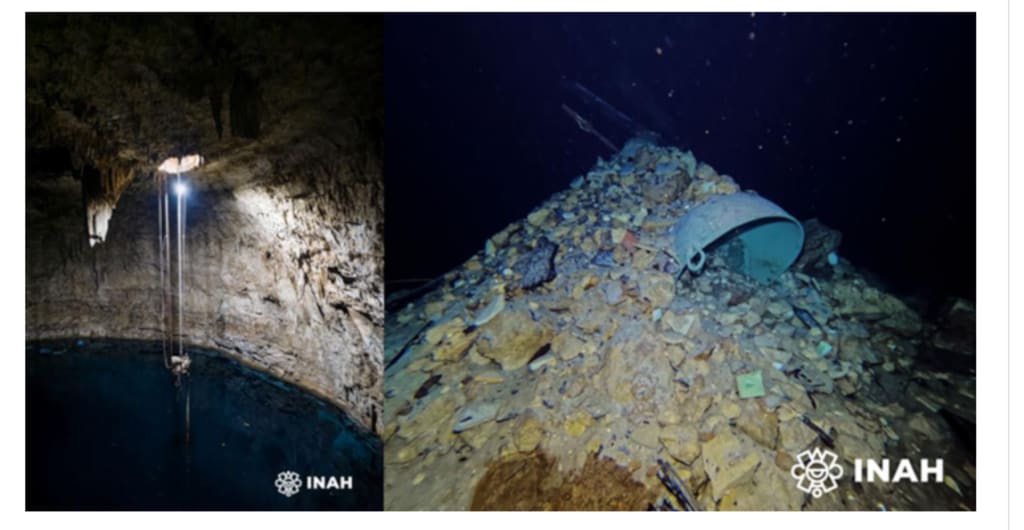
Weapons from the Caste War Discovered Submerged in Yucatán Cenote
An incredible collection of 19th-century weapons has been discovered in a submerged archaeological site located deep beneath the Yucatán Peninsula. A wide variety of artefacts concealed below the Síis Já cenote, situated beneath the Ex Convento de San Bernardino de Siena in Sisal, Valladolid, have been documented by archaeologists from Mexico's National Institute of Anthropology and History (INAH).
This amazing finding provides fresh insight into the turbulent era known as the Caste War of Yucatán (1847–1901), exposing a distinct underwater setting where government forces most likely disposed of their arsenals to prevent Maya rebels from obtaining them.
The Síis Já cenote, which means "well of cold water" in Mayan, is a natural time capsule. More than 150 weapons were found sitting on the cenote floor by experts from INAH's Subdirectorate of Underwater Archaeology (SAS) during a recent intervention intended to evaluate the site's condition in response to reports of unauthorised entry.
An Undiscovered Arsenal
Researchers have discovered Spanish and English muskets and rifles among the submerged artefacts, as well as an iron cannon that is amazingly intact and still attached to its original wooden carriage. The huge amount of armament indicates that the Yucatecan government army disposed of it quickly and purposefully between 1847 and 1848, during a crucial early stage of the Caste War, also known as the Maya Social War.
"The work of INAH is not only to recover objects or zones, it is also to preserve historical narratives, guaranteeing that the sites continue to be a source of identity, learning, and cultural continuity for present and future generations," Mexico's Secretary of Culture Claudia Curiel de Icaza said, highlighting the significance of preserving the country's cultural legacy.
Beyond Weapons: An Artefact Tapestry
There is more in the depths of the cenote than merely the ruins of battle. A variety of artefacts from pre-Hispanic times to the 20th century are strewn among the weapons. Ceramic vessels, porcelain, majolica, incense burners, and Talavera ceramics have all been recorded by archaeologists. In order to promote their conservation in the stable underwater environment, these artefacts are left in place.
Gustavo García, an underwater archaeologist, carried out a thorough photogrammetric survey to examine the results without harming them. The team is producing extremely precise three-dimensional models by taking numerous pictures of a weapon, the cannon, and material concentrations. Experts are able to reconstruct past practices related to the site, contextualise the discoveries within their original location, and analyse the archaeological data from several perspectives thanks to this sophisticated 3D registration.
Preserving a Vulnerable Underwater Legacy
The Síis Já cenote is under serious threat despite its historical value. The cenote and its fragile environment have been directly harmed by unlawful infrastructure that has collapsed, including steps and bridges, according to the most recent INAH expedition. In addition, the finding of unapproved "lifelines" suggests that recreational divers have entered this protected area.
Concerns should also be raised about environmental changes. The complete lack of common catfish, referred to locally as ahlu, indicates possible groundwater contamination. INAH and the Fundación Convento Sisal Valladolid A.C. have urged the community to assist in protecting the site in light of these dire circumstances.
Plans are in place to start thorough investigation again, starting with a methodical examination of the underwater environment and the careful removal of contemporary detritus. In order to preserve the memory of the Caste War and the secrets of Síis Já for everyone to view, materials that were previously recovered from the cenote in 2003 will shortly be given to the Ex Convento de San Bernardino de Siena for exhibition.
About the Creator
Enjoyed the story? Support the Creator.
Subscribe for free to receive all their stories in your feed.
Comments
There are no comments for this story
Be the first to respond and start the conversation.