
This mummified animal, which perished in a cave 300 million years ago, is responsible for every breath humans take.
Mummified fossil of Captorhinus aguti

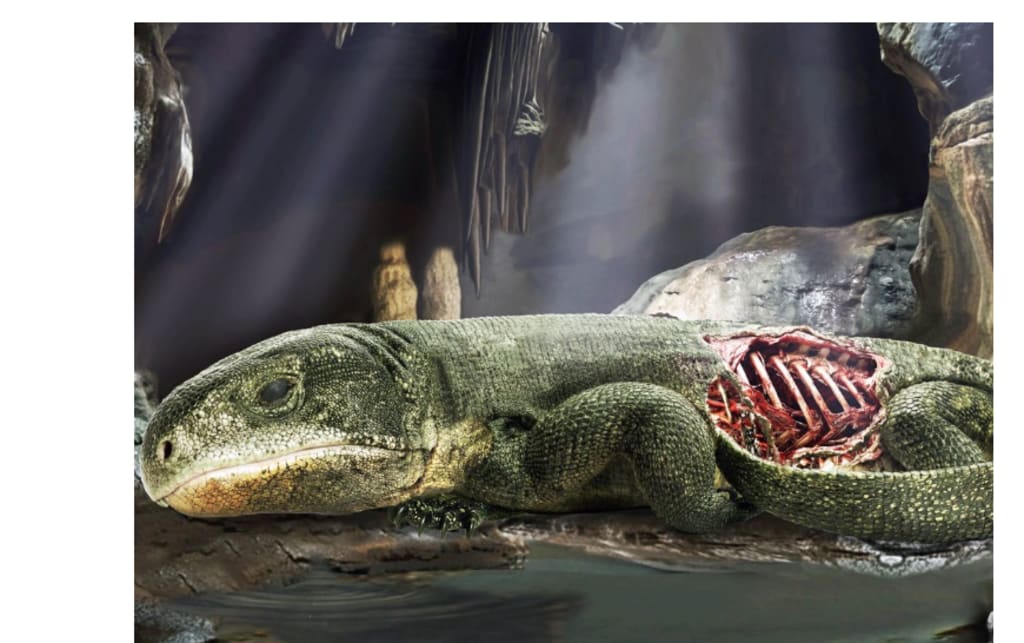
It's easy to forget that breathing with your ribs is an innovation because it seems so natural. There is no gulping, no throat pumping, and no need for moist skin to exchange gases with the air; instead, the chest expands, the lungs expand, and oxygen rushes in. But there has to be a place for that rib-driven breathing technique to begin.
According to a recent study published in Nature, one of the first pioneers was a rather small creature: Captorhinus aguti was a tiny amniote that resembled a lizard and lived around 289 million years ago.
The specimen, which was discovered mummified in a network of caves in Oklahoma, preserves not just bones but also skin, cartilage, and even remnants of old proteins, which palaeontologists hardly ever get to view from this era.
When taken as a whole, these tissues demonstrate the earliest known instance of costal respiration in amniotes, which comprise birds, mammals, reptiles, and their common ancestors.
Mummified fossil of Captorhinus aguti
Richards Spur, an Oklahoma location well-known to palaeontologists for its extensive collection of late Paleozoic terrestrial animals, is where Captorhinus aguti originated. An exceptionally varied snapshot of that era's existence has been produced by the cave system.
The way the environment kept the body—such as oxygen-poor dirt and hydrocarbons, which prevented the tissues from collapsing and withering away—was what made this specific discovery noteworthy.
Researchers discovered something more akin to a natural "mummy"—a small mammal frozen in a lifelike stance with one arm curled beneath its body—instead of a flattened imprint.
The researchers employed neutron computed tomography (nCT) at a facility in Australia to investigate it without causing any damage. This allowed them to peer through the surrounding rock as if they were doing a medical scan.
Skin pattern resembling an accordion
Researchers discovered there was much more than just bone when teams started analysing the scan data. "I began to notice all these structures encircling the bones." They had texture and were quite thin. Ethan Mooney, who co-led the study while working in Professor Robert R. Reisz's lab at the University of Toronto, remarked, "And, lo and behold, there was a nice wrapping of skin around the torso of this animal."
"A large portion of the body, from the torso to the neck, is covered by these concentric bands, giving the scaly skin a wonderful accordion-like texture." Because it mimics the flexible, ringed scales found in contemporary burrowing reptiles like worm lizards, that "accordion" pattern is particularly intriguing. Although the skin wasn't the primary goal, this type of body construction allows an animal to flex and twist without tearing it.
Captorhinus aguti and humans
Together, the three Captorhinus aguti specimens that the researchers studied preserved a collection of chest features that are uncommon in fossils this old.
A segmented cartilaginous sternum, ribs connected to the sternum, intermediate ribs, and connecting structures that connect the rib cage to the shoulder area were all found in one specimen.
This combination is important because it enables scientists to reconstruct how the entire breathing mechanism was put together in an early amniote, something that is typically lost to time.
According to Reisz, "we propose that the system found in Captorhinus represents the ancestral condition for the kind of rib-assisted respiration present in living reptiles, birds, and mammals."
This small Permian reptile may therefore demonstrate the fundamental structure that was later developed into the breathing mechanics that drive everything from a human sprint to a flying bird to a running lizard.
Life on land was altered by breathing
The predominant terrestrial vertebrates prior to amniotes were reptile-like creatures that could breathe partially through their skin and pumped air into their lungs using their mouths and throats. Although the method can function, it is not ideal for animals that must be extremely active on land.
Costal breathing is more effective because it uses the muscles between the ribs to compress and expand the chest cavity. It can promote increased activity levels, draw in more air, and exchange gases more efficiently. According to Mooney, "it was a game changer that allowed these animals to adopt a much more active lifestyle."
This additional oxygen capability could contribute to the explanation of a larger historical trend. With the ability to live and breathe more effectively on land, amniotes—including their early reptile ancestors—diversified quickly and eventually took the lead among terrestrial vertebrates.
There are still ancient proteins.
Anatomy was not the only thing preserved by the fossil. The researchers also found traces of the original proteins in the fossil's skin, cartilage, and bone using synchrotron-based infrared spectroscopy.
According to Mooney, "the discovery of protein remnants is remarkable and it significantly expands our comprehension of what is feasible in terms of soft tissue preservation in the fossil record." Paleozoic fossils are often much too old to preserve anything resembling original organic molecules, therefore this is an important discovery.
According to the findings, biological evidence from considerably deeper time may be preserved in the fossil record under the correct circumstances, contrary to what scientists previously believed.
Captorhinus aguti lessons
Captorhinus was neither a spectacular "missing link" skeleton nor a gigantic the size of a dinosaur. It was small, widespread, and most likely the type of animal that used to scuttle through the bush with little trouble.
However, because of its remarkable preservation, it is now contributing to the explanation of something basic. It demonstrates how early amniotes used breathing as a potent engine for terrestrial life and how our own ribs now rise and fall on a daily basis due to the same fundamental architecture.
About the Creator
Enjoyed the story? Support the Creator.
Subscribe for free to receive all their stories in your feed.
Comments
There are no comments for this story
Be the first to respond and start the conversation.