
The Writers Between the Frames...
When Hollywood Paid for the Perfect Words No One Would Ever Hear

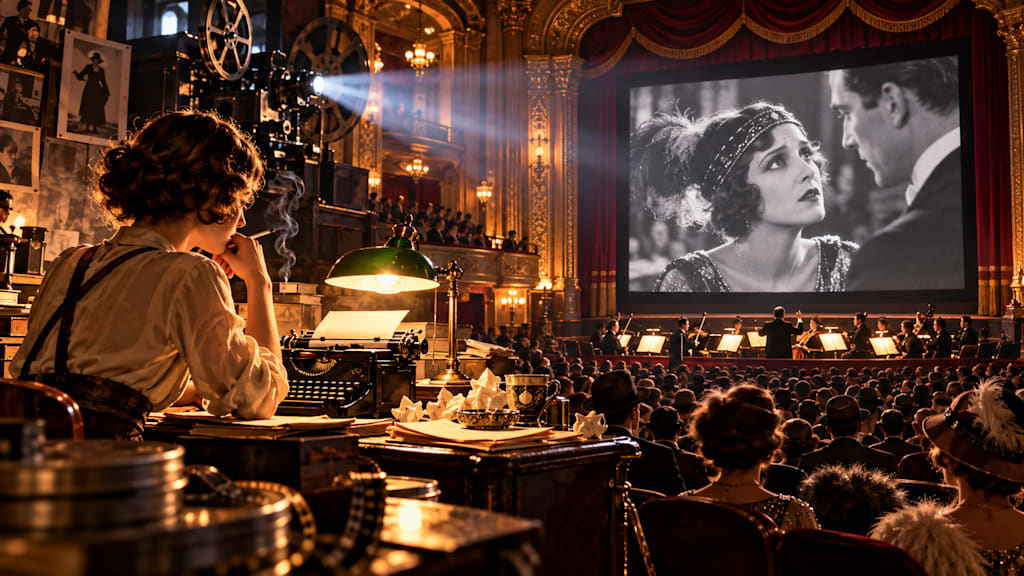
The theater is dark. An orchestra plays somewhere beneath the screen as hundreds of faces stare toward a rectangle of flickering light, watching a young man cross an elegant drawing room toward the woman he loves. He stops. She turns. Something has happened between them; the audience can see it in her face, but there is no voice to explain it, no whispered confession, no trembling accusation, no clever line delivered at precisely the right moment. The screen goes black. Words appear. The audience laughs. Then the words vanish, the actors return, and the story moves on. The sentence might have occupied the screen for only a few seconds, but somebody had to write it. In the strange, rapidly evolving world of silent Hollywood, those words could matter enormously.
Before synchronized dialogue transformed movies at the end of the 1920s, films relied upon intertitles, printed text inserted between photographed scenes. Some explained time and place, some carried dialogue, some clarified a complicated plot. In the hands of the best writers, some did something more: they became part of the performance. The Library of Congress defines intertitles as filmed printed text edited directly into the action, providing the textual content that spoken dialogue could not. For a brief period in movie history, learning how to write those disappearing sentences became a genuine craft. One of the people who mastered it was a tiny, sharp-witted young woman named Anita Loos.
A Voice for People Who Couldn’t Speak
A century later, it's easy to misunderstand silent movies. We call them silent, but theaters weren’t necessarily silent. Depending on the venue and production, audiences might hear a pianist, organist, or orchestra accompanying what happened onscreen. Music became so integral to the experience that major productions increasingly used elaborate scores, and by the 1920s, completely original feature-film scores were becoming more common. Audiences generally did not hear the actors. That created an extraordinary storytelling problem. Film was becoming more ambitious; stories were becoming longer and more complicated. Characters needed motives. Relationships needed context. Sometimes an expression and a gesture could communicate everything. Sometimes they couldn’t. So the screen itself spoke:
MEANWHILE, THREE YEARS LATER…
Or: “You knew all along.”
Then back to the actors. The challenge was deceptively difficult. Put too much writing on the screen, and the movie became something audiences had to read instead of watch. Put too little there, and they might have no idea why Mildred had suddenly slapped Walter and boarded a train for Philadelphia. The words had to arrive at precisely the right moment. They had to be understood quickly. Then they had to get out of the way. This was writing designed to disappear.
Enter Anita Loos
Anita Loos had been writing for movies when the movie business itself was barely old enough to shave. Her career began remarkably early. A 1926 New Yorker profile recounted that D. W. Griffith initially paid her $15 apiece for story ideas. Eventually, recognizing her gift for comedy, Griffith brought her into his operation. According to the same contemporary profile, he later paid her $25 for each day she worked writing titles, while allowing her to continue writing for other filmmakers. Loos possessed something particularly valuable to silent comedy: she could make the words themselves funny. Not simply “JOHN ARRIVES AT THE HOTEL,” but titles that participated in the joke.
Her major breakthrough in that style came with Douglas Fairbanks’s 1916 comedy His Picture in the Papers. Later accounts of the film emphasize how unusual Loos’s witty titles were; they didn’t merely explain what viewers were seeing, but added another layer of humor. That sounds utterly normal now. It wasn’t then. Loos was essentially discovering that words appearing between scenes didn’t have to behave like road signs. They could have personality. They could wink at the audience. They could contradict what a character believed. They could deliver the punchline. And audiences responded. A 1946 retrospective in The New Yorker recalled that His Picture in the Papers had been considered unusually risky because of its comic subtitles, until audiences laughed. The words weren’t interrupting the movie; they were part of the movie.
The Woman Called in to Help an Epic
Then came Intolerance. D. W. Griffith’s massive 1916 production was anything but simple. It intercut four stories separated by centuries: ancient Babylon, Judea in the time of Christ, sixteenth-century France, and contemporary America. Imagine holding that together without spoken dialogue; now imagine doing it in 1916. Griffith turned to Loos for help with the titles. The American Film Institute credits her specifically for title work on Intolerance, as does the Library of Congress. Those little cards suddenly had an enormous responsibility. They weren’t simply telling an audience what somebody had said. They could help bridge centuries. They could orient viewers. They could give structure to spectacle. Behind enormous sets, hundreds of extras, costumes, cameras, and one of the most ambitious productions of its era sat a surprisingly humble technology: words on a black screen. And someone had to choose exactly which ones.
The Title Writer Becomes a Specialist
By the later silent era, this was not merely something an actor scribbled on a napkin between takes. Movie writing had become increasingly specialized. One great example is a name that would later become permanently associated with one of Hollywood’s most famous films: Herman J. Mankiewicz. Long before Citizen Kane, Mankiewicz was writing titles. In 1927 and 1928 alone, he did title work on at least twenty-five films, involving stars including Clara Bow, Bebe Daniels, Wallace Beery, and others. Think about what that says about the industry. A studio could have actors, a director, cameras, sets, a completed story, and still bring in a writer specifically to sharpen the words appearing between the images. The title writer could be part dramatist, part editor, part gag writer, and part minimalist. Because unlike the novelist, there was no room for three pages describing heartbreak. Unlike the playwright, there was no actor available to rescue a mediocre sentence through delivery. The words simply appeared. There they were. If the joke failed, the audience sat quietly. If the line worked, a room full of strangers might erupt. And then the card disappeared forever into the next scene.
Writing for an Audience That Could Read
Something almost comical about the resistance Loos encountered. Movies were a visual medium, after all. Why make audiences read? Loos later recalled the skepticism around her title-heavy humor, and accounts of His Picture in the Papers describe the laughter it produced as proof that viewers would happily read when the words rewarded them. It seems obvious now, but almost every artistic language has to be invented while somebody else is standing nearby saying, “Nobody is going to want that.”
Another important piece of this history. Women were deeply involved in early American filmmaking in ways that would become less common as Hollywood’s corporate structures hardened. The Library of Congress notes that silent-era women worked not merely as performers but as screenwriters, directors, and producers, sometimes using those positions to play with the stereotypes appearing onscreen. Loos was part of that world. She was not some anonymous typist waiting for a director to dictate a sentence; she was helping figure out what writing for movies could be.
And Then the Screen Spoke
No profession built around silent cinema could ignore what happened next. Sound arrived. Not all at once. Not neatly. But once audiences heard synchronized speech in feature films, the basic relationship between movies and words changed. The black card no longer had to say, “I never loved you.” An actor could say it. A character could hesitate before saying it. Whisper it. Scream it. Lie while saying it. Another character could interrupt halfway through. Suddenly, the human voice had entered the screen. And the intertitle, the little literary interruption that had helped movies communicate for decades, began losing its central job.
But here is where the story refuses to end as neatly as we might expect. The writers didn’t simply vanish. Some adapted. The skills that made someone good at intertitles- economy, wit, rhythm, characterization, and knowing exactly when a line should land- were extremely useful once Hollywood needed people to write dialogue. Mankiewicz moved directly into talking pictures. The fast, witty writers who had been supplying titles and gags were unusually well equipped for an industry that suddenly needed characters who could open their mouths and say something worth hearing. Loos went much further still. She wrote novels, plays, and screenplays and became internationally famous for Gentlemen Prefer Blondes. The medium changed. The writer survived.
The Words Between the Frames
Today, the intertitle survives mostly as a visual signature of another age: black screen, decorative border, white lettering. To modern eyes, it can look quaint, primitive, even. But look more closely. Those cards belong to an extraordinary moment when an entirely new art form was inventing its grammar in public. Nobody had centuries of filmmaking tradition to consult. No established rulebook explained how much text an audience would tolerate, where a joke should appear, how quickly viewers could absorb information, or how words and moving images should interact. They were figuring it out while the film was running. And writers like Anita Loos discovered something that filmmakers have never forgotten: sometimes an image needs no explanation. Sometimes a face tells you everything. And sometimes the difference between confusion and heartbreak, or silence and a theater full of laughter, is one perfectly chosen sentence.
Then the lights change. The card disappears. The actors return. And the words that briefly held hundreds of people in their grip are gone. Until the next frame needs them.
About the Creator
The Iron Lighthouse
Where folklore meets freeway. A guide to the strange heart of the American backroads...
Enjoyed the story? Support the Creator.
Subscribe for free to receive all their stories in your feed.
Comments
There are no comments for this story
Be the first to respond and start the conversation.