
The Vulture Stone of Göbekli Tepe Associated with Trypillia Culture in Europe
A Sacred Language of the Universe and Time

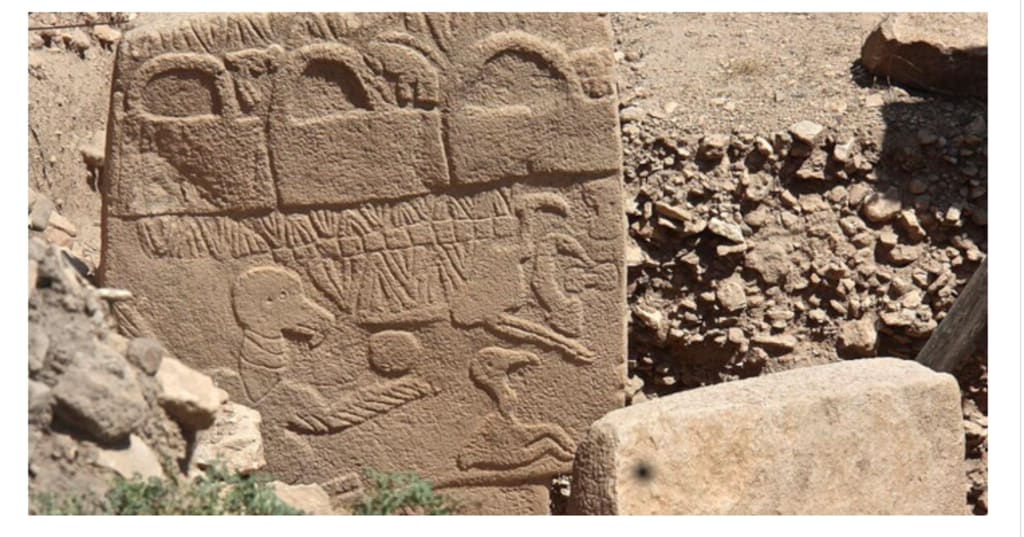
A recent investigation has revealed remarkable similarities between the ritual imagery of the Trypillia culture in Eastern Europe and the carved symbolism of Göbekli Tepe's well-known Vulture Stone. According to the research, these early farming communities may have had a deep cosmology language about time, death, sacred space, and celestial movements while being separated by millennia and great distances. This fascinating link suggests that the emergence of agriculture in Europe may have coincided with the transmission of fundamental astronomical and theological ideas from the Near East.
£bekli Tepe's Pillar 43, also referred to as the Vulture Stone, is at the center of the controversy. One of the oldest monumental ritual settings in the world, it is situated in southeast Turkey and dates to the Pre-Pottery Neolithic period (c. 9600–8200 BC). The intricate carvings of birds, a snake, a scorpion, abstract symbols, and a headless human figure may be seen on the Vulture Stone.
Oleksandr Zavalii's recent work, which was published in the International Journal of Culture and History, offers a more comprehensive perspective than earlier interpretations, which varied from representations of death rituals to astronomical codes. According to Zavalii, the pillar is a component of an organised sacred language that incorporates geometry, solar cycles, and lunar rhythms.
A Sacred Language of the Universe and Time
The study interprets the engravings as elements of a visual grammar rather than as simple decoration or an accurate scientific account of a comet strike. The Vulture Stone's lower half, which features a scorpion and a headless human, may represent the underworld or the earthly realm, while the upper section, which features bird figures and arch-like structures, may represent celestial imagery. The idea of a two-level universe, which is fundamental to many ancient belief systems, is reflected in this split.
The study also emphasises how numerical patterns recur across the site. For example, several enclosures at Göbekli Tepe include eleven T-shaped pillars, while the Vulture Stone has eleven rectangular parts. The numbers two, three, eleven, and thirteen are included in another pillar, Stele 33, which Zavalii speculates may represent duality, solar structure, and lunar cycles. Together, these components create a sacred cosmological diagram that arranges the relationships between the sky, the seasons, and communal customs.
Connecting Eastern Europe and Anatolia
Comparing the iconography of Göbekli Tepe with that of the Trypillia culture, which flourished much later (between 5500 and 2750 BC) in modern-day Ukraine, Moldova, and Romania, is the research's most innovative feature.
The investigation finds strong similarities between ceramic themes, temple layouts, and ritual artefacts. For instance, Trypillian "binocular-shaped" ritual artefacts and the H-shaped markings at Göbekli Tepe are comparable since both may convey concepts of duality or the dividing of sacred time.
The results point to a common legacy of symbolic solutions, even though the two civilisations are very different in time, making direct transfer challenging to demonstrate. It's possible that early agrarian communities relied on a shared religious language to organise their surroundings as they evolved.
Human culture underwent significant transformations as a result of the Fertile Crescent's shift from hunter-gatherer to farming, and it seems that these fundamental cosmological ideas followed agricultural methods into Europe.
The First Temple's Persistent Mysteries
£bekli Tepe is still resistant to a single, straightforward explanation. Its enormous enclosures and finely carved pillars probably had several levels of significance, including mythological, astronomical, ritual, funeral, and social. These categories were closely related to the prehistoric societies that constructed it. The location may have been both a celestial observatory that marked the changing of the seasons and a hub for ancestor devotion, as suggested by hypotheses of a skull cult.
About the Creator
Enjoyed the story? Support the Creator.
Subscribe for free to receive all their stories in your feed.
Comments
There are no comments for this story
Be the first to respond and start the conversation.