
The Secretary Who Knew Too Much — Constantinople, 843 AD
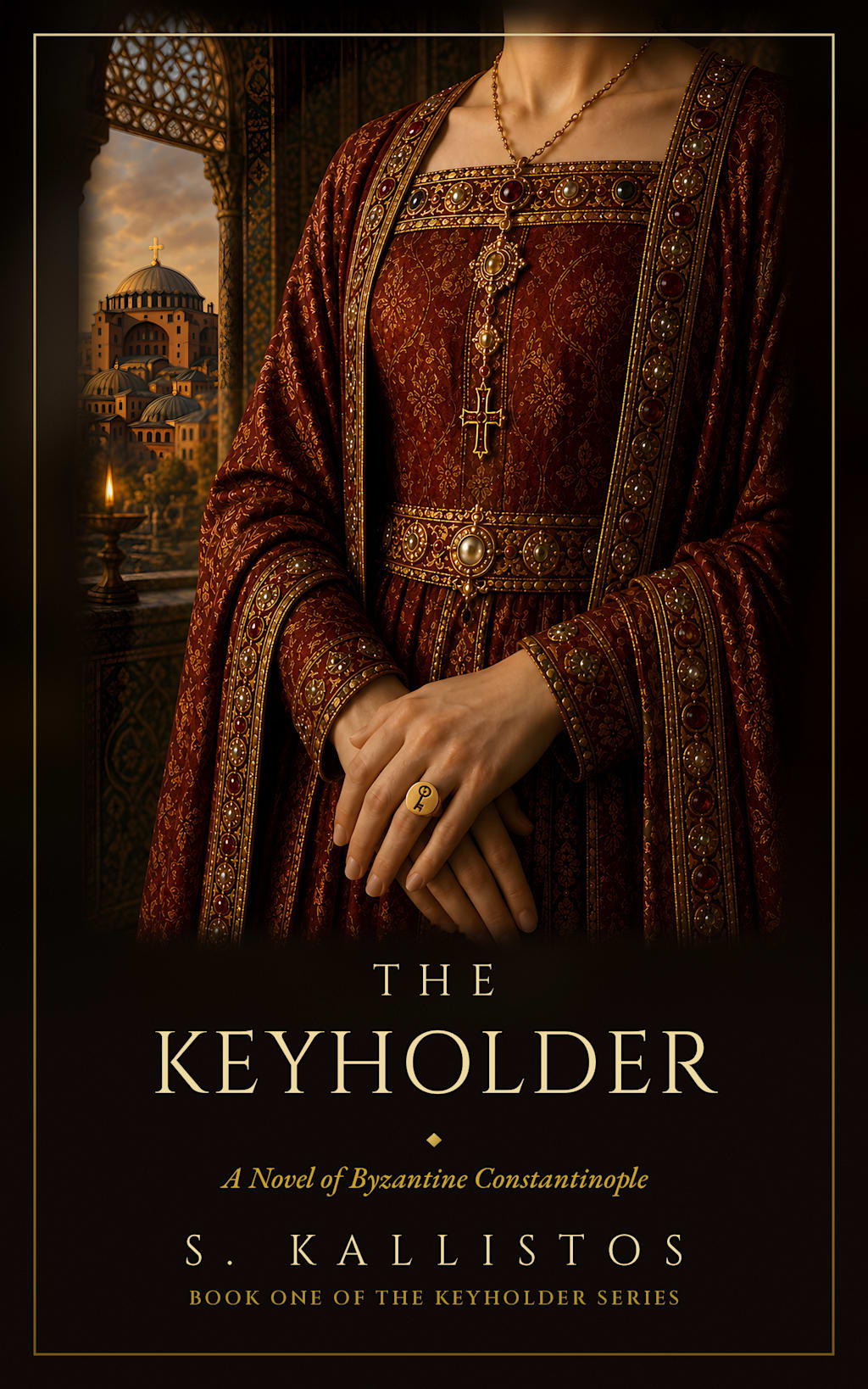
A short story set in the world of The Keyholder: A Novel of Byzantine Constantinople
✦ ✦ ✦
Nikiphoros Phokas was not yet aware that he was going to die. But he had a tormenting presentiment that he was about to suffer something severe. He took a piece of parchment from his desk, wrote a single word, sealed it and carried it in the inner pocket of his cloak to the corridor outside the Magnolia Hall.
After thirty years in the Logothesia of the Course — the empire's archive, a powerful and silent engine of its memory — he had learnt to wait. Experience had taught him that at the Sacred Palace of Constantinople, the important discussions happened in corridors, between meetings, when a person was heading from one appointment to another formal obligation.
He saw her at the far end of the passage. Theophano Doukena was coming from the Empress Theodora’s apartments. He realized it by the direction, by the set of her shoulders, by the particular calmness that appeared on her face after leaving Theodora's presence. Wheat-gold hair, skin that never darkened, green eyes that made people look twice. But Theophano had long since stopped noticing the effect.
"Lady Doukena, if you allow me."
She paused — a brief calculation; who is he, why is he here, what does he want — until the recognition. She had seen him before. A small man with eyes that looked elsewhere when he spoke and ink-stained fingers. A secretary. He had been carrying her husband's letters from the frontier.
"Nikiphoros."
The parchment. Sealed, unmarked. He drew it out from the pocket of his cloak.
"For you, my lady. If the time should come."
She took it but did not open it — the corridor was not the proper place. She looked at him the way he read margins — quickly, from the side, catching what others missed. She did not ask about the content. This was not routine correspondence. This was a sign left behind.
"What time?" she said.
"The time when remembering becomes necessary."
With a small, precise bow, he walked out. No need to explain. No need to turn back. Any words he added would narrow the letter's meaning, would turn a key into a directive, would make it easier to understand and therefore easier to dismiss.
She would open it later in her room, alone. A single word would be unveiled: Remember. But she would not understand. Not yet.

✦ ✦ ✦
He noticed the first sign four days later.
An unexplained reassignment of a young and competent clerk from his department to the harbour offices. The order was authorised by the Logothete’s deputy and the only thing Nikiphoros could deduce was that the Logothete had approved it but wished his approval to remain secret.
Two days later, a second sign struck his attention. A new guard was posted at the door of an archive room where Nikiphoros worked frequently. The room was sealed two hours earlier than usual. The guard was new to that post — not to the palace.
The next day, the third and simplest sign. An unknown man in the courtyard of the Chalke Gate. He spent three hours watching the entrance to the Logothesia. The day after he was there again.
The three signs combined had only one pure and simple explanation for Nikiphoros: someone had perceived that he knew too much and was contemplating the decision he was going to take. This was the way things were done in Constantinople.
Nikiphoros did not think of escaping. He could never live as a fugitive, with his enemies in pursuit of him. On the contrary, he kept working. He noted reports. He guided daily the younger clerks. He cleaned his stylus each evening and straightened the pile on his desk each morning. He continued meticulously to perform all the small acts of his daily professional routine.
He substituted the ink. Deliberately — his inkwell was still filled. But he had the obscure impulse to clearly distinguish his last entries from all the previous. Out of vanity, perhaps. Or by the instinct of a secretary who created an archive the whole of his life and now, for his own reasons, he wished his last records to be discernible.
✦ ✦ ✦
Nikiphoros Phokas had the specific posture of someone who had spent his life leaning over documents. He was short with narrow shoulders, and his eyes looked elsewhere when he spoke — from the habit of reading margins while others focus on centres. He had spent many years surrounded by parchments, candles and sealing wax, and coexisting with the particular silence of rooms where the empire's true affairs were handwritten rather than spoken.
He wrote the letter not due to the tormenting presentiment he had, but because he realized the likelihood of dying. A man who works with the empire’s archives — who reads the routine correspondence between provincial governors and the capital, who observes which names recur and which facts vanish, who notices when a document is sealed and filed forever — such a man knows that knowledge, in Constantinople, has a dreadful cost which, eventually, will be collected.
He had a younger sister, Anna. She was twenty. Still young, but with working hands and careful eyes. She had left their family home in Nicaea two years ago to relocate in the capital where she worked as a bookbinder, interested in old texts and documents rather than people.
Nikiphoros had sent a book to Anna a week ago, wrapped and sealed with a different wax than his own and carried by a man who was unaware of the parcel’s content. He had advised her once what to do in case something happened to him — be patient and abstain from abrupt actions until the right person arrived for the book. She would recognize such a person as someone who would have nothing but truth to lose.
He had also messaged Vardas — the only Keyholder he was personally acquainted with and believed that he had an independent conscience and will. He was uncertain whether the message would reach him. He was even less certain whether Vardas would eventually take action. But Nikiphoros had learned, after thirty years in archiving, that the action is the choice rather than the outcome. The outcome belongs to whoever follows.
The last piece was the letter to Theophano. Not an instruction, not a confession, not evidence. Only a single word. The most appropriate one for the meaning it carried. Her husband, General Leon — killed by an arrow that was not an enemy's on the Arab frontier — had trusted her. And Nikiphoros trusted Leon's judgement in this.

✦ ✦ ✦
On his last morning — a pale March morning — Nikiphoros entered his office at the usual hour. He set down his satchel next to his desk. He adjusted the inkwell beside the stylus.
He examined the pile of correspondence: four letters from provincial administrators, a shipping manifest from the harbour, a report on wheat stores that would seem insignificant to those who ignored the political power that wheat stores bore in Constantinople. All read and recorded in his cipher — initials reversed, dates starting from the day, unique symbols that related to people only he was capable of connecting. Then he looked at the office.
It was a nice room. He had spent the last nineteen years working there. The plaster had cracked at the left corner of the roof from a leak that returned each November, and the lamp hook was slightly bent since the time his old assistant, Markianos, used to hang a cage with a canary. He had an excellent view of the Bosphorus through the east window and on clear days he could discern the Asian shore — a thin line dividing the water from the sky, precise as a ruled margin.
It was a clear day that morning. The line was there.
✦ ✦ ✦
The afternoon came slowly. He worked the whole day. Patiently, he answered questions from junior clerks regarding the provincial correspondence — with precision, as though he would still be at his desk the next day. He cleaned his stylus. He straightened the pile on his desk.
A new guard was posted at the Chalke Gate at the fifth hour after midday. He was one of Symeon Komnenos's men. He knew that since he had been long ago accustomed to notice every guard rotation in the palace, the way other men knew the names of their children. It was a routine distortion. He could not abstain from reading patterns, even at his last moments.
He observed his office. The corner at the roof. The bent lamp hook where a cage with a canary had once hung. Abruptly, an involuntary but warm image of his mother, kneading in the kitchen in Nicaea and humming a song he could not exactly recall, crossed his mind.
He closed his eyes.
When he opened them, the Asian shore was no longer a line. It was a colour — amber, fading, like a sentence that trails off before reaching its verb.
He stood. He took nothing. Left the satchel beneath the desk — it contained nothing of importance. He walked out, leaving the door unlocked. There would be no point.
✦ ✦ ✦
Nikiphoros walked at a normal pace. He needed seven minutes to cover the distance to the Triclinium of the Magnaura from the Logothesia. He nodded to a scribe he had worked with for the past fifteen years. He passed a mosaic of Christ Pantocrator that he never had looked carefully before. Now he observed — gold tesserae catching the last daylight. The eyes of Christ followed him not with judgement but with the exhaustion of having watched too much for too long.
The corridor narrowed. Became darker here. The lamps had not yet been lit — the lamplighter would arrive later, as he was always late in March when the days lengthened.
Nikiphoros descended a few steps. A corridor. Stone and cold wax. A wooden door — heavy and iron-banded. The Triclinium.
Fragments of spare thoughts crossed his mind. Not related to what he was about to face in the interior. But of the word he wrote on the parchment. Remember. He had faith. Faith that Theophano would realise that the true meaning of the word was pointing at the debt the past creates and not the past itself. That remembering is not submission — it is the decision to carry what others have set down.
Nikiphoros spent his life carrying. Documents. Names. Connections. He worked with similar men. Small, with ink on their fingers. Together, they preserved and expanded the invisible web of archives which constituted the empire’s secret power that no one acknowledged.
He opened the door. Dark inside — no lamps, no windows on this side. Just marble and dust.
He stepped forward.
The door closed behind him. Not by his hand.

✦ ✦ ✦
He was discovered in the morning. The news spread fast. A secretary's dead body, hands bound behind his back. The official announcement was suicide due to despair over debts. A plain and satisfactory explanation for anyone who would not wonder why a man who intended to kill himself would first bind his own wrists.
Theophano sat down when Eirene knocked at the door and whispered the news to her. She spread her fingers flat on her knees. She thought of a single word: Remember — and started to perceive the cost that the man who wrote it had just paid.
But that is a different story.
✦ ✦ ✦
Some men are remembered for what they built. Others for what they destroyed. Nikiphoros Phokas would be remembered — if he was remembered at all — for what he wrote down. And that, in Constantinople, in the year of our Lord 843, in a palace where silence was policy and forgetting was survival, was the most dangerous thing a man could do.
✦ ✦ ✦
The Secretary Who Knew Too Much is set in the world of The Keyholder: A Novel of Byzantine Constantinople by S. Kallistos.
About the Creator
S. Kallistos
S. Kallistos is the pen name of a Greek author whose work explores the intersections of history, power, and human connection. He is the author of The Keyholder — A Novel of Byzantine Constantinople (Amazon, 2026).
Enjoyed the story? Support the Creator.
Subscribe for free to receive all their stories in your feed.
Comments
There are no comments for this story
Be the first to respond and start the conversation.