
The Nuclear Spacecraft We Weren't Allowed to Build
How Project Orion almost turned the Cold War's greatest threat into our ticket to the stars.

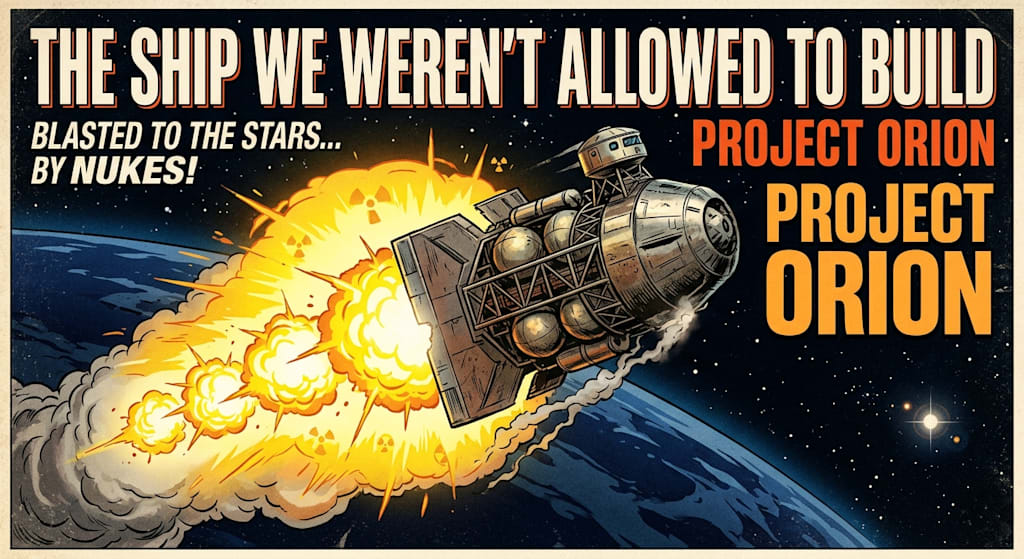
Have you ever looked up at the night sky and felt a sudden, sharp pang of vulnerability? It’s that tiny realization that everything we’ve ever known-every coffee shop, every library, every person you’ve ever loved-is sitting on one single, fragile blue marble. We’re essentially cosmic sitting ducks. If a big enough rock decides to pay us a visit, or if we finally lose our collective minds and press the "big red buttons," that’s it. Game over.
But what if I told you that back in the late 1950s, we actually figured out a way to get off this rock? And not just "hop to the moon" off, but "reach the stars in a single lifetime" off. It was a project so bold, so powerful, and—let’s be honest-so absolutely unhinged that it remains the greatest "what if" in the history of science.
This is the story of Project Orion.
The Math of Getting Nowhere
To understand why Orion was such a big deal, you have to understand why modern rockets kind of... suck.
The physics of space travel is governed by something called the Tsiolkovsky rocket equation. It sounds fancy, but the reality is depressing: about 90% of a rocket sitting on a launchpad is just fuel. You need fuel to lift the fuel, which means you need a bigger rocket, which needs more fuel. It’s a vicious, heavy loop. When Apollo 11 went to the moon, only about 4% of its mass actually made it there as payload.
In the late 1940s, a mathematician named Stanislav Ulam-one of the guys who helped build the atomic bomb-had a thought that probably would have gotten anyone else laughed out of the room. He asked: What if we stop burning chemicals and start riding explosions instead?
Riding the Shockwave
The concept behind Project Orion was called "Nuclear Pulse Propulsion." It sounds like something out of a pulp sci-fi novel, and it worked exactly like it sounds.
Imagine a massive spaceship with a giant, heavy-duty metal plate on the bottom (the "pusher plate"). To move, the ship would literally toss a small nuclear bomb out the back. The bomb would detonate about 25 meters behind the plate, hitting it with a high-velocity jet of plasma. A series of massive shock absorbers would smooth out the kick, turning a violent nuclear blast into a steady push.
Then, you do it again. And again. Every few seconds.
It sounds insane, right? Blasting your way to Mars on a trail of nukes? But here’s the kicker: the math checked out. Unlike chemical rockets, which get harder to build the bigger they are, Orion loved scale. The bigger the ship, the more efficient it became.
The Ship That Could Have Been
By the late 50s, General Atomics was running classified studies on this. They weren't just thinking about small probes; they were dreaming of 8-million-ton behemoths the size of small cities.
We’re talking about a ship that could carry thousands of tons of cargo. For context, the Saturn V rocket (the one that took us to the moon) cost about $25 billion to develop. Scientists estimated an Orion mission to Mars-carrying eight astronauts on a 125-day round trip-would have cost about $1.5 billion.
But it wasn’t just about the cost. It was the speed. Orion designs were theorized to reach up to 5% of the speed of light. At that pace, we could reach Alpha Centauri, our nearest neighbor, in about 80 to 90 years. That’s a single human lifespan. We could have been an interstellar species before the internet was even a thing.
So, Why Aren't We There?
You’ve probably already guessed the "catch." It’s the radiation.
While the physics worked and the engineering was surprisingly solid (they even tested small-scale models using TNT), the "suits" in Washington couldn't get past the optics. And can you blame them? If an Orion rocket failed during launch, you wouldn't just have a fireball on a launchpad; you’d have a radioactive catastrophe. If it blew up in the upper atmosphere, you’d be raining fallout across half the globe.
Then came the 1963 Partial Test Ban Treaty, which made detonating nukes in the atmosphere or space illegal. Just like that, Project Orion was dead in the water.
A Reflective Pause
It’s a bit of a "sliding doors" moment for humanity, isn't it?
Today, we look at Mars missions as this incredibly difficult, decades-long hurdle. We use ion drives and solar sailstechnologies that are "safer" and "cleaner" but lack that raw, thumping power Orion offered. We chose the safer path, the chemical path, the slow path.
And honestly? Maybe that’s for the best. We’re a species that still fights over borders and resources; perhaps we weren't ready to have "nuclear city-ships" floating over our heads.
But I can’t help but wonder. Somewhere in an alternate timeline, is there a version of us that didn't let fear or politics stop them? Are they looking back at Earth from a colony in another star system, wondering why we stayed behind?
It’s a fascinating footnote in our history-a reminder that we have the brilliance to reach the stars, even if we don't always have the nerve to light the fuse.
What do you think? If we could guarantee the safety of the launch, would you be okay with a "nuclear-powered" future for space travel, or is the risk just too high for the reward?
About the Creator
KWAO LEARNER WINFRED
History is my passion. Ever since I was a child, I've been fascinated by the stories of the past. I eagerly soaked up tales of ancient civilizations, heroic adventures.
https://waynefredlearner47.wixsite.com/my-site-3
Enjoyed the story? Support the Creator.
Subscribe for free to receive all their stories in your feed.
Comments
There are no comments for this story
Be the first to respond and start the conversation.