
The Grocery Aisle Time Forgot
Sentimental Saturday Edition

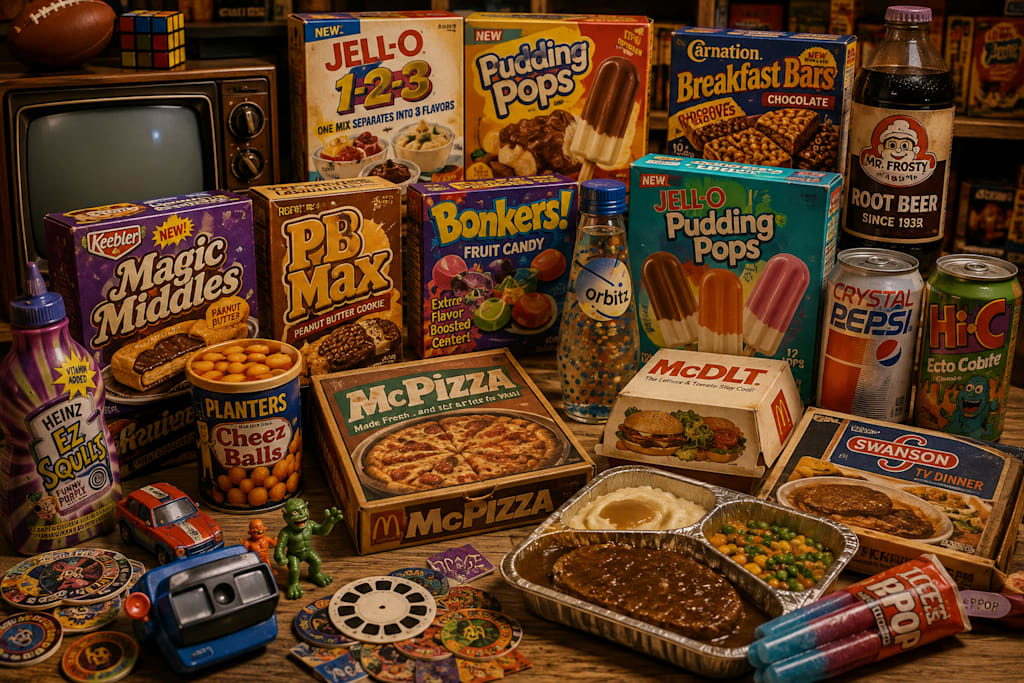
Walk into any supermarket today and you'll find an astonishing variety of food... entire aisles devoted to energy drinks, protein bars, gourmet chips, organic snacks, frozen meals from every corner of the world, and enough breakfast cereals to keep a family busy for years. Yet, somewhere between the almond milk and the artisan crackers, something quietly disappeared: entire foods. Not just recipes passed down through generations or restaurants that closed their doors, but products that once filled millions of shopping carts and then simply vanished.
For many Americans who grew up during the 1970s, 1980s, and 1990s, a trip to the grocery store wasn't just an errand; it was an adventure! The cereal aisle promised hidden prizes, the frozen food section offered futuristic dinners served in aluminum trays, and the checkout lane tempted children with candy bars that seemed destined to last forever. Only, they didn’t.
Some disappeared because tastes changed, some because companies merged, and others simply failed to sell enough to justify another production run. Together, they created a strange museum of edible Americana. A collection of foods that now survive mostly in old television commercials, faded advertisements, and childhood memories.
Perhaps no vanished snack inspires more nostalgic sighs than Keebler Magic Middles. At first glance, they looked like ordinary shortbread cookies, but inside was a creamy chocolate or peanut butter filling that felt impossibly luxurious to a child. For years, they occupied lunchboxes and cookie jars across America before quietly disappearing from store shelves, and to this day, devoted fans still search for something that tastes quite the same.
Then there was PB Max: a thick layer of peanut butter resting on a crunchy whole-grain cookie, all wrapped in rich milk chocolate. Introduced in the late 1980s, it quickly developed a loyal following. Ironically, the candy wasn’t discontinued because people stopped buying it; the story most often repeated is that the Mars family simply wasn’t fond of peanut butter and chose not to continue the product despite its success. Whether that decision still frustrates candy lovers decades later depends entirely on whom you ask.
The candy aisle claimed plenty of other casualties, too. Who remembers Bonkers!? These fruit-flavored candies looked harmless enough until the first bite released an explosion of fruity filling. Television commercials treated them like tiny edible fireworks, and children couldn’t get enough. Then, almost as quickly as they had arrived, they were gone.
Breakfast offered its own forgotten treasures. Long before protein shakes became fashionable, Carnation Breakfast Bars promised busy families a quick morning meal wrapped in foil—chocolate, peanut butter, oatmeal. Marketed as a practical solution for rushed mornings, they became a familiar sight in countless pantries before quietly fading into history.
Even desserts had their golden age. There was something magical about hearing the ice cream truck while holding a Jell-O Pudding Pop! Creamy, smooth, and available in several flavors, they became one of the defining frozen treats of the 1980s. Freezers everywhere seemed to contain at least one box during the summer months, and today, they remain one of the most requested discontinued desserts in America.
Then came the beverages. If there was ever a drink that perfectly captured the experimental spirit of the 1990s, it was Orbitz. Calling it a soda hardly does it justice... suspended inside the clear bottle floated dozens of colorful gelatin spheres that appeared to hover in midair, making it look less like a beverage and more like something discovered aboard a spaceship. Some people loved it, many simply stared at it, but almost everyone remembers it.
Fast food restaurants weren’t immune to disappearing acts, either. Perhaps no sandwich better represents its era than the McDLT. Introduced by McDonald’s in the 1980s, its unusual packaging separated the hot hamburger from the cool lettuce and tomato until the customer combined them. The slogan proudly proclaimed: "The hot stays hot... and the cool stays cool." The engineering was impressive, but unfortunately, the oversized foam container became increasingly unpopular as environmental concerns grew. The sandwich quietly disappeared, leaving behind one of the most memorable advertising campaigns of the decade.
Then there was McPizza. Yes, McDonald's once seriously attempted to compete with pizza restaurants. Restaurants installed specialized ovens, menus expanded, and families waited far longer than typical fast-food customers expected. The pizzas developed devoted fans, but the experiment struggled to fit McDonald's promise of speed. Eventually, the ovens cooled, and McPizza joined the ever-growing list of foods that became legends precisely because they disappeared.
Some products simply reflected their era. Take Heinz EZ Squirt Ketchup... bright green, purple, and blue condiments that delighted children who loved squeezing colorful ketchup onto french fries, while parents wondered what exactly had happened to America’s most familiar condiment. It was playful, strange, and unmistakably early 2000s... until, eventually, traditional red reclaimed its throne.
Looking back, one begins to notice a pattern: these foods weren’t merely things people ate; they became woven into everyday life. They were part of lunchboxes, birthday parties, Little League games, Saturday morning cartoons, family road trips, and sleepovers. The taste itself mattered, of course, but what mattered even more was when we tasted it. A cookie isn’t simply a cookie when it reminds you of your grandmother’s pantry. A soft drink isn’t merely carbonated sugar when it brings back memories of riding your bicycle on a hot July afternoon. Food has an extraordinary ability to preserve moments, sometimes better than photographs, sometimes better than words.
And before we leave this forgotten supermarket, we should pause to recognize one particularly curious phenomenon: not every discontinued food stayed discontinued. Some refused to remain dead. Every few years, something remarkable happens. A forgotten trademark changes hands, a recipe is rediscovered, or a company decides nostalgia is worth another chance. Suddenly, shoppers walking through an ordinary grocery store stop in their tracks: "Wait... I know that logo. I haven’t seen that since I was ten." Welcome to what might be called the Zombie Foods. These are the snacks and drinks that somehow clawed their way back from extinction: Dunkaroos returned after years away, Crystal Pepsi periodically rises for limited appearances, and specialty soda companies have resurrected beloved regional brands once thought lost forever. Some products emerge briefly before vanishing again; others find entirely new generations of fans. History, it turns out, occasionally grants second chances.
Still, most foods never receive such a dramatic resurrection. Most quietly fade away—their commercials disappear from television, their boxes vanish from grocery shelves, and their recipes become little more than memories shared between friends who suddenly exclaim, "Do you remember those?" That simple question may be the greatest tribute any forgotten food could hope to receive.
Because the grocery store has always reflected America. Its shelves change as technology advances, tastes evolve, science improves, and families discover new favorites. Each generation fills its shopping cart a little differently than the one before it.
Yet every so often, someone will mention Magic Middles, or PB Max, or Bonkers!, or Pudding Pops, and for just a moment, the years seem to melt away. You’re standing beside your parents once again, the shopping cart squeaks across the grocery store floor, fluorescent lights hum overhead, and you’re hoping they’ll say yes to one special treat. For a little while, the grocery aisle becomes a time machine.
History is often found in grand monuments, famous speeches, and remarkable inventions. Sometimes, however, it hides inside a cookie wrapper, a cereal box, or a bottle of soda that disappeared decades ago. The products may be gone, and the companies may have moved on, but the memories remain as fresh as ever. And perhaps that's the sweetest thing they ever left behind...
About the Creator
The Iron Lighthouse
Where folklore meets freeway. A guide to the strange heart of the American backroads...
Enjoyed the story? Support the Creator.
Subscribe for free to receive all their stories in your feed.
Comments
There are no comments for this story
Be the first to respond and start the conversation.