
The Forgotten Italian Mausoleum in Milovice
Most Czechs associate Milovice with Soviet troops or military training grounds. Yet deep in the woods on the edge of the town lies the largest Italian military cemetery in Central Europe — a place almost nobody in the Czech Republic knows about.
When people hear the word Milovice today, most immediately think of the huge children’s amusement park and the summer music festivals held outdoors.
Or perhaps the abandoned Boží Dar military airfield, or the nostalgic, slightly gloomy memories of the forced presence of Soviet occupying troops after August 1968.
This town in Central Bohemia is literally filled with the military history of the twentieth century.
But when you leave the noisy centre, drive past the crumbling apartment blocks once occupied by Soviet officers and turn onto an unremarkable forest road on the edge of town, you suddenly find yourself in a completely different world.
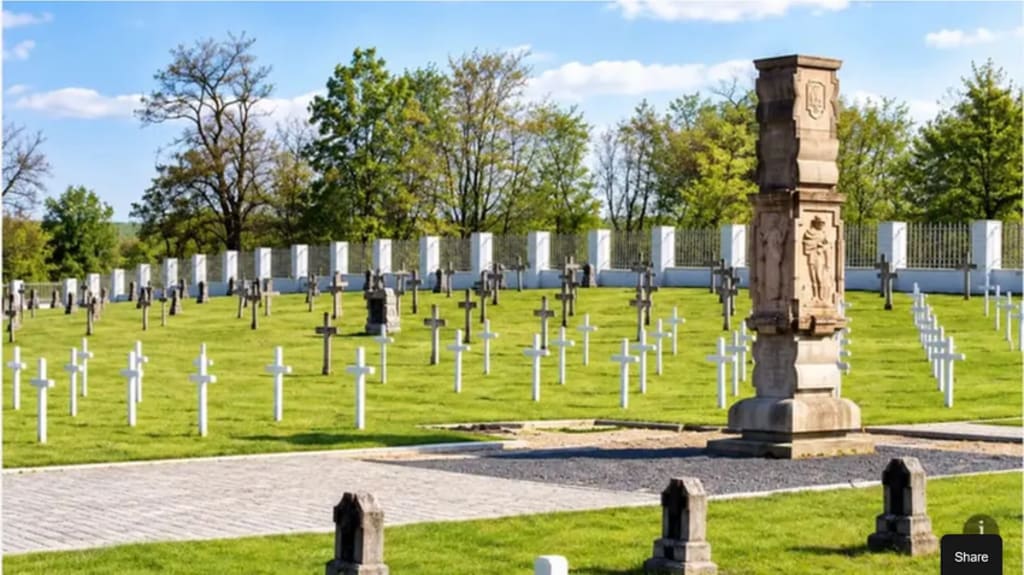
You enter a place that officially belongs to the Italian Republic, where beneath the perfectly kept grass and the shadows of tall pine trees, almost six thousand young men lie in eternal rest. They came here to die from the sunny shores of Sicily, Naples and Tuscany. The Italian military cemetery in Milovice is a haunting, monumental and almost completely overlooked reminder of the First World War in the Czech Republic.
The roots of this tragedy reach back to the autumn of 1917, when the legendary Battle of Caporetto (today’s Kobarid) took place on the Italian Front. The Austro-Hungarian and German armies launched a devastating attack that completely broke through the Italian lines and captured hundreds of thousands of Italian soldiers.
The Austro-Hungarian military bureaucracy was suddenly faced with a huge problem: where could all these enemy prisoners be housed? One of the places chosen was Milovice, where a large military training ground and shooting range had already been operating since 1904.
Within just a few weeks, a gigantic barracks town for prisoners had appeared in the fields — the Kriegsgefangenenlager Milowitz. But living conditions in the camp were catastrophic from the very beginning.
The young Italians, accustomed to the warm Mediterranean climate, were quickly forced into temporary wooden barracks with almost no heating, insulation or warm clothing.
When the harsh Central European winter arrived in late 1917 and early 1918, the camp became a factory for death. Food shortages caused by the total collapse of the Austro-Hungarian war economy meant that prisoners were given little more than soup made from rotten turnips and a small piece of watered-down bread.
Weakened by hunger and malnutrition, the Italians had almost no chance of surviving the freezing temperatures. In the overcrowded barracks, epidemics of typhus and pulmonary tuberculosis spread rapidly. The death rate reached horrifying levels — between fifty and seventy young men died every day.
Austrian soldiers could not dig graves quickly enough. The bodies of dead prisoners were taken without ceremony to the edge of the military grounds, where they were buried in enormous mass graves in the forest. By the end of the war in November 1918, exactly 5,170 Italians had died here, along with several hundred Russians and Serbs.
After the creation of independent Czechoslovakia in 1918, the state took over the administration of the cemetery. But a major change came in the 1920s. The Italian government under Benito Mussolini began building a powerful cult around the soldiers who had died in the First World War.
The Italian state officially purchased the land in Milovice and transformed it into a sacred, autonomous territory. Italian architects completely redesigned the site, following the style of Mediterranean military cemeteries. The mass graves were levelled, perfectly trimmed grass was planted over them and thousands of symmetrical stone crosses were erected.
In the centre of the cemetery, Rome had a monumental white marble chapel built, together with an ossuary where the remains of Italian officers were placed.
But with the arrival of the Second World War and the post-war division of Europe by the Iron Curtain, the site gradually disappeared from public awareness in Czechoslovakia.
To the communist regime, the Italian soldiers were imperialist foreigners. And after 1968, the surrounding forest became part of a strictly guarded Soviet military zone where ordinary citizens were not allowed to enter.
Today, the legal situation has been resolved, the cemetery is carefully maintained and Italian embassy and military delegations regularly visit the site. For them, Milovice is a sacred place of remembrance, comparable to the famous battlefields along the Piave River.
Yet for the ordinary Czech public, tourists and even many residents of Milovice itself, this enormous mass grave in the forest remains almost completely unknown.
While politicians and television crews regularly visit places such as Lety u Písku or Terezín, the quiet pine forest of Milovice receives hardly any visitors.
Thousands of young men who left their families and dreams behind in Italy continue to rest beneath the Czech moss, in almost complete isolation and forgotten by the world.
The story of the forgotten Milovice mausoleum still carries a deep moral, historical and personal lesson more than a century later. It shows us just how cruel and blind the machinery of war can be — tearing ordinary people away from their homes and sending them to die on the other side of Europe for the interests of those in power.
Those young Italians had committed no crime. They were conscripts who simply had to obey orders.
Did you know that Milovice is home to the largest Italian military cemetery in Central Europe, where almost 6,000 victims of the First World War are buried? Or did you know the town only for its connection with the Soviet army and music festivals?
Do you think international sites of remembrance like this should be promoted more and included in Czech history textbooks? Share your thoughts in the comments below!
Sources
Military History Institute Prague / VHÚ — Historical research on the prisoner-of-war camp in Milovice between 1914–1918 and the Italian prisoners captured after the Battle of Caporetto:
vhu.czCzech Radio Plus — Documentary radio programme about the construction of the Italian military cemetery in Milovice during the 1920s and how the site survived the Soviet occupation:
rozhlas.czMinistry of Defence of the Czech Republic / Department for War Veterans — Official records of war graves and international agreements between the Czech Republic and Italy concerning the administration of the memorial site in Milovice:
army.milEmbassy of Italy in Prague — Digital archive and historical sources concerning the construction of the marble chapel and records of annual commemorative ceremonies:
esteri.it
I am sorry for my imperfect English. I am still learning it and trying to improve with every article. Thank you for reading and for your patience. ❤️
About the Creator
Enjoyed the story? Support the Creator.
Subscribe for free to receive all their stories in your feed.
Comments
There are no comments for this story
Be the first to respond and start the conversation.