
The Empire of Copies: The Lost World of Xerox-Lore
The world of memes, before the internet!

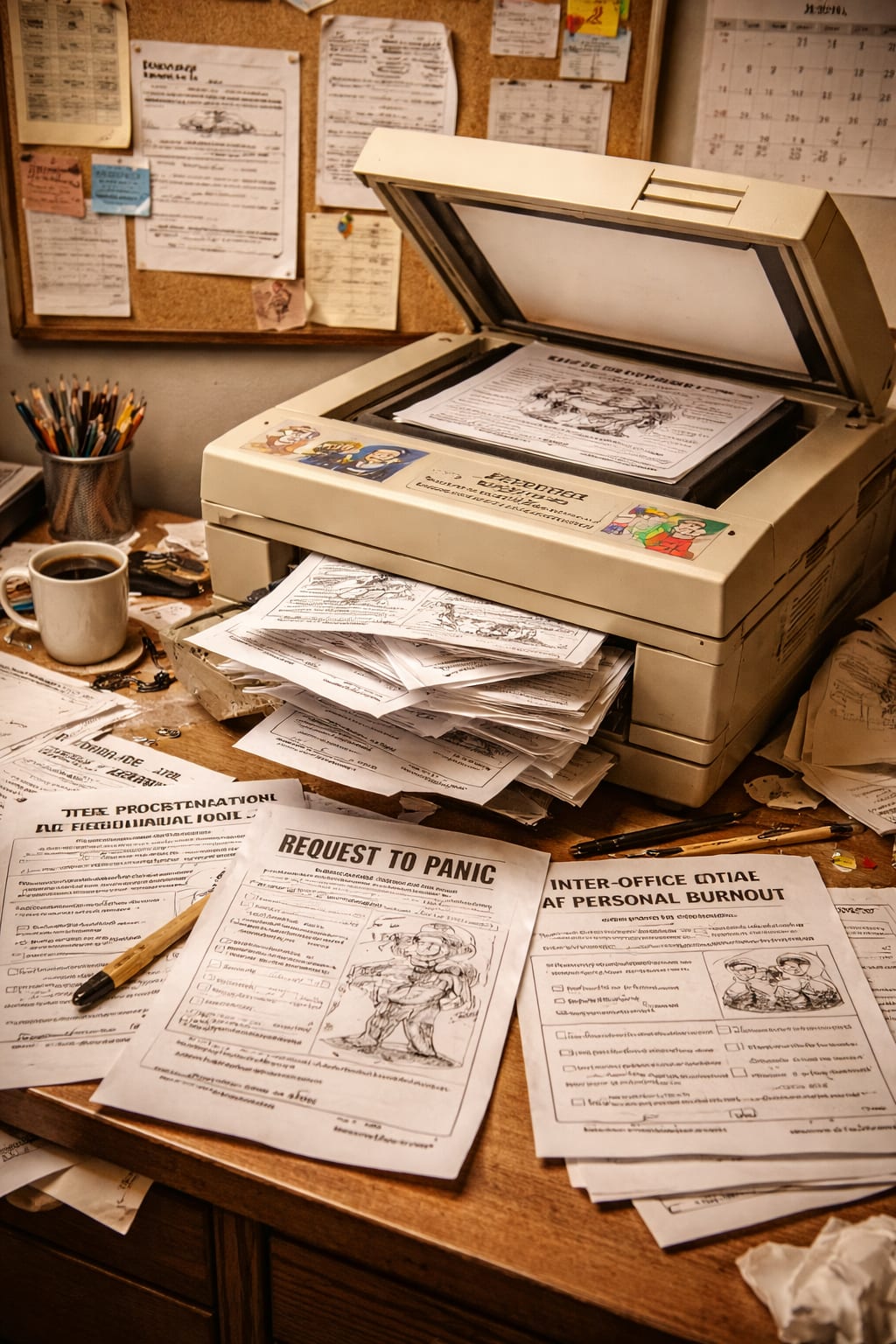
Long before the internet connected the world with invisible threads of information, before memes traveled at the speed of a click and humor could circle the globe in seconds, there existed another network... quieter, slower, but no less powerful. It didn’t rely on servers or satellites. It didn’t need algorithms or platforms. It ran on paper and toner, with the low mechanical hum of a photocopier tucked away in the corner of an office.
It was an empire built not of code, but of copies. And for a few decades, it thrived in the margins of American work life, passed from desk to desk, cubicle to cubicle, department to department, forming a hidden culture that most people experienced, but almost no one thought to preserve. They called it, though not always out loud, something like Xerox-lore.
The Machine That Changed Everything
The story begins, as many modern revolutions do, with a machine that seemed, at first, entirely practical. When companies like Xerox introduced reliable office copiers in the mid-20th century, they were meant to solve a simple problem: duplicating documents. Reports could be copied quickly. Memos could be distributed widely. Information could move more efficiently through the corporate bloodstream. But something unexpected happened.
Once people realized they could copy anything, not just official documents, but drawings, jokes, oddities, the copier became more than a tool. It became a gateway. A quiet invitation to experiment.
At first, it was small. Someone copied a cartoon and left it on a colleague’s desk. Someone else reproduced a funny memo and pinned it to a bulletin board. It wasn’t organized. It wasn’t intentional. It was just… something that spread. And once it started, it didn’t stop.
The Rise of the Paper Underground
By the 1970s and 80s, offices across America had developed their own informal ecosystems of shared humor. These weren’t sanctioned by management. They weren’t part of official communication. They existed in the spaces between policy and practice, the break rooms, the copier stations, the corkboards filled with notices no one officially acknowledged.
A sheet of paper might appear one morning, left casually near the copier. A cartoon, perhaps. A mock form. A piece of absurd bureaucracy taken just far enough to make someone laugh out loud before quickly checking if anyone else had noticed.
By the end of the day, that same sheet might exist in a dozen copies. By the end of the week, it might have traveled to another department. By the end of the month, it might be in another building entirely. No one tracked it. No one measured its reach. But it moved. Quietly. Persistently. Like a rumor with a sense of humor.
The Language of Absurdity
What made Xerox-lore so distinctive wasn’t just the act of copying; it was the content itself. These weren’t polished jokes. They weren’t professionally designed cartoons. They were raw, immediate, and often deeply specific to the experience of working in an office environment.
There were fake forms that mimicked the rigid structure of corporate paperwork but twisted it into something ridiculous:
- “Request for Permission to Panic”
- “Official Notice of Temporary Sanity Loss”
- “Bureaucratic Delay Justification Sheet”
There were cartoons that captured the quiet frustrations of office life. Endless meetings, unclear directives, the slow creep of monotony under fluorescent lights. Long before Dilbert would give corporate frustration a recognizable face, these anonymous creators were already sketching their own versions, often with a roughness that made them feel more immediate, more personal. And then there were the memos... Oh, the memos.
Written in the stiff, formal language of corporate communication, they would begin with all the seriousness of an official directive before unraveling into something completely absurd. A notice about “mandatory enthusiasm training.” A reminder to “schedule your existential crisis during approved hours.” A policy update regarding “unauthorized joy in the workplace.”
They worked because they felt real, just real enough to mirror the tone of actual office communication, but exaggerated just enough to expose its underlying strangeness.
Humor as Survival
To understand why Xerox-lore spread so effectively, you have to understand the environment in which it lived. The modern office, particularly in the late 20th century, was a place of structure. Hierarchies were clear. Roles were defined. Communication flowed in predictable directions. And while this structure made large organizations possible, it also created a kind of emotional distance. A sense that individuals were small parts of a much larger machine. Within that environment, humor became something more than entertainment.
It became a coping mechanism. A way to reclaim a sense of individuality. A way to acknowledge, quietly and collectively, that everyone else saw the same absurdities you did.
When someone found a photocopied joke that perfectly captured the frustration of a pointless meeting or the confusion of contradictory instructions, it created a moment of connection. A silent agreement that said: “It’s not just me.” And in a system that often felt impersonal, that kind of connection mattered.
The Network Without Wires
What’s remarkable about Xerox-lore is how closely it resembles the digital culture that would come later. There were no usernames. No profiles. No timestamps. And yet, the behavior was strikingly similar to what we now recognize as meme culture.
Content was:
- shared
- modified
- redistributed
- sometimes improved
- sometimes degraded
A cartoon might be copied, then annotated by someone else, then copied again with additional notes, evolving as it moved through the office like a game of visual telephone. No one owned it. No one controlled it. And yet, it persisted. It was, in every meaningful sense, a network. Just one made of paper instead of pixels.
The Slow Disappearance
Like many things that exist just beneath the surface, Xerox-lore didn’t end with a dramatic collapse. It faded. The rise of email in the 1990s changed everything. Suddenly, jokes could be sent instantly. No need to stand by a copier. No need to physically pass a sheet of paper from one person to another. The network sped up. And in speeding up, it changed.
Then came the internet. Then social media. Then the modern meme ecosystem, where content travels faster than thought and disappears just as quickly. In that new world, Xerox-lore felt slow and obsolete. And so it quietly slipped away...
The Things We Didn’t Save
One of the strangest aspects of Xerox-lore is how little of it remains. Because it was never meant to last. These weren’t archived documents. They weren’t preserved intentionally. They were passed around, laughed at, and eventually thrown away. Entire chains of humor, entire shared experiences, existed for a moment and then vanished.
What we’re left with are fragments. Occasional examples that survived by accident. Faint echoes of something that was once everywhere. It’s a reminder that not all culture, leaves a permanent record. Some of it exists only in memory.
The Lighthouse Reflection
There’s something quietly beautiful about Xerox-lore. Not because it was elaborate or groundbreaking, but because it was human. It was people, in structured environments, finding small ways to express themselves. To connect. To laugh. To push back, gently, against systems that didn’t always make sense.
Long before the internet gave everyone a platform, office workers had already figured out how to create one. They built it out of paper. They powered it with humor. And they sustained it through nothing more than the simple act of sharing something that made them smile.
It didn’t last. But for a time, it worked. And maybe that’s enough. Because somewhere, in the hum of an old copier and the shuffle of a freshly printed page, an entire culture once existed... quiet, fleeting, and just rebellious enough to matter.
About the Creator
The Iron Lighthouse
Where folklore meets freeway. A guide to the strange heart of the American backroads...
Enjoyed the story? Support the Creator.
Subscribe for free to receive all their stories in your feed.
Comments
There are no comments for this story
Be the first to respond and start the conversation.