
The Cyclists Who Paved the Way for America's Cars
Iron Lighthouse | Forgotten Americana

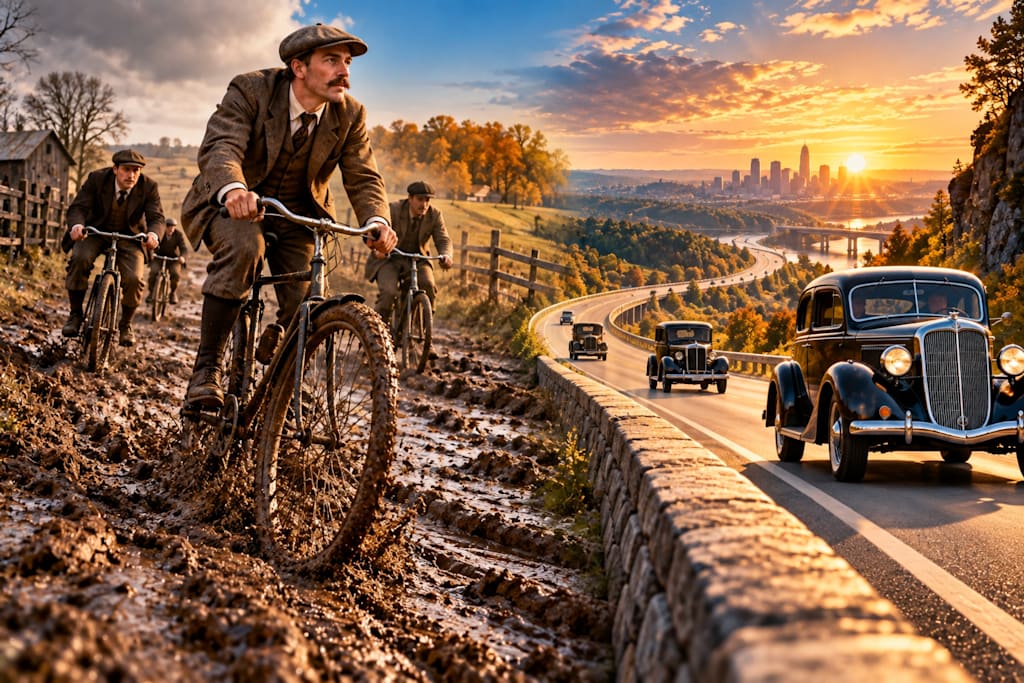
Imagine purchasing the finest bicycle money could buy in 1895. It's a beautiful machine... gleaming metal, pneumatic tires, a comfortable saddle. You’ve joined a cycling club, acquired a handsome riding outfit, and informed your family that you intend to spend Sunday exploring the countryside.
The weather is perfect. The birds are singing. The open road beckons. You pedal out of town, turn onto a country lane, and discover that the road is approximately forty percent mud, thirty percent wagon ruts, and thirty percent personal insult. Your magnificent new bicycle sinks into the earth. Your Sunday adventure has become an agricultural excavation. And somewhere in the distance, a horse appears to be laughing at you.
For thousands of American cyclists in the late nineteenth century, this was not merely an unfortunate afternoon. It was a transportation problem demanding national attention. And their determination to solve it helped change the American landscape forever.
Today, we associate highways with automobiles. The image is practically inseparable: long stretches of pavement, roadside diners, filling stations, traffic jams, and families arguing over whether Dad missed the exit. But before the automobile became America's dominant personal vehicle, bicyclists were among the country’s most energetic advocates for better roads. Their campaigns helped establish the institutions and public expectations that would eventually support the automobile age.
The irony is delicious. The bicycle helped prepare America for the car. And the car eventually took over much of the road.
The story begins in the 1880s and 1890s, when a new kind of bicycle transformed cycling from a daring athletic spectacle into practical personal transportation. Earlier high-wheel bicycles had been impressive machines, provided you enjoyed sitting several feet above the ground while contemplating the consequences of hitting a rock. The newer safety bicycle, with two similarly sized wheels and a chain-driven rear wheel, was far more approachable. Improvements such as pneumatic tires made riding more comfortable, and cycling became a fashionable pursuit among adults.
Bicycle clubs flourished. Riders organized excursions, races, and social events. The bicycle offered something thrilling: the ability to travel beyond one's neighborhood without depending on a horse, a train timetable, or somebody else's permission.
For women, cycling also became associated with greater independence and changing ideas about clothing and public life, although the cost of bicycles and social barriers limited who could join the craze. The bicycle promised freedom. Unfortunately, freedom still needed somewhere to ride.
Outside many American cities, roads were dreadful. Rain transformed dirt routes into mud. Dry weather produced dust and hardened ruts. Poor drainage could make travel miserable for cyclists, wagon drivers, and farmers alike. A horse could negotiate terrain that brought a bicycle to a humiliating stop. The cyclist, meanwhile, had paid good money for a vehicle that worked beautifully—until it encountered America.
So the riders organized. The League of American Wheelmen, founded in 1880, became a major force behind the Good Roads movement. Its members wanted routes that were smoother, better drained, and reliably maintained.
They also understood that asking the country to improve its roads solely for recreational cyclists might not win over every taxpayer, especially the farmer standing beside a wagon with one wheel buried in mud.
So bicycle advocates made a broader argument. Better roads would help farmers bring produce to market. They would improve commerce, connect communities, and make everyday travel easier for everyone.
The movement wasn't simply demanding that every country lane be paved. Road improvement involved practical questions about grading, drainage, construction materials, maintenance, and who should pay for the work.
The League distributed approximately five million pamphlets promoting better roads. Its members lobbied lawmakers, organized campaigns, and helped turn a common frustration into a public issue.
Five million pamphlets. Imagine the determination required to convince an entire country that its roads needed fixing when your primary mode of transportation was a bicycle.
Today, someone might post a complaint online. In the 1890s, you joined a club, organized a campaign, printed a mountain of literature, and rode to the next town to explain why its roads were terrible. Provided you could reach the next town.
The movement began producing results. In 1893, Congress authorized the federal government to investigate road management and construction methods. The Department of Agriculture established the Office of Road Inquiry with a $10,000 budget. It wasn't a national highway construction program. Its initial mission centered on gathering and sharing information about better road-building practices. But it was an important institutional beginning.
Through several reorganizations, the Office of Road Inquiry eventually evolved into today’s Federal Highway Administration.
Think about that… One ancestor of the federal agency associated with America’s highway system emerged during an era when organized cyclists pressed the government to take roads seriously. Not because they wanted to build an interstate for a family station wagon. Because they wanted to ride their bicycles without becoming permanently incorporated into the county’s topsoil. And then, in Southern California, someone took the idea of bicycle transportation to a spectacular new level.
Pasadena businessman Horace Dobbins envisioned a dedicated elevated route for cyclists, running toward Los Angeles. Not a painted lane squeezed between wagons. Not a narrow trail beside a muddy road. An elevated wooden cycleway, designed to give riders a smooth journey above some of the obstacles below.
On New Year’s Day in 1900, the first approximately 1.3-mile section of the California Cycleway opened between Pasadena and South Pasadena. Riders paid a toll to use it. They planned a much longer route toward Los Angeles, but never completed it.
Brother, imagine the sight. Cyclists gliding along an elevated wooden roadway while the ordinary traffic of the day moved below. At the dawn of the twentieth century, someone had looked at the bicycle and thought: This thing needs its own expressway.
The project was ambitious, expensive, and ultimately unsuccessful as a business. Its short completed section couldn’t attract enough paying riders to sustain the grander vision. But it offered a fascinating glimpse of a future that might have developed differently. America was experimenting with what personal transportation could become.
Then another machine began attracting attention: the automobile. Early cars were expensive, mechanically temperamental, and hardly guaranteed to outperform a bicycle on the country’s worst roads. But technology improved. Automobile ownership grew. Motorists began demanding reliable routes of their own.
And the road-improvement movement already had momentum. Cyclists had helped organize public support, promote legislation, and establish the idea that better roads were a shared economic necessity. Automobile advocates, farmers, commercial interests, and government agencies would carry that work much further.
The Smithsonian notes that some roads improved for bicycles in the 1890s were subsequently damaged by automobile traffic. As cars and trucks multiplied, their greater weight and growing numbers created demands for more extensive road construction.
Imagine being an elderly cyclist watching the transformation. You spent years campaigning for smoother roads. You wrote letters. You attended meetings. You helped persuade your neighbors that better roads would benefit the entire community. At last, improvements arrived. And now a fellow in an automobile is bouncing along your favorite route, kicking up dust and announcing that the future belongs to gasoline.
The bicycle hadn’t caused the automobile revolution by itself. Nor did cyclists single-handedly build the modern highway network. The enormous expansion of American road construction came later, supported by automobile demand, engineering advances, and major public investment. But the cyclists had helped establish something essential before that expansion began. They had made the condition of America’s roads a national concern.
The bicycle boom faded as the automobile captured the public imagination, yet cycling never disappeared. People continued riding for transportation, sport, and pleasure, and later generations would renew the call for streets that accommodated bicycles safely. The early Good Roads campaign reminds us that transportation history is rarely as straightforward as the vehicles we see around us.
We look at a highway and think of cars. We look at a bicycle and think of a quiet afternoon ride. But more than a century ago, American cyclists were helping change how the country thought about roads, public investment, and the freedom to travel.
They wanted to escape the mud. They wanted to reach the next town. They wanted the open road to live up to its promise. They helped persuade America to build a better one. Then the automobile arrived and transformed that road beyond anything the early cyclists could have imagined. The bicycle helped pave the way for the car.
And somewhere along that road, America forgot who started pedaling...
About the Creator
The Iron Lighthouse
Where folklore meets freeway. A guide to the strange heart of the American backroads...
Enjoyed the story? Support the Creator.
Subscribe for free to receive all their stories in your feed.
Comments
There are no comments for this story
Be the first to respond and start the conversation.