
The Barbecue That Never Left Home: Kentucky's Five-County Culinary Secret
Hidden Flavors of America - Part One of Five

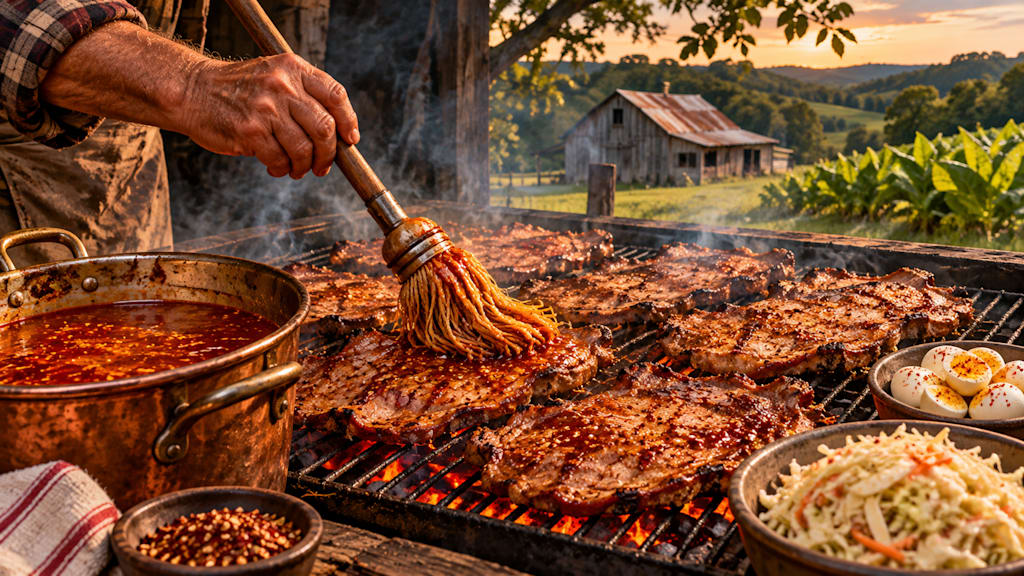
A corner of Kentucky refuses to follow the rules of barbecue. Travel south through the rolling countryside, past tobacco fields, small towns, and roads that seem perfectly content to take their time, and eventually you'll reach Monroe County.
Here, near the Tennessee border, something extraordinary has been happening over hickory coals for generations.
It doesn't look like the barbecue that made Kansas City famous.
It doesn't resemble Texas's enormous smoked briskets.
And it certainly doesn't involve a whole pork shoulder spending twelve hours inside a smoker. Instead, the meat arrives in thin slices, grilled over glowing embers and repeatedly introduced to a fiery mixture of vinegar, lard, butter, and pepper. Locals simply call it 'shoulder'.
Outsiders might call it one of America's most unusual barbecue traditions. And in a remarkably small region of south-central Kentucky, it has become something far more meaningful than lunch. It is a culinary inheritance.
Five Counties and a Different Kind of Barbecue
Kentucky possesses a barbecue history far more varied than its national reputation suggests.
In western Kentucky, people slowly smoke whole pork shoulders over hardwood coals. Around Owensboro, mutton barbecue and dark, Worcestershire-based sauces have become regional signatures. But travel toward the southern border, and the rules change.
Across Monroe, Barren, Cumberland, Allen, and Warren counties, a distinctive preparation known as Monroe County-style barbecue has maintained its place on local menus. Its defining feature is the meat itself.
Rather than cooking an entire shoulder until it can be pulled apart, pitmasters begin with a frozen Boston butt, the upper portion of a pork shoulder. Using a meat saw, they cut it crosswise into thin, often bone-in steaks. They lay the slices across iron grates above hickory embers.
As the meat cooks, the pitmaster turns it and applies a peppery liquid known simply as dip. The ingredients sound almost suspiciously straightforward.
Vinegar.
Butter.
Lard.
Salt.
Black pepper.
Cayenne.
Yet together, they produce something quite different from the thick, sweet barbecue sauces familiar across much of the country. This dip is thin, sharp, rich, and unapologetically spicy. Some cooks brush it onto the meat during grilling, then immerse the finished steaks in the warm mixture before serving.
Customers can request different heat levels, from a light application to a generous soak. For those who find ordinary hot sauce not challenging enough, there are particularly fiery variations. The result is a remarkable combination of smoke, vinegar, pork fat, and pepper. It is barbecue with a distinctly local accent.
A History Written in Smoke
Determining exactly when Monroe County barbecue began is difficult. Unlike a patented invention, a regional cooking tradition rarely arrives with a documented birthday. It develops through families, workplaces, local businesses, and cooks who learn by watching others. But one particularly important story has survived.
In research published in 2018, barbecue writer Steven Raichlen documented Larry Ross's recollections, whose family operated a meat business in Tompkinsville. Ross remembered an African American cook named Haskell Evans preparing pork steaks for farmworkers, birthdays, and reunions during the 1950s.
According to Ross, Evans was among the earliest people he knew preparing this style of barbecue in Tompkinsville. Evans also had a family connection to another important figure in the story. He was the grandfather of Anita Hamilton Bartlett, longtime proprietor of R&S Barbecue.
Bartlett traced her family's pepper-dip recipe to her grandfather, who associated its origins with an earlier enslaved community near Cave City, Kentucky. That oral history offers an important connection to the broader African American roots of Southern barbecue.
It should not, however, be mistaken for a complete or independently verified origin story for every element of Monroe County shoulder. The dish's precise development remains uncertain. Food historian Wes Berry has suggested another possible influence.
Monroe County was agricultural country, where tobacco farming demanded long hours of physically exhausting labor. Thin pork-shoulder steaks could cook much faster than whole shoulders, providing a substantial meal for hungry workers without requiring an entire day at the pit. It is a plausible explanation, although not a proven account of the dish's invention.
What we can say is that local cooks, farming communities, and generations of practical knowledge helped shape a tradition that became unmistakably their own.
The People Who Kept the Fires Burning
A recipe can be written on paper. A cooking tradition requires people. In Tompkinsville, Monroe County barbecue history is closely tied to family-run establishments and the people who spent years tending their pits.
One influential business was Tooley's Barbecue, associated with Alex Erwin Tooley and his family. Anita Hamilton Bartlett learned to prepare shoulder steaks while working with Tooley, then eventually took over the business, which became R&S Barbecue.
Elsewhere in town, another barbecue lineage developed through Paul and Nora Ford, who opened a modest restaurant in 1965. Their family business later became associated with Backyard BBQ. These establishments helped preserve more than a particular menu.
They maintained the skills involved in controlling a hickory fire, cutting and grilling thin shoulder steaks, and preparing a dip whose flavor could vary subtly from one kitchen to another. Even the butcher plays an important role.
The meat must be cut correctly, often while frozen, to achieve the thin slices that distinguish this preparation. A chain of knowledge stretches from the meat shop to the firebox to the dinner table. And although the technique may appear simple, simplicity does not mean carelessness.
Too much heat can dry the meat. Too little attention can produce uneven cooking. The dip must balance richness, acidity, and heat. A good plate of shoulder represents years of practiced judgment.
More Than a Meal
The traditional accompaniments are as distinctive as the barbecue itself. Vinegar slaw provides a cool, sharp contrast to the rich pork. Some establishments serve hard-boiled eggs pickled in peppery vinegar dip, creating a side dish as surprising as the main attraction. But the real story extends beyond the plate.
In Monroe County, barbecue has long been associated with family gatherings, community events, and small businesses. And one recent episode illustrates how deeply those connections endure.
In 2025, a fire damaged R&S Barbecue, temporarily disrupting Anita Hamilton Bartlett's business. Another local barbecue proprietor, Apryl Dawn Stewart of Backyard BBQ, organized a fundraiser to help. Despite heavy rain, residents came forward with purchases, baked goods, donations, and encouragement. According to the William B. Harlan Memorial Library's account, the effort raised approximately $3,693.
It was a remarkable example of competitors behaving like neighbors first. And perhaps it explains something about Monroe County barbecue's survival. The tradition is not preserved merely because customers enjoy the taste. It survives because the people who prepare it belong to communities that value the work, the relationships, and the memories surrounding it.
A barbecue pit can be a business. It can also be a gathering place. And sometimes, when another family's fire goes cold, it becomes a way to help them start again.
The Flavor of Belonging
America's food history is often told through famous cities and nationally recognized dishes. But some of its most revealing stories exist in smaller places. Places where a particular meal remains closely associated with a handful of counties. Places where people learned to prepare it from parents, grandparents, neighbors, and coworkers. Places where culinary identity was built gradually, without advertising campaigns or national recognition. Monroe County barbecue belongs to that America.
Its story includes agricultural labor, African American cooking traditions, family entrepreneurship, and the practical ingenuity of people preparing meals with the ingredients and equipment at hand.
Its exact origins may never be completely reconstructed. But its continued existence is undeniable. The hickory burns. The shoulder steaks sizzle. The pepper dip waits beside the pit. And somewhere in south-central Kentucky, another plate is served in much the same spirit as those that came before it.
Not because the rest of America demanded it. Not because it became fashionable. But because generations of Kentuckians decided it was worth keeping. Sometimes the most remarkable American traditions aren't the ones that traveled everywhere. They're the ones that gave people a reason to keep coming home.
Next in Part Two: The Dinner Bell at the Edge of the Desert — Nevada's Basque boarding houses, where immigrant sheepherders found familiar food and community beneath the enormous skies of the American West.
About the Creator
The Iron Lighthouse
Where folklore meets freeway. A guide to the strange heart of the American backroads...
Enjoyed the story? Support the Creator.
Subscribe for free to receive all their stories in your feed.
Comments
There are no comments for this story
Be the first to respond and start the conversation.