
Ten thousand years of human history are preserved in the Sinai rock shelter.
Take refuge on the plateau

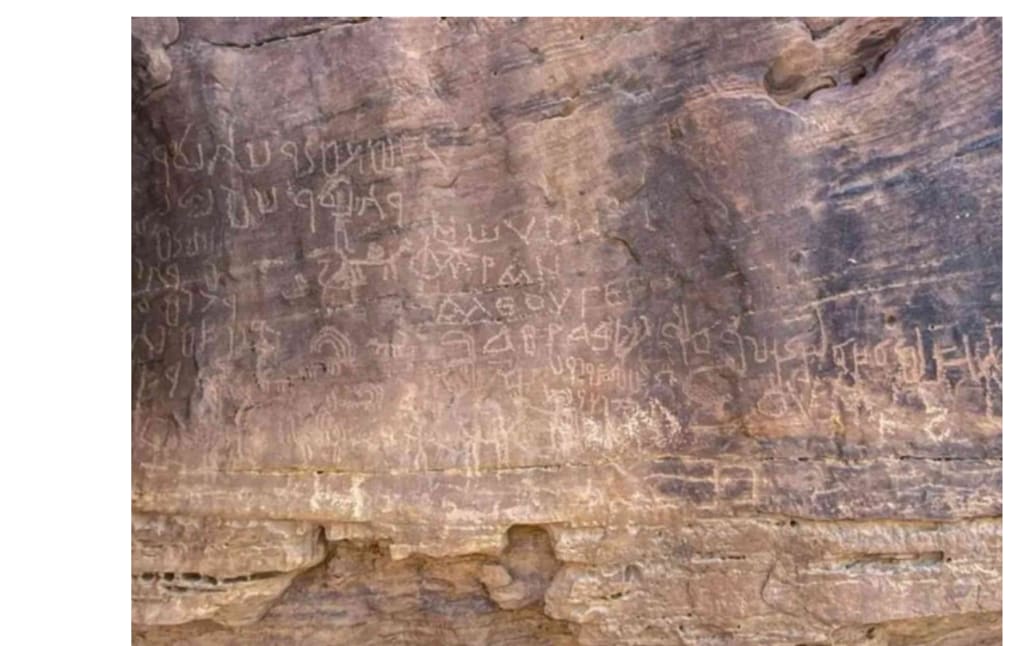
Nearly 10,000 years of human drawings, inscriptions, and everyday trash have been preserved in a single rock shelter in Egypt's Sinai Peninsula, according to research. That continuous record reveals how various tribes frequently returned to the same desert spot across millennia, compressing far-off eras into a common surface.
Take refuge on the plateau
A sandstone overhang that extends over 330 feet along the plateau's eastern edge narrows into a low, protected interior. Egypt's Supreme Council of Antiquities documented many layers of carved inscriptions, grey figures, and red paints on that ceiling.
These overlapping signs, which place widely distant eras side by side without obvious physical demarcation, range from early archaic representations to later written scripts. Before evaluating what each group left behind, it is crucial to comprehend how these layers built over time because they remain concentrated on a single surface.
Layers of history
The earliest pictures near the entryway were painted in crimson and were thought to be between 10,000 and 5,500 B.C. The shelter became a palimpsest—a surface that has been continually altered over time—when later creators added camels, horses, weaponry, and various inscriptions.
The record extends from early prehistory throughout the third century A.D. due to pottery remains that indicate Roman and Middle Kingdom visitation. The Umm Arak Plateau site in Egypt's Sinai Peninsula is extended in time by Arabic writing, demonstrating its continued appeal long after Egypt's pharaohs and Rome had vanished.
Animals on a stone
Early artists painted red animals and hunting scenes, including dogs and archers, on the ceiling at the entrance of the shelter. Early photos at the location showed activity and labour rather than official monuments, indicating that people noted common survival tasks.
Grey paintings, which were initially recorded there, show that subsequent visitors kept making their own markings. Such overlap is important because the ceiling maintains evolving conceptions of authority, animals, and everyday life.
Living things' waste
Flint tools, broken pottery, animal droppings, hearth traces, and low stone partitions were among the items that survived in the shelter in addition to portraits. Penned animals, hearth traces, and flint implements demonstrate that the shelter supported everyday life in addition to passing artists.
While some pottery dates to the Roman third century A.D., others are probably from Egypt's Middle Kingdom. Sherif Fathy, Egypt's minister of tourism and antiquities, stated, "These provide further evidence of the succession of civilisations that have inhabited this important part of Egypt over the millennia."
Close to the mines
This plateau attracted frequent tourists since Serabit el-Khadim, a historic turquoise mining and temple site, is only about three miles (4.8 km) away. Work, devotion, and travel had already traversed this terrain at that adjacent location, which was home to turquoise mines and a temple dedicated to Hathor.
The overhang serves as a gathering spot, rest stop, and viewpoint as a wide plain opens northward from the plateau. Location by itself does not establish that every visit served the same goal, but it does make recurring visits appear far less coincidental.
Sinai as a bridge between cultures
Umm Arak is a tiny version of Sinai, which has historically served as a cultural bridge connecting Africa and western Asia. Horses, camels, weaponry, and changing styles demonstrate how varied customs, technologies, and methods of
At Umm Arak, touch, reuse, and memory are preserved because one phase does not erase the next. Because of Umm Arak's lengthy sequence, archaeologists are able to interpret South Sinai as inhabited land rather than as a void between wealthier settlements.
Words come from many different ages.
While some engravings were written in Arabic, others are in Nabataean, an old script associated with nomadic peoples. Each inscription at Umm Arak identified the shelter as more than a stop because writing typically included names, prayers, or claims.
According to Arabic sources, the location was still known in the early Islamic ages and probably even later. Umm Arak sounds and visuals are provided by written layers, yet many symbols still need to be carefully examined.
Local expertise is important.
Sheikh Rabie Barakat, a native of the Serabit el-Khadim region in Egypt's Sinai Peninsula, led surveyors to the Umm Arak shelter, demonstrating the importance of local knowledge.
Research on Serabit el-Khadim has long demonstrated that Bedouin knowledge—nomadic desert groups with a profound acquaintance with the environment, including routes, names, and delicate locations—is essential to South Sinai legacy.
When South Sinai locals discover remnants that maps and quick trips frequently overlook, archaeology on the ground shifts. This also emphasises a practical aspect, since local participation in access and care will be necessary for long-term protection.
Nowadays, protection is important.
Because surfaces are gradually worn away by wind, salts, cracking, and human harm, South Sinai sandstone art does not survive by accident. The same environment can tear, fracture, and damage carved rock, according to a conservation study conducted at Wadi Nasib, a neighbouring desert valley in Egypt's Sinai Peninsula.
Visibility will aid in protection once people are aware of the Umm Arak shelter, but it can also hasten destruction. New discoveries require prompt management because of this tension, which transforms documentation from record keeping into urgent prevention.
The discovery's significance
Umm Arak is more significant as a permanent location where numerous moments refused to vanish than as a single moment. Careful research, local stewardship, and the ability of academics to publish more thorough findings without allowing the shelter to deteriorate first will determine its next usefulness.
About the Creator
Enjoyed the story? Support the Creator.
Subscribe for free to receive all their stories in your feed.
Comments
There are no comments for this story
Be the first to respond and start the conversation.