World History
The Net Worth of History’s Richest Palaces: Symbols of Power, Wealth, and Empire
This article explores the richest palaces in history, their estimated net worth, and why they were so extraordinarily valuable. 1. The Forbidden City, China – The Richest Palace in History The Forbidden City in Beijing is widely regarded as the richest palace ever built. Constructed in the early 15th century during the Ming Dynasty and expanded by the Qing emperors, it served as the imperial residence for nearly 500 years. Why it was so wealthy: Built using rare woods, marble, jade, and gold Contained over 9,000 rooms Stored priceless treasures: gold seals, jade artifacts, silk, paintings, and imperial regalia Controlled enormous lands and taxes across China Estimated Net Worth: Modern estimates place the Forbidden City’s wealth at over $70 trillion USD, making it richer than any royal palace or private fortune in human history. This staggering value reflects not just the palace itself, but the accumulated wealth of Chinese emperors, who ruled one of the largest economies the world had ever seen. 2. Qin Shi Huang’s Palace and Tomb Complex – Wealth Beyond Imagination Qin Shi Huang, the first emperor of unified China, built a palace and underground tomb complex unlike anything before or after. Legendary Wealth: Underground rivers of liquid mercury representing China’s rivers
By Say the truth 8 months ago in History
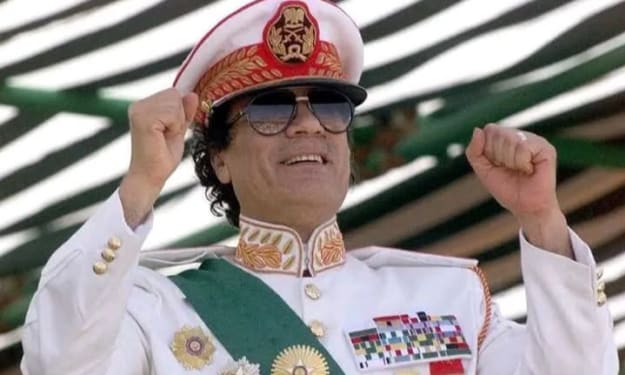
Muammar al-Qaddafi: The Desert Revolutionary Who Ruled Libya for 42 Years
Muammar al-Qaddafi was born into a Bedouin family of the small al-Qadhadhfa tribe in the harsh environment of the Libyan desert. His early years were marked by poverty and traditional nomadic life—sleeping in tents, caring for livestock, and attending a local primary school in Sabha. From a young age, Qaddafi was deeply influenced by the sweeping changes in the Arab world, especially the rise of Arab nationalism championed by Egyptian leader Gamal Abdel Nasser. This ideology, centered on unity among Arab states and resistance to colonial influence, would shape his worldview throughout his life. � Pakistan Times +1 Qaddafi continued his education, moving between schools in Misrata and Sabha and showing early signs of political activism. During his studies he organized protests supporting Arab nationalist causes, including opposition to the dissolution of the short-lived United Arab Republic between Egypt and Syria. Expelled from school at one point for his activism, he eventually enrolled in the military academy in Benghazi, where he joined a group of young officers harboring revolutionary ambitions. � Pakistan Times +1 The 1969 Coup: From Officer to Leader On September 1, 1969, at the age of just 27, Qaddafi and a small group of junior military officers executed a swift and bloodless coup that overthrew King Idris I, who had ruled the newly independent Libya since 1951. The king was abroad for medical treatment, and the coup leaders seized the moment, abolishing the monarchy and declaring Libya a republic. Qaddafi was immediately named chairman of the Revolutionary Command Council and commander-in-chief of the armed forces—positions that gave him de facto control of the country. � Encyclopedia Britannica Once in power, Qaddafi moved quickly to assert Libya’s independence from Western influence. He ordered the removal of U.S. and British military bases from Libya and nationalized the country’s oil industry, which was dominated by foreign companies. He also expelled many Italians and Jews from Libya, echoing his brand of strict Islamic principles and fierce opposition to colonial legacy. � Encyclopedia Britannica Domestic Policies and The Green Book Qaddafi sought to reshape Libya’s society through a blend of Islamic socialism and revolutionary populism. In 1973 he published his influential manifesto, The Green Book, outlining his ideas of direct democracy, economic redistribution, and rejection of traditional political parties and institutions. According to Qaddafi, power should reside in people’s committees and popular congresses rather than centralized state structures. � Encyclopedia Britannica In practice, these reforms were a mixture of radical inclusivity and strict authoritarian control. Healthcare and education were made widely accessible, and Libya’s vast oil revenues funded ambitious development projects. But political dissent was ruthlessly suppressed, freedom of speech was virtually nonexistent, and secret police kept tight control over public life. While some Libyans benefited from state welfare, many others lived in fear of arbitrary detention and persecution. � Encyclopedia Britannica International Relations and Global Controversies Qaddafi’s ambitions were not confined to Libya. He positioned himself as a voice of anti-imperialism, supporting revolutionary movements and opposition groups across the globe, from the Irish Republican Army in Europe to radical organizations in the United States. These policies often brought Libya into direct conflict with Western powers. In 1986, U.S. aircraft bombed Qaddafi’s compound in Tripoli in retaliation for Libya’s alleged involvement in terrorist activities, killing several of his family members. � Encyclopedia Britannica Perhaps the most notorious international incident linked to Qaddafi was the bombing of Pan Am Flight 103 over Lockerbie, Scotland, in 1988, which killed 270 people. Libya’s alleged role in the tragedy led to years of United Nations and Western sanctions that isolated the regime. Although Libya later handed over suspects for trial and sanctions were gradually lifted in the early 2000s, the episode cemented Qaddafi’s reputation in the West as a sponsor of terrorism. � Encyclopedia Britannica The Arab Spring and the Fall of a Regime In 2011, inspired by uprisings in Tunisia and Egypt, Libyans took to the streets in protest against Qaddafi’s rule. What began as peaceful demonstrations quickly escalated into a full-scale civil conflict as government forces attempted to crush dissent with brutal force. The international community, alarmed by reports of mass atrocities, authorized a NATO intervention to protect civilians. After months of fighting, rebels captured Tripoli and later Qaddafi’s hometown of Sirte. On October 20, 2011, Qaddafi was killed by rebel fighters, bringing an end to his 42-year rule. � Encyclopedia Britannica +1 Legacy: A Leader of Contrasts Muammar al-Qaddafi’s life remains deeply contested. To some, he was a visionary revolutionary who challenged Western dominance and tried to uplift his people through welfare and development. To others, he was a ruthless autocrat whose regime was marked by repression, human rights abuses, and international provocation. His death did not bring immediate peace to Libya—rather, the country has struggled with instability and factional violence in the years since. Yet the debates over his legacy continue, reflecting the complex and often contradictory nature of his life and rule.
By Hasbanullah8 months ago in History
Mercury and the Chinese Imperial Kings: Power, Immortality, and a Deadly Obsession. AI-Generated.
This article explores why Chinese imperial kings valued mercury, how it was used in medicine, alchemy, governance, and burial practices, and the profound consequences of this fascination. Mercury in Ancient Chinese Thought In ancient China, mercury was known as “quicksilver” and closely associated with yin–yang philosophy and the Five Elements (Wu Xing) system. Mercury’s fluid nature and ability to transform between liquid and solid states made it appear mysterious and powerful. Daoist thinkers believed mercury: Represented transformation and rebirth Could stabilize the body’s internal energies Was a bridge between the material and spiritual worlds This belief system laid the foundation for mercury’s central role in imperial practices. Daoist Alchemy and the Quest for Immortality One of the strongest motivations behind mercury use was the imperial quest for immortality. Daoist alchemists believed that consuming specially prepared elixirs could grant: Eternal life Youth Superhuman wisdom Divine legitimacy to rule forever Mercury, often combined with sulfur and other minerals, was considered a core ingredient in these elixirs. External Alchemy (Waidan) External alchemy focused on creating physical elixirs. Mercury was heated, purified, and mixed with other substances to form pills believed to: Strengthen the body Prevent aging Protect against disease Unfortunately, these elixirs were highly toxic. Emperor Qin Shi Huang and Mercury Rivers The most famous association between mercury and Chinese imperial power comes from Qin Shi Huang (259–210 BCE), the first emperor to unify China. According to historical records, especially Sima Qian’s “Records of the Grand Historian”, Qin Shi Huang: Consumed mercury-based elixirs to gain immortality Ordered vast mercury deposits to be used in his tomb Believed mercury symbolized eternal cosmic order His underground mausoleum was said to contain: Artificial rivers and seas of flowing mercury Representations of China’s geography A microcosm of his empire meant to last forever Modern scientific tests around the tomb site have confirmed abnormally high mercury levels, supporting ancient descriptions. Ironically, historians widely believe that mercury poisoning contributed to Qin Shi Huang’s death, turning his quest for eternal life into a fatal mistake. Mercury in Imperial Medicine Beyond alchemy, mercury was also used in traditional Chinese medicine (TCM) during imperial times. Mercury compounds were prescribed to: Treat skin diseases Kill parasites Calm the spirit Address severe infections Court physicians believed that in small, controlled doses, mercury could balance internal energies. However, long-term use often led to: Neurological damage Organ failure Mental instability Many emperors likely suffered unknowingly from chronic mercury poisoning. Tang and Song Dynasty Emperors Mercury use continued long after Qin Shi Huang. During the Tang Dynasty, Daoist influence at court was strong. Several emperors: Patronized alchemists Consumed mercury-based elixirs Died prematurely Historical records suggest that at least six Tang emperors may have been poisoned by elixirs meant to prolong life. In the Song Dynasty, skepticism began to grow, but mercury still appeared in medicines and rituals, though with increasing caution. Mercury, Kingship, and Divine Authority Mercury was not only a substance—it was a symbol of imperial legitimacy. Emperors believed: Immortality equaled eternal mandate from Heaven Mastery over mercury meant mastery over nature Transformation of mercury mirrored transformation of the empire This symbolism reinforced the emperor’s role as the Son of Heaven, ruling between heaven and earth. Mercury in Imperial Tombs Beyond Qin Shi Huang, mercury was used in many imperial burials. Purposes included: Preserving the body Preventing decay Protecting tombs from robbers (mercury vapors are toxic) Symbolizing eternal flow of life Mercury sealed the boundary between the living and the dead, ensuring the emperor’s continued authority in the afterlife. The Human and Environmental Cost The imperial obsession with mercury came at a terrible price: Court alchemists and servants died from exposure Miners suffered long-term poisoning Entire regions were contaminated Workers extracting mercury were often prisoners or forced laborers, sacrificed for imperial ambition. Decline of Mercury Use By the Ming and Qing Dynasties, understanding of mercury’s dangers improved: Confucian scholars criticized alchemy Internal alchemy (meditation and breathing) replaced external elixirs Mercury use declined in imperial medicine Nevertheless, traces of mercury symbolism remained in ritual and art. Modern Scientific Understanding Today, mercury is recognized as a powerful neurotoxin. Archaeological studies of imperial remains and tombs have revealed: High mercury concentrations in soil and bones Evidence supporting historical accounts of poisoning What was once thought to grant immortality is now known to shorten life dramatically. Conclusion Mercury’s role in Chinese imperial history is a story of ambition, belief, and tragedy. For centuries, emperors saw mercury as the key to eternal rule and cosmic harmony. It shaped medical practices, burial traditions, and political ideology. Yet, the very substance meant to grant immortality often caused premature death, making mercury one of the greatest ironies of imperial China. The legacy of mercury in Chinese kingship reminds us that the pursuit of power without understanding can turn hope into destruction.
By Say the truth 8 months ago in History
The Fountain of Youth: Myth, History, and the Eternal Human Dream
Origins of the Legend The concept of a life-restoring spring is far older than modern history. Ancient civilizations believed that water held divine and healing powers. In ancient Mesopotamian mythology, the Epic of Gilgamesh describes a plant that could restore youth, showing that the fear of aging existed thousands of years ago. Ancient Greek myths spoke of rivers and sacred springs that granted immortality to gods. In Indian traditions, the concept of Amrita, the nectar of immortality, appears in Hindu mythology. Chinese legends mention elixirs of life sought by emperors to escape death. These early stories laid the foundation for what later became known in the West as the Fountain of Youth. Medieval and Islamic Influences During the medieval period, legends of miraculous waters spread widely through Europe, the Middle East, and Africa. Islamic scholars and travelers wrote about distant lands containing healing springs. Some medieval texts described a spring discovered by Al-Khidr, a mystical figure associated with eternal life in Islamic tradition. European alchemists during the Middle Ages also pursued the idea symbolically. For them, the Fountain of Youth represented the Philosopher’s Stone, an object believed to grant eternal life and turn base metals into gold. Though these pursuits were unsuccessful, they contributed to the development of early chemistry and medicine. The Age of Exploration and Ponce de León The Fountain of Youth gained worldwide fame during the Age of Exploration in the 15th and 16th centuries. The most famous story is associated with Juan Ponce de León, a Spanish explorer. According to legend, Ponce de León searched for the Fountain of Youth while exploring the Caribbean and Florida around 1513. It was believed that somewhere in the New World, there existed a spring that could restore youth to anyone who drank from it. While historical evidence suggests that Ponce de León was more interested in land and wealth than mythical waters, later writers popularized the idea that he was searching for the Fountain of Youth. This connection permanently linked the legend to Florida, where today a tourist site called the Fountain of Youth Archaeological Park exists. Symbolism and Cultural Meaning The Fountain of Youth is more than just a physical place—it is a symbol. It represents humanity’s desire to: Escape aging Avoid illness Delay death Preserve beauty and strength Aging reminds humans of their mortality, and the Fountain of Youth reflects the universal fear of losing vitality. Artists, poets, and writers have used this symbol to explore themes of time, vanity, and the consequences of eternal life. In some stories, immortality is shown as a curse rather than a blessing, suggesting that endless youth may come at a heavy cost. Scientific Interpretations and Modern Parallels In modern times, science has replaced myth as humanity’s tool to fight aging. Researchers study: Stem cells Telomeres and DNA aging Anti-aging medicine Regenerative therapies Gene editing While no scientific discovery can truly reverse aging completely, modern medicine has extended human lifespan significantly. Clean water, vaccines, nutrition, and medical technology have achieved what ancient people imagined through magic. Some scientists refer to modern anti-aging research as a “scientific Fountain of Youth”, though they emphasize healthspan (quality of life) rather than immortality. The Fountain of Youth in Literature and Popular Culture The legend has appeared in countless works of art and entertainment: Novels and poems during the Renaissance Fantasy stories involving magical springs Movies and TV shows depicting eternal youth Modern video games and comics One famous depiction appears in Oscar Wilde’s The Picture of Dorian Gray, where youth is preserved at the cost of morality. Such stories often warn that the pursuit of eternal youth can lead to loss of humanity. Psychological Perspective From a psychological point of view, belief in the Fountain of Youth reflects: Fear of death Desire for control over life Hope for renewal and second chances People associate youth with opportunity, beauty, and freedom. The legend comforts people by suggesting that aging is not final and that renewal is possible. Does the Fountain of Youth Exist? Scientifically and historically, there is no evidence that the Fountain of Youth exists as a real place. However, its idea exists everywhere—in medicine, wellness culture, cosmetics, fitness industries, and health trends. In this sense, the Fountain of Youth is not a physical spring but a human aspiration that evolves with time. Conclusion The Fountain of Youth is one of humanity’s most powerful myths. From ancient legends to modern science, it represents the timeless struggle against aging and death. Though no magical waters have ever been found, the story continues to inspire exploration, creativity, and scientific progress. Ultimately, the Fountain of Youth teaches us not only about the desire to remain young, but also about the importance of living meaningfully at every stage of life. While eternal youth may remain a myth, the quest for health, vitality, and wisdom is very real—and it continues to shape human history.
By Say the truth 8 months ago in History
Genghis Khan: The Complete History of the Greatest Conqueror in Human History
Early Life and Struggles Temujin was born into the Borjigin clan in present-day Mongolia. His father, Yesugei, was a minor tribal leader who was poisoned by rival Tatars when Temujin was still young. After his father’s death, Temujin’s family was abandoned by their tribe, leaving them to survive alone in harsh conditions. During his youth, Temujin experienced extreme poverty, hunger, and violence. He even killed his half-brother Bekhter during a dispute over food—an event that shaped his ruthless survival instincts. Temujin was later captured by a rival tribe and enslaved but managed to escape. These early hardships forged his resilience, strategic thinking, and determination to never be powerless again. Rise to Power and Unification of the Mongols In the late 12th century, the Mongolian steppe was divided among many warring tribes. Temujin began forming alliances, attracting followers not by noble birth but by loyalty and merit—a revolutionary idea at the time. He formed alliances with key leaders such as Toghrul (Ong Khan) and his childhood friend Jamukha. However, these alliances eventually collapsed, leading to brutal conflicts. Temujin defeated Jamukha and other rival tribal leaders through superior military organization and strategy. In 1206, a grand assembly called a Kurultai was held, where Temujin was officially proclaimed “Genghis Khan”, meaning Universal Ruler. This marked the birth of the Mongol nation. Military Genius and Conquests Genghis Khan transformed the Mongol army into the most efficient fighting force of its time. His military innovations included: Highly disciplined cavalry Advanced intelligence and spy networks Psychological warfare Merit-based promotions Strict military discipline Conquest of Northern China Genghis Khan first turned his attention to the Western Xia and Jin Dynasty in northern China. Mongol forces captured major cities, forcing Chinese states to submit and pay tribute. Campaign Against Central Asia One of the most significant events was Genghis Khan’s campaign against the Khwarazmian Empire (modern-day Iran, Uzbekistan, and Turkmenistan). After Mongol envoys were killed, Genghis Khan launched a massive retaliation. Cities like Bukhara, Samarkand, and Urgench were destroyed, demonstrating Mongol brutality and military dominance. This campaign opened Central Asia to Mongol control and sent shockwaves throughout the Islamic world. Administration and Law – The Yassa Despite his reputation for violence, Genghis Khan was a skilled administrator. He introduced a legal code known as the Yassa, which emphasized: Discipline and loyalty Religious tolerance Protection of envoys and traders Equality under law He promoted religious freedom, allowing Buddhism, Islam, Christianity, and traditional Mongol beliefs to coexist. Trade was encouraged through protection of merchants along the Silk Road, helping revive transcontinental commerce. Leadership Style and Vision Unlike many rulers of his time, Genghis Khan: Promoted people based on ability, not birth United tribes under a single identity Rewarded loyalty generously Punished betrayal severely He adopted foreign technologies, administrators, and scholars from conquered lands, integrating them into his empire. This openness allowed the Mongol Empire to function efficiently despite its vast size. Death of Genghis Khan Genghis Khan died in 1227 CE during a campaign against the Western Xia. The exact cause of his death remains unknown, with theories ranging from illness to injuries sustained in battle. In accordance with Mongol tradition, his burial site was kept secret. To this day, his tomb has never been found, adding mystery to his legend. Expansion After His Death After Genghis Khan’s death, his empire was divided among his sons, but continued to expand under his successors: Ögedei Khan Kublai Khan Möngke Khan Under Kublai Khan, the Mongols conquered all of China and established the Yuan Dynasty. At its height, the Mongol Empire stretched from Eastern Europe to the Sea of Japan, covering nearly 22% of the Earth’s land surface. Impact on World History Genghis Khan’s influence reshaped the world: Connected East and West through trade and communication Accelerated cultural and technological exchange Changed warfare and military organization Laid foundations for modern states in Asia and Europe However, his conquests also caused massive destruction and loss of life. Historians estimate millions died during Mongol campaigns, making his legacy both transformative and controversial. Legacy and Historical Debate Today, Genghis Khan is viewed differently across cultures: In Mongolia, he is a national hero and symbol of unity In China and Central Asia, he is seen as both conqueror and reformer In the West, he is often portrayed as a brutal warlord Modern genetic studies even suggest that a significant portion of the world’s population may be descended from Genghis Khan, highlighting his lasting biological legacy. Conclusion Genghis Khan’s life is one of the most extraordinary stories in human history. Rising from abandonment and poverty, he unified the Mongol tribes and created an empire that reshaped Eurasia. While remembered for both ruthless conquest and visionary leadership, his influence on politics, warfare, trade, and culture is undeniable. More than a conqueror, Genghis Khan was a world-changing figure whose legacy continues to shape history even today.
By Say the truth 8 months ago in History
7 once‑popular foreign cars whose engines can last up to 1 million kilometres
In an era of rapidly evolving automotive technology, where many modern engines are designed with planned obsolescence in mind, it’s refreshing to look back at a select group of foreign-made cars whose powerplants defied the odds — achieving the almost mythical milestone of 1 million kilometres without major rebuilds. These aren’t just vehicles; they’re mechanical legends, silent testaments to engineering integrity, thoughtful design, and the old-school philosophy that a car should outlive its original owner.
By Aizanat Alimova-Umalatova8 months ago in History
The Shadow of a Giant
I never met him. But I knew his voice. It came through our black-and-white TV in 1983, calm and steady, speaking of “morning in America” while my father fixed dinner and my mother worried about bills. To me, he was just a man in a suit—distant, polished, untouchable.
By KAMRAN AHMAD8 months ago in History
Did Trump’s Policies Push America Toward a New Imperialism?
Did Trump’s Policies Push America Toward a New Imperialism? When Donald Trump entered the White House, he promised a dramatic shift in how the United States dealt with the world. Under the banner of “America First,” his administration rejected many long-standing diplomatic norms and embraced a tougher, more confrontational style. Supporters praised this approach as strength and realism. Critics, however, argued it looked like a modern form of imperialism—less about cooperation and more about control through pressure.
By Wings of Time 8 months ago in History
The USA’s “Next Targets”?
Are These Really the USA’s “Next Targets”? Separating Fear, Facts, and Foreign Policy In recent weeks, a striking claim has circulated across social media and online discussions: “The USA’s next targets are Greenland, Cuba, Colombia, and Iran.” The statement is dramatic, alarming, and widely shared. But does it reflect reality—or does it reveal something deeper about how fear spreads during moments of global uncertainty?
By Wings of Time 8 months ago in History
What Is Really Happening Between the USA and Venezuela?
What Is Really Happening Between the USA and Venezuela? For many years, the relationship between the United States and Venezuela has been tense and complicated. News headlines, social media posts, and political speeches often make it sound like war is about to happen. However, the reality is more complex. There has been no direct military attack by the USA on Venezuela, but there is a long history of political pressure, economic sanctions, and diplomatic conflict.
By Wings of Time 8 months ago in History