World History
The Forgotten Eighth Continent: Tales of Kumari Kandam
Kumari Kandam: The Absent Abstemious of Legend Kumari Kandam, generally referred to as the “lost abstemious of the Indian Ocean,” has absorbed scholars, mythologists, and cultural enthusiasts for generations. This allegorical landmass is said to accept already existed south of abreast India and was home to a affluent and avant-garde Tamil acculturation afore actuality swallowed by the ocean bags of years ago. While there is no accurate affirmation to abutment its existence, the adventure of Kumari Kandam holds cogent cultural and actual importance, decidedly aural the Tamil community.
By Say the truth 2 years ago in History
Trump wins
Donald Trump: A Historic Return to the White House Donald Trump has been elected as the 47th president of the United States, marking a pivotal moment in American politics. In his address to the nation, he expressed deep gratitude to the American people for the extraordinary honor of serving as both the 47th and 45th president.
By FRANCIS IKEGBUNAM2 years ago in History
The Most DANGEROUS Man in Europe: Otto Skorzeny
If there’s one name that pops up whenever you mention World War II's greatest daredevils, it’s Otto Skorzeny. Imagine James Bond—but with a dark twist, if he had been working for the Nazis. Yes, Skorzeny was that larger-than-life character who somehow managed to be at the center of some of the war’s wildest, most dangerous missions. This guy didn’t just tiptoe around danger; he dove headfirst into it with a grin.
By Marveline Merab2 years ago in History
The Titanomachy
In Greek mythology, the Titans are frequently portrayed as colossal and formidable entities that embody the elemental forces of nature. They emerged from the union of Uranus, the personification of the sky, and Gaia, the embodiment of the earth, symbolizing fundamental powers and the vast unpredictability of the natural world. Among their progeny were various deities, some of whom would ultimately rebel against their forebears and contest the Titans' supremacy in a renowned conflict known as the Titanomachy, or the War of the Titans.
By A História2 years ago in History
Top Benefits of Owning Real Estate Properties in Wah Cantt
Investing in real estate is a significant decision, and choosing the right location can make all the difference. In Pakistan, Wah Cantt has become one of the most attractive locations for real estate investment due to its strategic location, peaceful environment, and growing infrastructure. Whether for personal use or as a financial investment, owning real estate properties in Wah Cantt provides a range of benefits that make it a wise choice.
By Arena properties2 years ago in History
Nicolaus Copernicus: The Revolutionary Astronomer Who Changed Our View of the Universe**
**Nicolaus Copernicus: The Revolutionary Astronomer Who Changed Our View of the Universe** **Introduction** Nicolaus Copernicus (1473 - 1543) is renowned for transforming the scientific worldview of the cosmos. His revolutionary theory placed the Sun, rather than the Earth, at the center of the universe, challenging centuries of established beliefs. Copernicus’s life and work laid the foundation for modern astronomy and altered the trajectory of scientific thought, ultimately inspiring other great scientists like Galileo, Kepler, and Newton.
By Mahalakshmi2 years ago in History
No Time for Sorrow
Mara was a medical caretaker — a title she'd worn proudly once. Be that as it may, presently, she felt more like a scrounger. Supplies were waning, and she expected to return food and medication once again to the facility. She lacked the opportunity and energy to contemplate the companions she'd lost, or the patients she wasn't ready to save. There was no time for anguish. Consistently spent grieving was a second squandered, and in circumstances such as these, seconds could mean endurance. She rushed through the vacant roads, her heart beating as she dodged into the back streets, staying away from watches. Each corner brought another risk, each shadow could conceal somebody standing by to snare her. Mara's brain was well-honed, working out each move. She didn't permit herself to choose not to move on, to ponder the countenances she'd once known or the recollections she'd appreciated. They were covered now, locked away in some piece of her brain that she was unable to bear to get to. Not at present. As she approached the center, Mara saw a young man, no more seasoned than twelve, sitting by a heap of rubble. His face was smeared with soil, and his eyes were empty, empty such that somebody who had seen a lot of it could be. Mara felt an ache in her chest, a glimmer of sympathy she hadn't permitted herself to feel in weeks. She realized she ought to continue to move — her provisions were required back at the facility — however, something made her interruption. The kid didn't gaze upward as she drew nearer; he was gazing at his hands, which gripped a little, messy toy — a reminder of a day-to-day existence before the conflict. She hunched next to him, delicately putting a hand on his shoulder. "Are you alone?" she asked delicately. The kid gazed upward, and briefly, Mara saw the profundity of his anguish. His lips shuddered, however, he gestured. She didn't have to inquire as to whether he had family. She knew the response as of now; she had seen that look too often. The inclination to help him was overpowering. In any case, Mara's brain was at battle with her heart. She didn't have the assets to take on someone else, particularly not a youngster who might require security. The center was at that point packed, and every patient was barely surviving. She was unable to allow herself to be answerable for another life. Not when so many others were relying upon her. "I… I don't have any place to go," the kid said, his voice scarcely over a murmur. Mara gulped, the contention seething inside her. The consistent piece of her brain shouted that she was unable to take him with her. Yet, something more profound, something more human, overwhelmed that rationale. "Accompany me," she said at last, realizing that this choice could cost her and others. "I'll take you someplace safe." The kid didn't grin or say thanks to her; he essentially gestured, like he'd lost the capacity to expect much else. Together, they advanced back to the center. Mara kept a tight hang on his hand, her faculties increased. She examined the roads, alert for any indication of risk. The facility was concealed in the cellar of an old emergency clinic building. It was dull, cold, and squeezed, yet it was a shelter. Inside, volunteers moved discreetly, keeping an eye on the injured and the debilitated. The space was loaded up with the aroma of germ-killers and the low mumbles of patients. Mara directed the kid to a corner where an improvised bed lay. She gave him a little slice of bread and a taste of water, the main arrangements she could save. As she went to leave, the kid got her hand. "Will… will you return?" Mara faltered, feeling a peculiar feeling of obligation for him. "I'll be here," she guaranteed, however, she couldn't say whether it was a commitment she could keep. In this world, conviction was an extravagance she was unable to bear. The hours obscured into one another. Mara treated injuries, watched out for fevers, and held the hands of those whose time was getting ceaselessly. She lacked the opportunity and energy to think, process, or lament. The essence of the withering tormented her, however she constrained herself to keep on track. Every life was a sign of why she was unable to permit herself to feel. Sorrow would just dial her back, and she was unable to bear the cost of that. Days passed, and the kid remained close by, helping in little ways — getting water, consoling more youthful youngsters, and figuring out how to change basic dressings. Mara could see the versatility working in him, and in some little way, it gave her expectations. Perhaps, she thought, they could endure this together. In any case, she held her feelings under tight restraints, reluctant to allow herself to become connected. Each bond was a potential injury, another misfortune in the works. One night, as Mara was keeping an eye on a patient, she heard a stunning blast close by. The walls shook, dust tumbling from the roof. The patients and volunteers crouched together, dread obvious in their eyes. Mara's heartbeat, and without precedent for months, she felt genuine fear. She looked around, looking for the kid, yet he was no place to be seen. Alarm flooded inside her. Disregarding her security, she darted into the passage, calling out to him. She went through the hallways, her psyche dashing. She had sworn not to mind, not to give anybody access, but rather she understood, at that time, that she had fizzled. She minded profoundly, and the prospect of losing him tore at her heart. At last, she found him close to the entry, assisting a harmed man with limping to somewhere safe and secure. Alleviation washed over her, and she maneuvered him into her arms, holding him firmly. "Never run off that way," she murmured, her voice stifled with feeling. The kid saw her, shock in his eyes. "I thought… I figured you couldn't have cared less." Mara dealt with a powerless grin. "I lack opportunity and willpower to mind," she expressed, attempting to conceal reality, however, the untruth felt empty. The conflict had stripped her of numerous things, however, it hadn't taken her mankind. Not totally. She understood, with a combination of trouble and acknowledgment, that regardless of how enthusiastically she attempted, she was unable to protect herself from pain or love. It was essential for what her identity was, a section she couldn't just stop. The days became hazier, and the difficulties just increased. Yet, Mara and the kid confronted them together, tracking down comfort in one another's presence. They figured out how to track down little snapshots of satisfaction amid the bedlam, and in those minutes, Mara permitted herself to trust. She realized the street ahead would be hard, yet she additionally knew that, as long as they had one another, they would continue to push ahead. There was no time for melancholy, yet maybe, quite possibly, there was the ideal opportunity for trust.
By Hridoy Hasan2 years ago in History
Exploring the El Alamein War Museum: A Historic Journey
Located on the northern coast of Egypt, the El Alamein War Museum stands as a solemn tribute to the history of World War II and the intense battle fought in this region. As one of the most significant military sites in Egypt, the museum offers a unique opportunity to explore the profound history of the North African Campaign. Through its exhibitions and the nearby El Alamein War Cemetery, the museum provides a deeply reflective and informative experience for visitors interested in understanding the pivotal role this region played in shaping the outcome of the war.
By Visit Egypt2 years ago in History
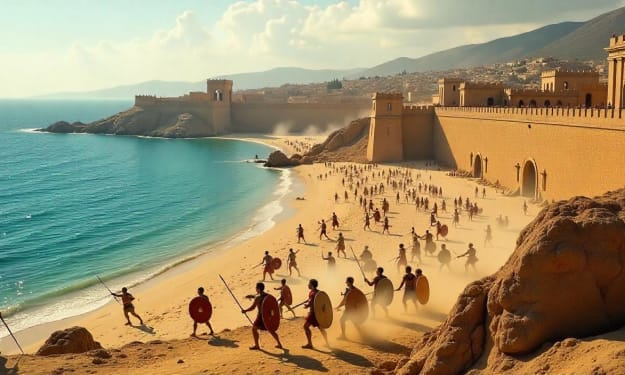
The Epic of the Trojan War
Over centuries, nations have risen and fallen, leaving their mark on history through stories and legends. Among these tales, the Trojan War stands out as a timeless narrative blending heroism, divine intervention, and human tragedy. The story, immortalized in Homer’s Iliad, captures the essence of ancient Greek beliefs and values, exploring the motives, battles, and heroes involved in a war that may be as much myth as reality. The primary source of knowledge about the Trojan War is Homer’s Iliad, written in the 8th century BCE, which recounts the final 52 days of a conflict lasting ten years. The term Iliad derives from Ilion, the ancient name for Troy. Although Homer’s account is our most detailed source, the tale of Troy was preserved through a rich oral tradition and other epic poems that preceded his work.
By A História2 years ago in History
THE LEGACY OF MOORISH SPAIN
The Queen of Castille sits regally on a somewhat bewildered-looking white steed, crown perched prominently on her head. Her eyes are drawn to the ochre-coloured castle gleaming brightly in late November sunlight on a distant hill. Her husband, the King of Aragon, leans forward on his horse with his hand out ready to accept the hefty keys reluctantly proffered by the last Nasrid ruler of the final bastion of Moorish rule in Al Andalus, Boabdil. Though spared the humiliation of kissing the monarch’s hand, the Moor's eyes seem to be silently pleading, “Remember what you promised.”
By Kimberley Silverthorne2 years ago in History
Yemanjá
Yemanjá, also known as Iemanjá in Brazil, is a prominent figure in Afro-Brazilian religions and cultural expressions, recognized as the powerful and nurturing goddess of the sea. Revered in Candomblé and Umbanda, Yemanjá is known as the "Queen of the Ocean," embodying themes of motherhood, protection, and transformation. Her influence extends far beyond religious boundaries, touching Brazilian art, music, and annual celebrations that draw millions of devotees and tourists alike. In this article, we explore Yemanjá's origins, her symbolic role in Brazilian culture, and how her annual festival continues to inspire a sense of connection and renewal. Yemanjá originates from the Yoruba religion of West Africa, where she was venerated as one of the Orishas, powerful deities connected to nature. In the Yoruba tradition, Yemanjá is associated with rivers and motherhood, symbolizing fertility, nurturing, and emotional depth. The transatlantic slave trade, however, brought Yoruba practitioners to Brazil, where they adapted their religious practices in the face of colonial oppression. Over time, the worship of Yemanjá blended with local indigenous beliefs and elements of Catholicism, leading to the vibrant, syncretic Afro-Brazilian religious traditions we see today.
By A História2 years ago in History
Shajar al-Durr: The Story of a Powerful Queen
Shajar al-Durr: The Story of a Powerful Queen Shajar al-Durr, a prominent historical figure in medieval Egypt, was born in the mid-13th century in Damascus. She is best known as the wife of Sultan al-Malik al-Salih Ayyub and for her unique role in the history of Egypt and the Muslim world. Early Life and Marriage Shajar al-Durr’s early life remains somewhat obscure, but she is believed to have been of Turkish descent. She was initially a slave and was later freed and married to Sultan al-Malik al-Salih Ayyub, a member of the Ayyubid dynasty. Their marriage was not just one of romance; it was also a strategic alliance that strengthened the sultan’s political power. Shajar al-Durr became a trusted companion to al-Salih, and together they had a son, who would later be a key figure in the royal lineage. The Death of al-Malik al-Salih The turning point in Shajar al-Durr’s life came with the death of her husband in 1249 during the Seventh Crusade, led by King Louis IX of France. Al-Salih’s death left a power vacuum in Egypt, and Shajar al-Durr faced the daunting challenge of maintaining stability in a kingdom threatened by external forces. In a remarkable move, she chose to conceal the news of her husband’s death from the military and the court, fearing that revealing it would lead to chaos and a loss of morale. Ascension to Power Demonstrating exceptional political acumen, Shajar al-Durr took control of the situation. She called for an emergency assembly of the military leaders and presented herself as the new ruler of Egypt. Her leadership during this critical time was unprecedented; she became one of the few women in history to ascend to such a position of power. As the de facto queen, she rallied the troops and sought to unify the kingdom against the French invasion. Her determination and courage galvanized the military, leading to a strong defense against the Crusaders. The Battle of Mansourah One of the most significant moments of Shajar al-Durr’s reign was the Battle of Mansourah in 1250. Under her leadership, the Egyptian forces achieved a decisive victory against Louis IX’s army. This battle was a turning point, significantly weakening the Crusaders’ position in the region. Shajar al-Durr’s strategic insights and her ability to inspire the troops were crucial in turning the tide of the conflict. Marriage to Aybak and Downfall Despite her successes, Shajar al-Durr faced mounting political pressures. In an effort to consolidate her power and gain support, she married one of her military commanders, Aybak, who later became the Sultan of Egypt. This marriage was politically motivated, but it also led to complications in her rule. Aybak, initially a supporter, eventually turned against her, leading to her downfall. In 1250, amid political intrigues and power struggles, Shajar al-Durr was forced to relinquish her throne. The exact circumstances of her death remain unclear, but it is widely believed that she was murdered by Aybak, who wanted to secure his position as sultan without her influence. Legacy Shajar al-Durr’s story is a remarkable tale of resilience and strength. She defied the gender norms of her time and became a symbol of female power in a predominantly male-dominated society. Her reign, albeit short, left a lasting impact on Egyptian history and remains a subject of fascination for historians and scholars. Shajar al-Durr's legacy is a testament to her intelligence, courage, and determination in a tumultuous period, inspiring future generations to acknowledge the strength of women in leadership roles.
By Ahmed Mohamed2 years ago in History