World History
William Harvey: The Pioneer of Blood Circulation
William Harvey: The Pioneer of Blood Circulation William Harvey (1578–1657) was an English physician who revolutionized the understanding of the human body by discovering the circulation of blood. His groundbreaking work, *De Motu Cordis* (*On the Motion of the Heart and Blood*), fundamentally transformed medicine and established the modern study of physiology. This article delves into the life, discoveries, and legacy of William Harvey, segmented into key subsections.
By Mahalakshmi2 years ago in History
1,000 Days of War
Cartoon explainer: The rockets are labeled with the Russian words that Putin consistently uses to describe his goals for the Ukrainian war: denazification, demilitarization of Ukraine and protection of civilians in Eastern Ukraine. The last rocket has its true goal - "re-Sovietization."
By Lana V Lynx2 years ago in History
Medieval Marvel: The Bridge Over a Vanished River
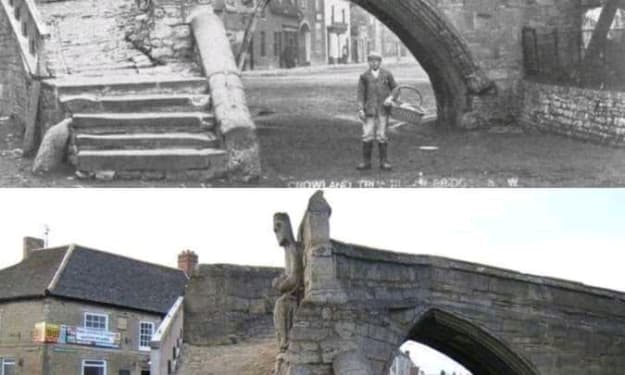
Nestled in the heart of Crowland, Lincolnshire, stands a remarkable relic of medieval engineering—a three-span stone bridge that once straddled the confluence of the River Welland and one of its tributaries. Known for its distinct design and historical significance, this ancient structure is an enduring symbol of ingenuity and resilience. Despite the rivers beneath it vanishing due to diversions in the 17th century, the bridge continues to captivate onlookers with its architectural brilliance and fascinating history. A Glimpse into the Past The bridge as it stands today was constructed between 1360 and 1390, replacing earlier timber structures that had served the same purpose. Its creation marked a significant upgrade, reflecting its importance as a critical crossing point during the medieval period. The site, however, boasts an even older history, with mentions of a crossing in Crowland dating back to 716 during the reign of King Æthelbald of Mercia. The area’s strategic and practical value is further evidenced by its inclusion in a 943 charter issued by King Eadred. What makes this bridge extraordinary is its ability to endure through the centuries, even as the environment around it has dramatically changed. Following river diversions in the mid-1600s, the once-bustling waterways beneath its arches dried up, leaving the structure standing alone as a monument to its storied past. Despite this transformation, it remains a source of pride for Crowland, now recognized as both a scheduled monument and a Grade I listed building. The Making of a Masterpiece The bridge owes its longevity and striking appearance to the Barnack stone used in its construction. This durable material was quarried approximately ten miles west of Crowland and transported via the River Welland. The choice of stone was not only practical but also symbolic, signifying the region’s access to valuable resources and the labor required to transport and shape them. Its design is equally ingenious. Unlike most medieval bridges, which spanned a single river or stream, this one had to accommodate the confluence of two waterways. To solve this, its builders designed three arches, supported by a central platform where three stairways converge. This unique arrangement allowed for efficient crossings in multiple directions and eliminated the need for constructing separate bridges for each waterway. The bridge’s innovative layout highlights the creativity and problem-solving skills of its medieval architects. Life Around the Bridge During its prime, the bridge served as a vital link for trade and travel, connecting communities and facilitating commerce in the region. The River Welland and its tributary were essential waterways, and the bridge’s location ensured it remained at the heart of activity in Crowland. Merchants, pilgrims, and local residents alike would have relied on the bridge to navigate the area, making it a bustling hub of medieval life. The drying up of the rivers in the 17th century drastically altered the landscape and the bridge’s role within it. What was once a crucial crossing became a curiosity, standing alone over dry land. This shift in purpose only added to its mystique, as the structure transitioned from a functional piece of infrastructure to a historical artifact, preserved as a window into the past. Legacy and Preservation The bridge’s survival is a testament to the craftsmanship of its builders and the value placed on its preservation over the centuries. Designated a scheduled monument and a Grade I listed building, it enjoys legal protections that ensure its legacy endures. Today, it stands not only as a reminder of medieval engineering prowess but also as a symbol of Crowland’s rich history. For visitors, the bridge offers an opportunity to step back in time and imagine the bustling activity that once surrounded it. The dry riverbed beneath its arches serves as a poignant reminder of the changes wrought by nature and human intervention, while the stone structure itself speaks to the enduring power of thoughtful design and skilled craftsmanship. A Monument to Ingenuity The bridge in Crowland is more than just an architectural marvel; it is a storyteller. Each stone and arch speaks of a time when waterways were lifelines, and bridges like this one were feats of innovation and necessity. Its unique design, blending practicality with beauty, showcases the medieval commitment to solving challenges with creativity and resourcefulness. Though the rivers it once spanned are long gone, the bridge remains firmly rooted in its place and in the hearts of those who visit. It serves as a reminder of the enduring legacy of medieval engineering, a testament to the ingenuity of its builders, and a symbol of the history that continues to shape the landscape of Crowland. For historians, architects, and casual visitors alike, the bridge is a treasure—a timeless link to a world that, though distant, remains vividly alive through its stone arches.
By Deji Akomolafe2 years ago in History
"The Hidden Lifeline: Unveiling the Advantages of Libya’s Underground Water Resources"
The Advantages of Libya’s Underground Baptize Resources Libya, one of the best barren nations in the world, owes abundant of its adaptation to its underground baptize resources. In a country area condensate is deficient and apparent baptize about non-existent, the all-inclusive aquifers hidden below the arid bank accommodate a basal lifeline. These underground reservoirs, primarily the Nubian Sandstone Aquifer System and others like the Kufra and Murzuk Basins, accept enabled Libya to advance admitting its acrid environment. This commodity explores the advantages of Libya’s underground baptize assets and their role in the country’s economic, social, and ecology development. 1. A Basal Antecedent of Freshwater
By Say the truth 2 years ago in History
Unraveling the Secrets of Ancient Egypt
Welcome to the intriguing realm of Ancient Egypt, renowned as one of history's most iconic and thoroughly studied civilizations. Even with extensive research and numerous archaeological findings, Egypt remains a source of fascination for historians and enthusiasts. In this article, we will delve into the origins, societal structure, religious beliefs, and lasting legacy of this extraordinary civilization, examining the pivotal phases that contributed to its enduring impact on the world. The origins of Ancient Egypt can be traced back to approximately 5,500 BCE during the Predynastic Period. During this era, Northeast Africa was characterized by a verdant savanna, where various tribes thrived by taking advantage of the region's rich resources. As the climate shifted towards aridity, these groups began to migrate to the fertile Nile Valley, setting the stage for one of the most sophisticated agricultural societies of the ancient world.
By A História2 years ago in History
Libya’s Underground Baptize Resources: A Hidden Treasure Below the Desert
Libya, a country accepted for its all-inclusive stretches of barren deserts, has continued faced challenges accompanying to baptize scarcity. With below than 2% of its acreage actuality abundant and an anniversary condensate of alone 20 to 50 millimeters in best areas, Libya’s annex on underground baptize assets is analytical for its survival.
By Say the truth 2 years ago in History
John Logie Baird: The Pioneer of Television
John Logie Baird: The Pioneer of Television John Logie Baird, a Scottish inventor, is best known for developing the world’s first working television system. His innovations laid the groundwork for the television technology that transformed communication and entertainment globally. This article explores his early life, groundbreaking inventions, challenges, and enduring legacy.
By Mahalakshmi2 years ago in History
The First Automotive Accident in the World: Historical Incident in Transport Modes
The first known car accident occurred in 1771. Modern road safety and automobile engineering as we know it today has only one particular day to its past. And that was the steam-powered tractor designed by Nicolas-Joseph Cugnot, the first automobile, crashing on the streets of Paris. It is rather difficult to imagine an automobile accident in a time when cars such as we understand them did not exist. Actually, the steam contraption, invented by Cugnot was one of the crucial moments in modern history. And the accident, though minor, became an historical event.
By Abhay kumar chauhan2 years ago in History
Ukrainian Theatre - Nationalism and the Nationalist Theatre
Early on in her book Theatre & Nation, Nadine Holdsworth draws from a number of sociologists and theorists to define three key terms: nation, nationalism, and national identity. These are important terms to be distinguished; after all, the purview of this essay is Ukrainian theatre of national identity. Whether or not this can be conflated with Ukrainian nationalist theatre is a matter of connotation. If, as for many, the term nationalism conjures up images of Nazi Germany, Stalinist Russia, or Trumpist America—all of which have negative connotations—then it may be uncomfortable to ascribe the word nationalist to Ukrainian theatre. After all, if it earned condemnation from the Ukrainian Communist Party, to the point of Kulish’s banishment, arrest, and eventual execution, then it must have been disruptive to some utopian vision that the USSR wanted to achieve.
By Steven Christopher McKnight2 years ago in History