World History
Is Hinduism really a Religion?
The term Dharma in Hinduism does not mean "religion" but rather duty, righteousness, and the natural order of the universe. Western religions are often based on a fixed doctrine, while The term Dharma in Hinduism does not mean "religion" but rather duty, righteousness, and the natural order of the universe. Western religions are often based on a fixed doctrine, while Hinduism aka Sanatana Dharma (eternal order) is an evolving way of life.
By Sujeet M Sonar2 years ago in History
Genghis Khan’s Conquest – The Rise of an Empire. AI-Generated.
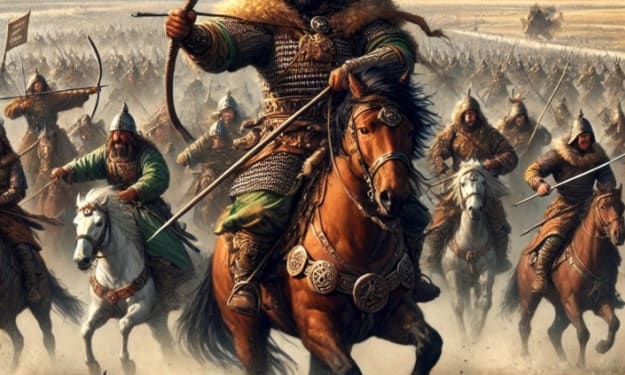
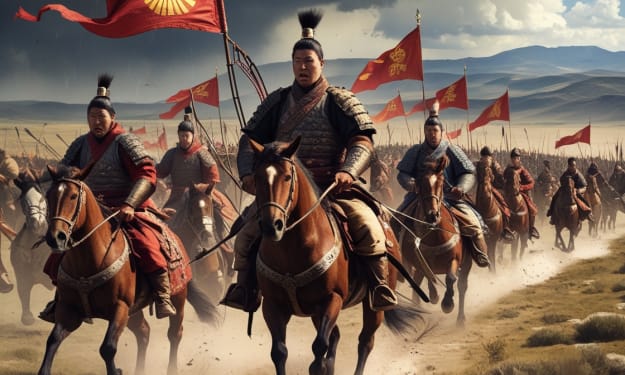
Genghis Khan: The Amplification of an Empire Following his affinity of the Mongol tribes, Genghis Khan boarded on a alternation of aggressive aggressive campaigns that would carve his name into history. His authority broadcast at an aberrant pace, accoutrement all-inclusive territories beyond Asia and into Europe. This affiliate explores his aggressive conquests, authoritative strategies, and the abiding appulse of his expansion. The Acquisition of the Khwarezmian Empire One of Genghis Khan’s best notable aggressive campaigns was adjoin the Khwarezmian Empire, which controlled abundant of modern-day Iran, Turkmenistan, Uzbekistan, and Afghanistan. Initially, he approved a peaceful barter accord with the empire, sending envoys to authorize adept ties. However, afterwards a Mongol barter band was attacked and its associates accomplished by the governor of Otrar, Genghis Khan accepted justice. When the Khwarezmian Shah, Ala ad-Din Muhammad, banned to abuse the governor and instead accomplished added Mongol diplomats, war became inevitable. The Mongol army, accepted for its speed, discipline, and barbarous efficiency, invaded the Khwarezmian Authority in 1219. Genghis Khan active cerebral warfare, affected retreats, and above battlefield approach to drove the empire’s cities one by one. Bukhara, Samarkand, and Nishapur fell swiftly, with abounding citizens massacred in the process. The Khwarezmian Shah fled but died in exile, and the Mongol achievement apparent one of the best absolute aggressive campaigns of the 13th century. Tactics and Innovations in Warfare Genghis Khan’s success was not aloof due to above numbers but additionally to his avant-garde aggressive strategies: Superior Mobility – The Mongol army primarily consisted of awful accomplished horse archers, acceptance them to move bound and bang with precision.
By Say the truth 2 years ago in History
Genghis Khan: Conquering the World and Forging an Empire
Genghis Khan: The Expansion of an Empire Introduction Following his unification of the Mongol tribes, Genghis Khan embarked on a series of ambitious military campaigns that would carve his name into history. His empire expanded at an unprecedented pace, covering vast territories across Asia and into Europe. This chapter explores his military conquests, administrative strategies, and the lasting impact of his expansion. The Conquest of the Khwarezmian Empire One of Genghis Khan’s most notable military campaigns was against the Khwarezmian Empire, which controlled much of modern-day Iran, Turkmenistan, Uzbekistan, and Afghanistan. Initially, he sought a peaceful trade relationship with the empire, sending envoys to establish diplomatic ties. However, after a Mongol trade caravan was attacked and its members executed by the governor of Otrar, Genghis Khan demanded justice. When the Khwarezmian Shah, Ala ad-Din Muhammad, refused to punish the governor and instead executed more Mongol diplomats, war became inevitable. The Mongol army, known for its speed, discipline, and brutal efficiency, invaded the Khwarezmian Empire in 1219. Genghis Khan employed psychological warfare, feigned retreats, and superior battlefield tactics to crush the empire’s cities one by one. Bukhara, Samarkand, and Nishapur fell swiftly, with many citizens massacred in the process. The Khwarezmian Shah fled but died in exile, and the Mongol victory marked one of the most decisive military campaigns of the 13th century. Tactics and Innovations in Warfare Genghis Khan’s success was not just due to superior numbers but also to his innovative military strategies: Superior Mobility – The Mongol army primarily consisted of highly skilled horse archers, allowing them to move quickly and strike with precision. Intelligence and Espionage – Spies and scouts were deployed to gather crucial information about enemy forces, terrain, and resources before launching an attack. Psychological Warfare – The Mongols spread fear by leaving survivors to tell of their devastation, often leading to cities surrendering without a fight. Adaptation of Siege Warfare – Although initially nomadic warriors, the Mongols learned siege tactics from Chinese engineers, using catapults, trebuchets, and battering rams to break city walls. Campaigns Against the Jin Dynasty The Mongol conquest of the Jin Dynasty (China) was a prolonged conflict that lasted from 1211 to 1234. The Jin rulers controlled northern China, and their heavily fortified cities posed a significant challenge. However, the Mongols adapted their warfare strategies, learning to use siege weaponry effectively and employing defectors to undermine enemy defenses. In 1215, the Mongols captured Zhongdu (modern-day Beijing), demonstrating their capability to defeat well-fortified cities. The fall of Zhongdu led to the gradual collapse of the Jin Dynasty, and after years of continued campaigns, the Mongols fully conquered the region by 1234. Expansion into the Caucasus and Eastern Europe After subjugating the Khwarezmian Empire, Genghis Khan’s forces advanced into the Caucasus region and parts of Eastern Europe. The Mongols defeated the Georgian Kingdom, the Cumans, and the Russian principalities in the early 1220s. The Battle of the Kalka River in 1223 saw the Mongols annihilate a combined Rus’ and Cuman force, further cementing their dominance in the region. Administrative and Economic Reforms While Genghis Khan is often remembered for his brutal military campaigns, he was also a visionary leader who implemented key administrative and economic reforms: Religious Tolerance – Unlike many conquerors, Genghis Khan allowed religious freedom within his empire, integrating Buddhists, Christians, Muslims, and Confucians into his administration. Trade and Communication – The Mongols established the Yam system, an early postal and intelligence network, which improved communication and facilitated trade across the empire. Legal Code – The Yassa – Genghis Khan introduced the Yassa, a unified legal code that emphasized loyalty, discipline, and order among his people. Protection of Merchants – Trade routes, including the Silk Road, were secured under Mongol rule, leading to a flourishing of commerce and cultural exchange. Legacy and Impact of His Conquests Genghis Khan’s military expansions laid the foundation for the largest contiguous land empire in history. His legacy influenced global trade, military tactics, and governance for centuries. The Mongol conquests reshaped Asia and Europe, and the trade networks he established played a crucial role in the eventual rise of the modern global economy. Though his methods were often brutal, his ability to unify diverse peoples and create a functioning empire remains a testament to his extraordinary leadership. Conclusion Genghis Khan’s expansion was not just about conquest—it was about reshaping the world order. His innovative warfare tactics, administrative reforms, and vision of a connected world transformed the regions he conquered. As his empire continued to expand, his successors would carry forward his legacy, setting the stage for even greater Mongol dominance in the years to come. In the next chapter, we will explore how the Mongol Empire transitioned after Genghis Khan’s death, and how his successors divided and governed the vast lands he left behind.
By Say the truth 2 years ago in History
Nefertiti: The Enigmatic Queen of Egypt
Few names in ancient history evoke as much fascination as Nefertiti. Known for her legendary beauty, her powerful role as queen, and the mystery surrounding her fate, she remains one of Egypt’s most intriguing figures. But Nefertiti was more than just a beautiful face—she was a co-ruler, religious revolutionary, and possibly even a pharaoh in her own right.
By Siboli Mukherjee2 years ago in History
Empowerment Through Style: Celebrating Women’s Strength on International Women’s Day
In the contemporary world, the emergence of female role models is acknowledged in various sectors, but numerous economically and socially disadvantaged women continue to face challenges in obtaining essential needs such as water, sanitation, and financial stability. Although the government highlights 'Nari Shakti' at prominent events like the Republic Day parade, the daily challenges faced by working women—like their right to be listened to—are frequently ignored.
By Cupidclothings 2 years ago in History
Genghis Khan: The Expansion of an Empire
Genghis Khan: The Expansion of an Empire By the aboriginal 13th century, Genghis Khan had unified the Mongol tribes, accustomed a appalling military, and launched acknowledged campaigns adjoin battling steppe factions. However, his appetite did not stop at Mongolia’s borders. Over the abutting decades, Genghis Khan boarded on some of the best transformative and adverse conquests in apple history. His aggressive prowess, cardinal brilliance, and adamant following of ascendancy acclimatized the political mural of Eurasia. The Acquisition of the Xi Xia Dynasty (1205–1210) Genghis Khan’s aboriginal above ambition above Mongolia was the Xi Xia Dynasty, a almost baby but affluent commonwealth amid in northwestern China. The Xi Xia rulers had continued accepted accolade from Mongol tribes, a convenance that Genghis Khan approved to overturn. The Campaign Begins: In 1205, the Mongols launched their aboriginal arrest adjoin Xi Xia. Despite antecedent resistance, Mongol armament devastated Xi Xia’s borderland defenses. Siege of Zhongxing (1209–1210): The Mongols acclimatized their commonly adaptable warfare action to accommodate annoy tactics, utilizing captured engineers and annoy weapons. Xi Xia’s capital, Zhongxing, fell in 1210. Xi Xia’s Surrender: The Xi Xia emperor submitted to Genghis Khan, accordant to pay accolade and accommodate troops for approaching Mongol campaigns. The Aggression of the Jin Dynasty (1211–1215) After accepting Xi Xia, Genghis Khan angry his absorption to the able Jin Dynasty, which disqualified arctic China and had continued been the ascendant force in the region. Breaking the Jin Defenses: The Mongols beyond the Great Wall in 1211, application above advancement and cerebral warfare to defeat the beyond but ailing all-around Jin forces. Battle of Yehuling (1211): This absolute action saw the Mongols abort a ample Jin army by adorable them into a aerial canyon and ambushing them. Fall of Zhongdu (1215): After a abiding siege, the Mongols captured the Jin capital, banishment the emperor to abscond south. The Jin Dynasty’s adeptness was assuredly weakened, admitting it would amble for addition decade. Campaign Adjoin the Khwarezmian Authority (1219–1221) One of Genghis Khan’s best acclaimed and barbarous campaigns was adjoin the Khwarezmian Empire, which spanned modern-day Iran, Turkmenistan, Uzbekistan, and Afghanistan. A Diplomatic Insult: In 1218, Genghis Khan beatific a barter appointment to the Khwarezmian Shah, Ala ad-Din Muhammad. The Shah, apprehensive Mongol espionage, accomplished the envoys. This act of affront affronted Genghis Khan. The Mongol Response: In 1219, Genghis Khan launched a all-encompassing aggression with an army of over 200,000 men. Destruction of Samarkand and Bukhara: The Mongols captured and devastated above cities, slaughtering citizenry and ensuring no attrition remained. Pursuit of the Shah: The Shah fled westward but was relentlessly pursued by Mongol detachments. He died in banishment on a alien island in the Caspian Sea. Aftermath: The once-powerful Khwarezmian Authority was absolutely destroyed, paving the way for Mongol ascendancy of Central Asia. Advancing into Persia and the Caucasus (1221–1223) Following the acquisition of Khwarezm, Mongol armament pushed westward into Persia and the Caucasus, testing the backbone of new enemies. Siege of Nishapur (1221): The Mongols captured Nishapur, reportedly killing hundreds of bags in avengement for the afterlife of Genghis Khan’s son-in-law. Battle of the Kalka River (1223): A Mongol force led by Subotai and Jebe defeated an affiliated force of Rus’ princes and Cumans, demonstrating the Mongols' adeptness to extend their ability into Eastern Europe. Administrative Reforms and Governance Despite his acceptability as a adamant conqueror, Genghis Khan was additionally a acute ambassador who implemented reforms to administer his all-inclusive authority effectively. Legal Cipher (Yassa): A austere but fair cipher of laws ensured accord and adjustment amid Mongols and their subjects. Religious Tolerance: The Mongols accustomed abandon of religion, all-around Buddhists, Christians, Muslims, and others aural their empire. Trade and Infrastructure: Genghis Khan revitalized barter forth the Silk Road, attention merchants and standardizing taxation. Conclusion By the mid-1220s, Genghis Khan had created the better abutting authority the apple had anytime seen. His aggressive campaigns adjoin Xi Xia, the Jin Dynasty, and the Khwarezmian Authority showcased his cardinal ability and the adamant ability of the Mongol army. However, his conquests were far from over. In the abutting appearance of his life, Genghis Khan would face challenges from centralized dissent, borderland rebellions, and the adventure to defended his empire’s future. His legacy, artificial in claret and brilliance, would appearance history for centuries to come.
By Say the truth 2 years ago in History
Genghis Khan: The Unstoppable Conqueror
Genghis Khan: The Acceleration of an Authority (Part 3) As Genghis Khan circumscribed adeptness over the Mongol tribes, his appetite grew above the steppes of Mongolia. He approved to actualize an authority clashing any the apple had apparent before. With discipline, strategy, and adamant efficiency, he launched a alternation of campaigns that adapted Asia and the world. This allotment of his activity focuses on the amplification of his empire, the aboriginal conquests, and the accumulation of the Mongol war machine. The Mongol War Machine One of the key affidavit for Genghis Khan’s aggressive success was the about-face of the Mongol army. Clashing abounding added medieval armies, which relied on acceptance and feudal levies, Genghis Khan congenital a awful organized, meritocratic aggressive structure. His key innovations included: The Tumens System: The Mongol army was disconnected into units of 10, 100, 1,000, and 10,000 men, ensuring adaptability and discipline. Loyalty Over Nobility: He answer soldiers based on accomplishment and adherence rather than birthright. Superior Tactics: The Mongols able the affected retreat, barricade maneuvers, and cerebral warfare.
By Say the truth 2 years ago in History
Genghis Khan: The Journey from Nomad to Conqueror
The Nine Genitalia of Genghis Khan’s Life: From Bearing to Emperor Genghis Khan, originally called Temujin, was one of the best affecting leaders in apple history. Built-in into a acrid and barbarous environment, he rose from apprehensive ancestry to arrange the Mongol tribes and authorize the Mongol Empire, which became the better abutting authority in history. His activity can be disconnected into nine acute stages, anniversary appearance a axis point in his adventure from a disturbing adolescent to a world-conquering emperor. 1. Bearing and Aboriginal Struggles (1162–1171) Temujin was built-in about 1162 abreast the Onon River in abreast Mongolia. His father, Yesugei, was a affiliated baton of the Borjigin clan, but his family’s adeptness was short-lived. Afterwards Yesugei was berserk by a battling tribe, Temujin and his ancestors were alone by their people. Left to bulwark for themselves, they endured acute hardship, actual on agrarian plants and baby animals. This aeon of adversity shaped Temujin’s animation and determination. 2. Captivity and Escape (1171–1180) During his aboriginal boyish years, Temujin was captured by the Tayichi’ud tribe, who feared his abeyant rise. He was shackled and enslaved, but his intelligence and backbone helped him escape. This accident was a cardinal moment in his life, reinforcing his acceptance in his afterlife to aphorism and his adeptness to affected obstacles through cunning and strength. 3. Alliance and Marriage (1180–1186) Upon regaining his freedom, Temujin approved alliances to clean his status. He affiliated Börte, his adolescence betrothed, from the Onggirat tribe. Soon after, Börte was kidnapped by the Merkits, a battling tribe. Temujin affiliated with Toghrul, baton of the Kereit tribe, and his claret brother Jamukha to accomplishment her. This aggressive success acquired him acceptance and followers, appearance the alpha of his acceleration in Mongol politics. 4. Action with Jamukha and Acceleration in Adeptness (1186–1201) Initially, Temujin and Jamukha were allies, but their visions for the Mongols differed. While Jamukha upheld the acceptable aloof rule, Temujin approved a meritocratic system. Their brainy action led to a action in 1187, area Temujin was defeated. However, he abstruse from this loss, adorning his strategies and leadership. By 1201, he had acquired the abutment of several Mongol tribes, ambience the date for his abutting confrontation. 5. Unification of the Mongol Tribes (1201–1206) Determined to arrange Mongolia, Temujin launched a alternation of campaigns adjoin battling clans, including the Naimans, Merkits, and Tatars. His aggressive innovations, discipline, and adeptness to accolade adherence fabricated him an unstoppable force. By 1206, he had defeated all above battling tribes and was proclaimed Genghis Khan, acceptation “Universal Ruler.” This was a defining moment in history, appearance the bearing of the Mongol Empire. 6. Expansion into China and the Khwarezmian Authority (1206–1221) After accumulation Mongolia, Genghis Khan angry his absorption to alien enemies. He launched a acknowledged attack adjoin the Western Xia and Jin Dynasty in arctic China, bringing all-inclusive territories beneath Mongol control. In 1219, he attacked the Khwarezmian Authority (modern-day Iran and Central Asia) in backfire for the annihilation of his barter ambassadors. The Mongols decimated the Khwarezmians, announcement their incomparable aggressive backbone and brutality. 7. Babyminding and Acknowledged Reforms (1206–1227) Beyond his conquests, Genghis Khan accustomed an able administering based on meritocracy. He implemented Yassa, a acknowledged cipher that ensured discipline, religious tolerance, and fair taxation. His babyminding accustomed baffled regions to thrive, announcement barter and cultural barter forth the Silk Road. 8. Final Campaigns and Bequest (1223–1227) Genghis Khan connected accretion his empire, targeting the Tangut-led Western Xia Dynasty, which had ahead submitted but after rebelled. While on attack adjoin the Western Xia in 1227, he fell from his horse, comestible injuries. He never absolutely recovered and anesthetized abroad that year. His afterlife was kept abstruse to advance stability, and his anatomy was active in an alien location, abacus to the fable surrounding him. 9. Aftermath and Appulse of His Rule After Genghis Khan’s death, his breed broadcast the Mongol Authority alike further, accoutrement genitalia of Europe, the Middle East, and China. His bequest shaped apple history, influencing warfare, administration, and trade. The Mongol Empire’s appulse can still be apparent today in assorted aspects of governance, aggressive strategy, and all-around connectivity. Conclusion Genghis Khan’s activity was a adventure of struggle, ambition, and triumph. Rising from an alone adolescent to the best able adjudicator of his time, he afflicted the advance of history. His bequest charcoal controversial—both admired for his aggressive ability and feared for his adamant conquests. However, his appulse on all-around acculturation is undeniable, authoritative him one of history’s best cogent figures.
By Say the truth 2 years ago in History
Love Amidst World War II
Letter 1: From James to Eleanor October 12, 1943 Somewhere in France My Dearest Eleanor, As I sit beneath the dim glow of a lantern, the distant rumble of artillery echoing through the night, my thoughts drift to you. The days here are long and uncertain, yet the memory of your laughter and the warmth of your touch sustain me. I carry your last letter close to my heart, rereading your words whenever fear and loneliness creep in.
By Akua Asabea2 years ago in History
The Lost Tomb of Genghis Khan
The Lost Tomb of Genghis Khan: A Mystery Unsolved Introduction Genghis Khan, the great Mongolian conqueror and founder of the Mongol Empire, left an indelible mark on world history. However, despite his legendary status, one of the greatest mysteries surrounding him remains unsolved—his final resting place. Unlike other great rulers who built grand mausoleums, Genghis Khan's tomb has never been found, making it one of the most elusive archaeological secrets in history. The Secretive Burial of Genghis Khan Unlike the grand tombs of emperors like China’s Qin Shi Huang or Egypt’s pharaohs, Genghis Khan's burial was intentionally kept secret. According to historical sources, he died in 1227, likely from an illness, during his campaign against the Western Xia Dynasty. His body was reportedly transported back to Mongolia, but where he was buried remains a mystery. Legends say that a special funeral procession took his body to an unknown location, ensuring secrecy by killing anyone who witnessed the burial. Some accounts suggest that a river was diverted over his grave to conceal it, while others claim thousands of horses trampled the land to erase any trace of his tomb. Theories on the Location of the Tomb For centuries, historians and archaeologists have speculated about the exact location of Genghis Khan’s tomb. Some of the most popular theories include: Burkhan Khaldun, Mongolia – This sacred mountain in the Khentii region is often cited as a possible burial site. Genghis Khan considered this area sacred and spent much of his life there. Ikh Khorig (The Great Taboo), Mongolia – This restricted area, covering over 240 square kilometers, was guarded for centuries by the Mongolian elite to prevent any outsiders from disturbing the site. The Orkhon Valley, Mongolia – Some believe his tomb lies near the historic Orkhon Valley, an important cultural and political center of the Mongol Empire. Underground Complex Theory – Some researchers suggest that an elaborate underground chamber was built to house Genghis Khan’s remains, filled with treasure and protected by deadly traps, much like the tombs of Chinese emperors. Historical Accounts and Expeditions Many historians and explorers have attempted to uncover the lost tomb, but all efforts have been in vain. Marco Polo (13th Century) – The Venetian traveler wrote that no one knew the location of Genghis Khan’s tomb, as those who buried him were executed. The Soviet Era (20th Century) – During the Soviet occupation of Mongolia, expeditions were launched to locate the tomb, but the efforts were largely unsuccessful. Modern Archaeology (21st Century) – Recent efforts, including satellite imaging and ground-penetrating radar, have been used to search for the tomb, but no definitive evidence has been found. Why Was the Tomb Kept Secret? The secrecy surrounding Genghis Khan’s tomb is rooted in Mongolian tradition. The Mongols believed that their great leader’s spirit should not be disturbed and that his final resting place should remain hidden from the world. The secrecy was likely enforced to prevent looting or desecration by rival factions or foreign invaders. Additionally, the Mongols followed a nomadic lifestyle and did not build grand temples or tombs like other civilizations. Instead, they believed in preserving the natural landscape, which may explain why Genghis Khan's burial site was never marked with a grand monument. Myths and Legends About the Tomb Several myths surround the tomb of Genghis Khan: The Cursed Tomb – Some legends claim that whoever finds and disturbs Genghis Khan’s tomb will suffer a terrible fate, much like the curse of the Egyptian pharaohs. Buried with Treasure – It is believed that the tomb contains an immense treasure, including gold, silver, and weapons from his conquests. The Ghostly Guardians – Folklore suggests that supernatural forces or spirits protect the tomb, preventing anyone from discovering its location. The Ongoing Search for the Tomb Despite centuries of mystery, the search for Genghis Khan’s tomb continues. Recent advances in technology, such as LIDAR (Light Detection and Ranging) and remote sensing, have given archaeologists new tools to explore the Mongolian landscape without disturbing sacred lands. Organizations like the National Geographic Society and Mongolian researchers have collaborated on expeditions, using modern techniques to scan possible burial sites. While some promising leads have been found, none have confirmed the exact location of the tomb. Conclusion The lost tomb of Genghis Khan remains one of the greatest archaeological mysteries of all time. Whether buried beneath a mountain, hidden under a river, or resting in an unmarked grave in the Mongolian wilderness, the final resting place of the great conqueror continues to captivate historians and explorers alike. Until definitive evidence is uncovered, the mystery of Genghis Khan’s tomb will persist, keeping his legacy shrouded in secrecy and legend.
By Say the truth 2 years ago in History
The Legend of Varuna
In ancient times, when the universe was still in its infancy and the distinctions between the mortal and divine realms were indistinct, there existed a formidable deity who presided over the vast, unexplored waters of the cosmos. This deity was Varuna, the god of the oceans, the skies, and the celestial order. His narrative is one of adventure, wisdom, and the perpetual equilibrium between chaos and harmony.
By A História2 years ago in History