World History
Temples in the City: Balancing Tradition and Modernity in Urban Spaces
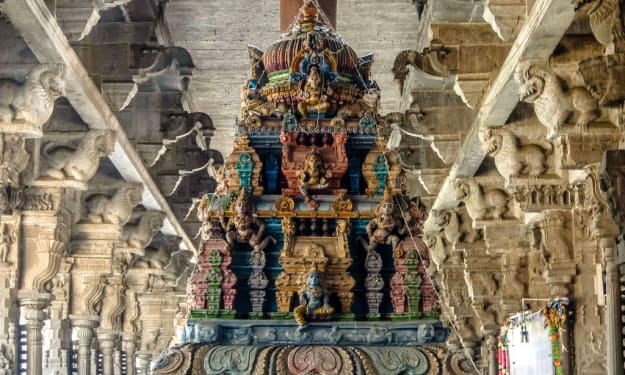
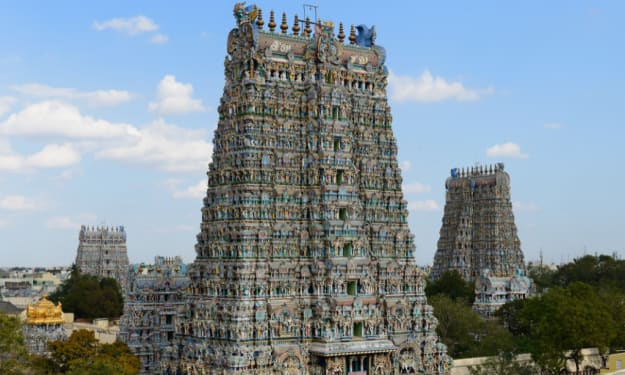
Temples in Urban Areas: Preserving Tradition Amidst Modernization In the ever-evolving landscapes of urban cities, where skyscrapers, shopping malls, and busy streets dominate, temples stand as pillars of tradition and spiritual sanctity. While the world around them becomes increasingly modernized, temples continue to offer a serene refuge for those seeking solace, peace, and divine connection.
By Sri Kamakshi Ambal Temple2 years ago in History
The Cosmic Connection: How Kalachakra Shapes the Spiritual Journey at Sri Kamakshi Ambal Temple
In the heart of Kanchipuram, one of the seven Moksha-puris (sacred cities) of India, lies the magnificent Sri Kamakshi Ambal Temple. This ancient temple, dedicated to Goddess Kamakshi, is not just a place of worship but also a sacred space where the concept of cosmic time, known as Kalachakra, is deeply embedded in its architecture, rituals, and spiritual practices. The idea of Kalachakra refers to the cycle of time, representing the cyclical nature of the universe and life.
By Sri Kamakshi Ambal Temple2 years ago in History
The Nomadic Empire
For millennia, the vast expanse of the Asian steppes has been a crucible of human history. Its strategic location and abundant resources made it a prize fiercely contested by numerous ancient peoples. Among these, the Scythians stand out as one of the most influential civilizations, leaving an indelible mark on both Asia and Europe. Their nomadic lifestyle, warrior culture, and intricate artistry not only defined their own era but also shaped the civilizations that followed. This is the story of how the Scythians, a people of the open plains, became a force to be reckoned with, defying empires and leaving a legacy that endures to this day.
By A História2 years ago in History
Turkey's Underworld
What Is Derinkuyu All About Derinkuyu's Underground City Discovering An Underground City Beneath Cappadocia Nestled in Turkey’s Cappadocia region is a city so enigmatic that it had been lost to history for centuries. And Derinkuyu, buried 18 stories beneath the surface, is as much of an archaeological feat as it is a tale of survival, adaptation, and the mysteries of a lost civilization.
By Rohitha Lanka2 years ago in History
The last days of the Neanderthals.
The last days of the Neanderthals. The story of the Neanderthals is one of survival adaptation and ultimately extinction. For thousands of years they thrived across Europe and parts of Asia coexisting with early Homo sapiens before vanishing from the fossil record around 40,000 years ago. Their disappearance has long puzzled scientists sparking debates over the causes and consequences of their extinction. However recent research has painted a more nuanced picture of their fate revealing that Neanderthals were not a primitive dead end in human evolution but rather a sophisticated and resilient species that left an enduring legacy in modern human DNA. Neanderthals evolved from a common ancestor shared with Homo sapiens roughly 500,000 years ago. While some researchers suggest Homo antecessor as this ancestor the exact lineage remains debated. What is certain is that Neanderthals adapted to the harsh climates of Ice Age Europe and Asia developing robust physiques suited for cold environments. Their short stocky bodies helped retain heat and their large nasal cavities warmed the air they breathed. These adaptations allowed them to hunt large Ice Age mammals like mammoths and woolly rhinoceroses proving their ability to survive in extreme conditions.
By Adnan Rasheed2 years ago in History
History of River
Rivers have shaped the course of human history and the natural world for millions of years. These dynamic waterways, flowing from highlands to seas, have not only carved landscapes but have also fostered the growth of civilizations, driven economies, and inspired cultural narratives. The history of rivers begins long before humans walked the Earth. Geologically, rivers formed as rainwater collected in natural channels, cutting through rock and soil over millennia. The world's oldest rivers, such as the Finke River in Australia and the Nile in Africa, date back tens of millions of years, bearing witness to Earth's ever-evolving topography. In human history, rivers have been both cradles of civilization and critical lifelines. The earliest known civilizations flourished along river valleys due to their fertile lands and access to water. Around 3100 BCE, the ancient Egyptians thrived along the Nile River. The river's predictable flooding deposited nutrient-rich silt, allowing agriculture to prosper. The Nile became a symbol of life, worshiped as a divine force and immortalized in countless hymns and hieroglyphs. Similarly, the Tigris and Euphrates Rivers nurtured Mesopotamia, often referred to as the "Cradle of Civilization." The Sumerians, Akkadians, Babylonians, and Assyrians all depended on these rivers for irrigation, transport, and trade. Their ingenuity in building canals and levees highlights how ancient societies learned to harness rivers’ power while contending with their unpredictable nature. In South Asia, the Indus River Valley Civilization (circa 2600–1900 BCE) flourished along the Indus River and its tributaries. Cities like Harappa and Mohenjo-daro showcased advanced urban planning, with sophisticated drainage systems—an impressive feat that underscored the river’s significance in shaping early human settlements. China's history is deeply intertwined with its rivers, particularly the Yellow River (Huang He) and the Yangtze River (Chang Jiang). The Yellow River, often called the "Mother River of China," supported ancient Chinese civilization for thousands of years. However, it was also known as "China's Sorrow" due to its devastating floods, which prompted complex hydraulic engineering efforts to control its waters. In the Americas, rivers played equally vital roles. The Mississippi River provided a crucial trade route for Native American tribes and, later, European settlers. The Amazon River, the largest river by discharge volume, sustained diverse ecosystems and Indigenous cultures, long before European exploration. Rivers have not only shaped economies but also influenced culture and religion. The Ganges River in India is considered sacred by Hindus, believed to purify sins and deliver salvation. Pilgrims flock to its banks to perform rituals, reinforcing the river’s spiritual significance. In medieval and modern history, rivers continued to be strategic assets. Cities like Paris along the Seine, London along the Thames, and Rome along the Tiber grew into influential centers of trade and governance. Rivers enabled commerce, facilitated military campaigns, and connected remote regions, fueling economic and cultural exchanges. The Industrial Revolution (18th–19th centuries) saw rivers harnessed for power, with watermills driving factories and transportation canals enhancing trade. However, industrialization also brought pollution, disrupting ecosystems and endangering river health. Today, rivers remain vital, but they face modern challenges. Dams, pollution, and climate change threaten their ecosystems and the communities relying on them. Efforts like the revival of the Rhine in Europe and conservation projects for the Colorado River in the United States aim to balance human needs with environmental sustainability. Ultimately, rivers are more than flowing water—they are the lifeblood of civilizations, carriers of culture, and enduring symbols of nature’s power. Understanding their history enriches our appreciation of the interconnectedness between natural landscapes and human progress, urging us to protect these vital arteries of the Earth.
By Budhirai Tripura2 years ago in History
Trump and Zelenskyy’s Oval Office Face-Off Takes a Shocking Turn!
On March 1, 2025, a highly anticipated meeting took place in the Oval Office between U.S. President Donald Trump, Vice President JD Vance, and Ukrainian President Volodymyr Zelenskyy. The agenda was to discuss a minerals agreement granting the U.S. access to Ukraine’s rare earth elements, crucial for various technological applications. However, the meeting devolved into a heated confrontation, ending abruptly without any agreements signed.
By Lynn Myers2 years ago in History
St. David’s Day: A Guide to Wales’ Most Beloved Tradition
Every year on March 1st, Wales comes alive with parades, singing, and the vibrant colours of daffodils and leeks. But what is the story behind St. David’s Day, and why is it so important to the Welsh people? Whether you’re Welsh, have Welsh heritage, or simply love learning about cultural traditions, this guide will take you through the history, symbols, and celebrations of Wales’ most beloved holiday.
By Bevy Osuos2 years ago in History
The Timeless Relevance of Ancient Subjects in Modern Education
Introduction In the rapidly evolving world of education, where new disciplines emerge to address contemporary challenges, certain ancient subjects have withstood the test of time. These millennia-old disciplines continue to be integral components of modern curricula, offering invaluable insights into human civilization and the natural world. This article delves into the enduring significance of these ancient subjects, exploring their historical roots and their relevance in today's academic landscape.
By TechyByGaurav 2 years ago in History