World History
India vs Pakistan Wars: A History of Conflict and Consequence . AI-Generated.
The rivalry between India and Pakistan is one of the most intense geopolitical conflicts in modern history. Since their independence in 1947, both countries have engaged in several wars and military conflicts, primarily over the disputed region of Jammu and Kashmir. This article provides a historical review of the wars fought between India and Pakistan, focusing on their causes, outcomes, and long-term consequences.
By MD NAZIM UDDIN about a year ago in History
The Fall of the Roman Empire
The Roman Empire, once a powerful and expansive force that ruled much of Europe, North Africa, and the Near East, fell in the 5th century AD. Its fall marked the end of an era in European history, reshaping the continent for centuries to come. The reasons behind the empire's collapse are complex and multifaceted, involving a mix of internal decay and external pressures. However, the consequences of its fall were equally significant, as they set the stage for the Middle Ages and the rise of new powers in Europe.
By Haseeb Mujaddidiabout a year ago in History
The Story of Pakistan and India's Independence
The 20th century had begun. Hindustan – a land rich in history, culture, and diversity – was under British colonial rule. In 1857, for the first time, the people of Hindustan revolted against the British in what became known as the "First War of Independence." Though it wasn't completely successful, it sparked a flame – the flame of freedom.
By Real life 🧬 stories about a year ago in History
My ideal client is freelancer Habib Mahmood
Chapter 1: Born in the Land of Possibilities Habib Mahmud Anderson was born in sunny San Diego, California, into a middle-class American family. His father, a software engineer with a love for building gadgets, taught Habib how to hold a screwdriver before he could even tie his own shoes. His mother, a school teacher, brought books, maps, and curiosity into the house. They didn’t raise him with the dream of only becoming successful—they raised him to be kind, aware, and driven to make a difference.
By Habib Mahmudabout a year ago in History
Simmering Conflict: Recent Military Engagements Heighten India-Pakistan Tensions
Recent months have witnessed a concerning uptick in military engagements and heightened rhetoric between India and Pakistan, reigniting fears of a potential escalation along their heavily militarized border. While neither nation has declared a formal war, the frequency and intensity of reported cross-border firing, alleged incursions, and strongly worded statements from both sides paint a picture of a region teetering on the edge. These developments underscore the deep-seated mistrust and unresolved territorial disputes, particularly concerning the Kashmir region, that continue to plague their bilateral relations.
By Muhammad Jawadabout a year ago in History
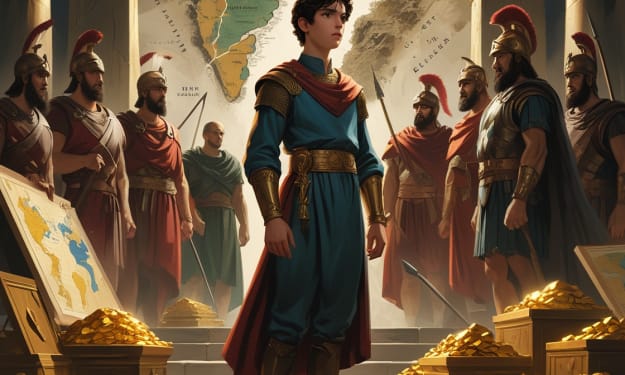
The Overlooked Wealth: Revealing the Riches of the Greek Empire. AI-Generated.
The Overlooked Wealth: Revealing the Riches of the Greek Empire The Greek Empireextending from the sun-drenched islands of the Aegean to the frontiers of India under Alexander the Greatis frequently commemorated for its scholarly accomplishments, mythology, and renowned military feats. Yet concealed beneath this celebrated heritage lies another breathtaking narrative: that of the extensive wealth accumulated by the ancient Greeks. This fortune encompassed not only gold and silver but also sacred artifacts, tributes from allies, war plunder, and invaluable art. At its pinnacle, the empire’s treasury ranked among the most precious in the ancient realm. 1. The Genesis of Affluence The origins of Greek wealth can be traced to city-states such as Athens, Corinth, and Sparta. Among these, Athens distinguished itself as a financial center. During the 5th century BCE, it spearheaded the Delian Leaguea military consortium established to confront the Persian menace. The league’s treasury was initially secured on the island of Delos, situated within a sacred sanctuary. However, Athens subsequently relocated the treasury to the Parthenon, effectively asserting control over the league’s assets. Each league member provided a tributeeither in vessels or fundswhich enriched the Athenian coffers with silver, gold, and exotic goods from throughout the Mediterranean. This revenue supported not only Athens’ navy and military endeavors but also its construction initiatives, including the Parthenon itself. 2. The Laurion Mines Athens’ affluence was not solely reliant on tributes. A significant silver-mining operation in Laurion, located just southeast of Athens, constituted a major economic pillar. Thousands of enslaved workers toiled under harsh conditions to extract silver, which was utilized to mint the renowned Athenian tetradrachma coin widely accepted across the ancient world. It is estimated that Laurion yielded hundreds of tons of silver, much of which financed the Athenian war apparatus and cultural proliferation. 3. Alexander the Great: Conqueror and Custodian No other figure in Greek history may have impacted its wealth as significantly as Alexander the Great. As he advanced eastward during his campaigns (334–323 BCE), he plundered and integrated vast royal treasuries from the Persian Empire, including the fabled city of Persepolis. Historical records indicate that Alexander appropriated over 180,000 talents of silver and goldequivalent to roughly 4,000 metric tons. In present-day value, this would exceed $250 billion. He employed part of this treasure to finance his expeditions, reward his troops, and invigorate economies in subjugated territories by re-minting coins and constructing infrastructure. Alexander's pillaging campaign not only redistributed riches throughout his expansive empire but also facilitated the creation of a novel Hellenistic economic framework, merging Greek and Eastern components. 4. Religious and Cultural Appreciations The Greeks held the belief that wealth ought to be dedicated to the deities, and numerous sanctuariessuch as those located in Delphi, Olympia, and Delosserved as repositories for offerings. These included gilded statues, intricately carved ivory, and exquisitely crafted vessels. For example, Delphi’s Temple of Apollo contained gifts from rulers and military leaders, comprising golden tripods, shields, and bronze bulls. These sacred repositories were occasionally looted during conflicts. The Roman general Sulla, for instance, ransacked the Oracle of Delphi during his expedition in Greece in 86 BCE. Nevertheless, a significant number of treasures endured for centuries, concealed or buried to evade theft. 5. Diminution and Dispersal The decline of the Greek realm commenced with the ascent of Rome. By the 2nd century BCE, the majority of Greek regions had either been annexed or heavily influenced by Roman authority. Consequently, a substantial portion of Greece’s wealthboth monetary and artisticwas transferred to Rome. Emperors such as Nero and Augustus plundered Greek temples and transported statues, manuscripts, and gold back to Italy. Subsequent invasions, ranging from the Visigoths to the Ottomans, perpetuated this pattern of exploitation. However, a considerable number of treasures also vanished from history entirelylost to the passage of time, buried under collapsed temples, sunken ships, or concealed within forgotten tombs. 6. The Treasure Today: Worth and Heritage While precise figures remain conjectural, historians estimate that the total wealth of the Greek Empire during its zenithincluding Athens, Macedon, and Hellenistic kingdomsmight easily exceed $500 billion in contemporary terms. This encompasses: Silver and gold from mines and tributes Loot from Persian treasures Religious donations and temple caches Artistic and cultural creations (many regarded as priceless today) Only a small portion of this wealth persists, safeguarded in institutions like the Acropolis Museum, the British Museum, or lost within archaeological sites awaiting rediscovery. Conclusion: A Wealth Beyond Gold The treasure of the Greek Empire represented more than mere material richesit also encompassed intellectual, cultural, and spiritual value. Although much of its physical wealth has been dispersed or lost, the legacy of this empire continues to enrich humanity. From coins that once financed philosophers to statues that inspired Renaissance artists, the true wealth of ancient Greece resides in its lasting influence.
By Say the truth about a year ago in History
India-Pakistan Wars
Introduction: The Roots of a Bloody Rivalry The India-Pakistan conflict is one of the most protracted and volatile military confrontations in modern history. Born from the traumatic partition of British India in 1947, the two nations have engaged in four full-scale wars (1947, 1965, 1971, 1999), numerous border skirmishes, and a continuous low-intensity conflict over Kashmir.
By Himadri Niloyabout a year ago in History
The Pyramids of Peru and the Portals of the Gods: Where Are All Their Architectural and Historical Documents?
High in the forgotten deserts of southern Peru, under skies that flicker with starlight and silence, there are ruins few speak of, and fewer understand. Pyramids, buried beneath centuries of dust, stand in defiance of time, their purpose unclear, their builders unnamed. Nearby, a doorway carved into the rock waits in eternal stillness. They call it the Puerta de Hayu Marca, the Gate of the Gods. Yet, amid such ancient wonder, one question echoes across the sand and stone:
By The Secret History Of The Worldabout a year ago in History
Barack Obama's life story
Barack Hussein Obama II 4 August 1961 ko Honolulu, Hawaii mein paida hue. Unka taluq aik mix nasli khandan se tha—un ke walid, Barack Obama Sr., Kenya ke rehne wale the, jabke unki walida, Ann Dunham, America ke Kansas state se taluq rakhti thi. Obama ki zindagi shuru se hi aik mukhtalif aur rang birangi tehzeeb se mutasir rahi. Unka bachpan kuch waqt tak Indonesia mein bhi guzra, jahan unki maa ne dusri shadi ke baad kuch arsa guzara.
By Real life 🧬 stories about a year ago in History
"History of Dark Psychology: Manipulation, Control, and the Human Mind" . AI-Generated.
The History of Dark Psychology Dark psychology is the study of the human mind’s darker side. It looks at how people use deception, control, and manipulation. Gaslighting, mind control, and emotional abuse are all examples of this. Dark psychology has its origins in antiquity. Manipulation was the topic of writing by philosophers like Plato and Machiavelli. Plato warned of persuasive rhetoric used to deceive.
By articelmunafabout a year ago in History