World History
The Last Night of the Dreamer
The Last Night of the Dreamer He didn’t know it would be his last night. But somehow, we believe he felt it. It was April 3rd, 1968. Memphis, Tennessee. The rain was falling like grief from a sky that couldn’t hold itself together. Inside the Mason Temple, a crowd waited restlessly. Dr. Martin Luther King Jr. had arrived in the city to support a sanitation workers' strike. These men — Black, overworked, underpaid — were demanding not just fair wages, but dignity.
By Furqan Elahiabout a year ago in History
Age of Kings and Conquests
Between 800 and 850 AD, the world stood at a pivotal crossroad. In every corner of the known world, empires rose, borders shifted, and rulers seized power—or lost it. This was an age where kings became emperors, warriors carved out kingdoms, and the tides of religion and culture surged across continents. The early medieval world was anything but stagnant. It was alive, restless, and full of stories that shaped the centuries to come.
By Abid ur Rahmanabout a year ago in History
The King of Time: How an Orphan's Dream Became Rolex"
Title: From Poverty to Rolex — The King of Time --- A young orphan, whose parents passed away in his early years. Life threw him into the furnace of trials from the very beginning. Surrounded by poverty, loneliness, and despair, yet a dream burned in his heart — a dream to rise, to conquer time, and to make his name known to the world. This is the story of Hans Wilsdorf, known today as the founder of Rolex. And today, MIK WONDERS proudly presents this extraordinary journey of struggle and success. --- Born in Hardship Hans lost both his parents at a young age and was raised in an orphanage. Life offered him nothing but hardship. But what life took away, it replaced with resilience, patience, and the courage to dream. The only thing he had was time — something that belongs to no one. But Hans made up his mind to master it, to capture time itself. --- The First Step into Watchmaking Hans began working in a Swiss watchmaking company, where he learned everything — from intricate mechanics to design and precision. He worked tirelessly, learning each tiny detail of how time ticks. But his mind wasn't just focused on gears and dials. He had a vision — to create a watch that was not only functional but a symbol of trust, precision, and excellence for people from all walks of life. --- The Birth of Rolex in London Hans moved to London and, in 1905, started a small watch distribution company with a partner. His aim? “To create elegant, simple, and reliable watches.” In 1908, he registered a name that was short, elegant, and memorable — ROLEX. A name easy to pronounce across languages and cultures. And thus, a dream began to take form. --- The Waterproof Watch In 1927, Rolex did the unthinkable — it created the world’s first waterproof watch: the Oyster. To prove it, a young woman swam across the English Channel wearing the watch — and it still told the correct time afterward. It was a bold move, but it marked Rolex as a name of trust and innovation. --- The Self-Winding Revolution In 1931, Hans introduced the self-winding mechanism — a watch that winds itself using the wearer’s movement. This wasn’t just an upgrade; it was a revolution in the world of horology. Rolex was no longer just a company — it became a philosophy of progress, purpose, and precision. --- Wartime Grace and Humanity During World War II, Hans did something few businessmen would: he offered Rolex watches to captured Allied soldiers in Nazi prison camps, saying they could pay after the war. This wasn’t business. It was humanity. A reflection of values that went beyond profit — values that Rolex would become known for. --- Creating Tudor — Excellence for Everyone Not content with just luxury for the elite, Hans created the Tudor brand — delivering Rolex-level quality at more accessible prices. This was a gift to the working man, the dreamers, and the fighters. It wasn’t just about selling watches. It was about sharing success. --- A Tribute by MIK WONDERS Today, when you wear a Rolex, you don’t just wear a watch. You wear a dream. A legacy. A timepiece crafted with tears, hope, and resilience. MIK WONDERS salutes Hans Wilsdorf — a man who proved that you don’t have to be born rich to be remembered as royal. His life is a beacon for all those who feel stuck in life’s darkest tunnels. --- The Final Lesson: Own Your Time Hans Wilsdorf didn’t just measure time — he owned it. From the dusty corners of an orphanage to the elite wrists of presidents, actors, and astronauts — his journey proves one thing: > "Time belongs to no one, but the one who learns to respect and master it, owns everything." --- Are you ready to own your time? Let this story inspire you. Let it awaken the Rolex within you.
By MIK Wonder'sabout a year ago in History
Why Ancient Rome Banned Pants — And What It Revealed About Their Deepest Fear
By YASIR HAMID What if I told you that wearing pants could get you banished from your own city? Not fined. Not shamed. Not politely asked to change your outfit. Exiled. It sounds ridiculous today. But in Ancient Rome, this wasn’t a joke — it was law. Wearing pants wasn’t just frowned upon. It was considered so rebellious, so culturally offensive, that it could get you thrown out of the heart of the empire. To the Romans, pants weren’t merely clothing. They were a symbol of something far more dangerous: change, defiance, and the slow unraveling of everything Rome believed in. The Year Rome Declared War on Pants In the year 397 AD, under the rule of Emperor Honorius, a decree spread across the streets of Rome that left many stunned. It wasn’t about war, taxes, or even religion. It was about trousers. Wearing pants within the city of Rome became a criminal offense. And not just any offense — the kind that could result in exile. It wasn’t a minor dress code violation. It was considered a full-blown cultural betrayal. Why would an empire that once ruled most of the known world be afraid of a pair of trousers? To understand that, we have to look at what pants represented in the Roman world. Tunics, Togas, and the Uniform of Civilization Stroll through a mental image of ancient Rome. Picture sun-drenched marble streets, towering columns, and statues celebrating the ideal male form. The citizens wear light tunics or flowing togas, fabric that drapes and sways, showing off their bodies with elegance and openness. To the Romans, their clothing wasn't just about comfort. It was a badge of identity. A declaration that they were civilized. Their togas and tunics symbolized grace, power, and classical beauty. In contrast, pants were tight, awkward, and utilitarian. They clung to the legs — hiding the body — and to Roman eyes, that looked like shame. Or worse... barbarism. But it wasn’t just an aesthetic issue. It was also political. Because pants were what their enemies wore. The Enemy’s Uniform Travel beyond Rome’s warm Mediterranean climate — into the wild forests of Germania, the rocky highlands of Britannia, or the freezing steppes of the East — and you’d find something very different. The warriors in these regions didn’t wear tunics or togas. They wore pants. Thick wool trousers. Leather riding gear. Garments made for mobility, protection, and cold. These were not fashion statements. They were functional armor for tribal survival and battle. To Romans, those pants came to symbolize rebellion and threat. The men who wore them were the same ones storming Roman borders, raiding outposts, and refusing to submit to the empire’s rule. When Romans saw pants, they didn’t just see clothing. They saw opposition. So when citizens within Rome started adopting these “foreign” garments, it was more than a fashion faux pas. It was a quiet revolt. The Cold Truth That Changed Everything As Rome expanded its borders and stationed its armies in colder, more rugged terrain, something practical started to happen. Soldiers who had once marched proudly in tunics found themselves freezing to death in snow-covered forests. Togas, beautiful as they were, did little to stop frostbite. So slowly — and unofficially — Roman soldiers began wearing pants. First on patrol. Then during full campaigns. Then… every day. And when these soldiers returned to Rome, they brought those pants with them. Rome’s elite may have banned them. But the army — the backbone of Roman power — had embraced them out of necessity. Suddenly, the empire’s identity began to crack. Rome Divided — By Fabric While the senators and elites clung to their robes, determined to preserve Rome’s image of dignity and classical superiority, the soldiers and working class embraced practicality. They adapted. They changed. This created a cultural divide. The ban on pants wasn’t just a fashion rule. It was a last-ditch attempt to hold the old world together. Emperor Honorius wasn’t worried about clothing — he was terrified of what the shift symbolized. That Rome was no longer Rome. That the empire was slowly becoming… something else. The Fall of the Toga Despite the laws, the pants persisted. Even senators — secretly, on cold winter mornings — began wearing them outside the city. The thing once considered barbaric became common. Comfortable. Normal. And as Germanic tribes flooded into Rome’s collapsing borders, they didn’t just topple the buildings and loot the treasury. They brought their own customs, clothes, and culture with them. Pants weren’t just worn. They won. From Rebellion to Routine It’s fascinating to think how a piece of clothing could become a battleground for identity, fear, and control. What started as a foreign threat eventually became a daily habit. And even though the Roman Empire eventually fell, pants remained. So the next time you pull on your jeans, leggings, or sweatpants, take a moment to remember: There was a time — not so long ago — when that simple act could’ve gotten you exiled from the greatest city on Earth. Not for what you said. Not for what you did. But for what you wore. So, what do you think? Was Ancient Rome too obsessed with appearances? Or did they have a point — that clothes reflect culture, values, and even power? Let me know in the comments. And if you enjoyed this story, give it a share — because sometimes, the smallest things in history reveal the biggest truths. 💬 Want more stories like this? Follow for deep dives into forgotten history, bizarre laws, ancient myths, and the quirky moments that shaped our world — one unbelievable detail at a time.
By Yasir Hamid about a year ago in History
The Lady of the Airwaves
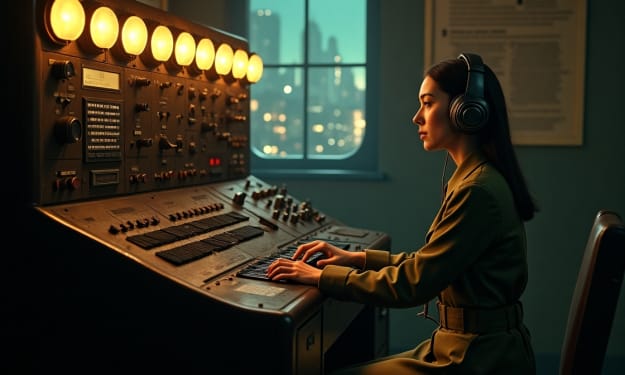
London, 1942 The air in the bunker always smelled like warm dust and electricity. Eleanor Hughes sat hunched over the console, headphones clamped tight over her curls, twisting the dial one meticulous notch at a time. The low hum of static was a comfort now, more familiar than any lullaby from her childhood. At twenty-four, Eleanor had already become a ghost. No records, no name on the payroll, no family allowed to ask where she was. Officially, she was “on war assignment.” Unofficially, she was a wireless operator buried beneath Whitehall, intercepting enemy transmissions and forwarding them up the invisible chain of command. The men called her “The Lady of the Airwaves,” half in jest, half in awe. Unlike most of them, Eleanor didn’t just hear Morse. She listened. That night, the signal came at 2:14 a.m. At first, it sounded like any other scrambled German chatter, but as she filtered through the garble, something caught her ear—English. Not clipped like the BBC, nor American. It was clear, conversational, but... strange. “...repeating for clarity. London, this is Station Echo-One-Seven. If you can hear this—do not dismiss. The year is 2025. I repeat, twenty-twenty-five.” Eleanor froze. The headphones crackled, and her breath caught in her throat. “Anomalies in frequency drift have allowed us temporary contact across time. To whomever receives this: there is a threat. Operation GOLIATH must never proceed. Millions will die. We believe your time is the origin point.” Silence. Then static. She tore off the headphones and stared at the machine as if it had betrayed her. Her pulse thundered. Had she fallen asleep? Hallucinated? Some cruel trick by German intelligence? She logged the incident—every word—and locked the page in her drawer. The next night, the voice returned. “We know how this sounds. But we’ve tracked signal leakage through electromagnetic warping. You’re near the rift’s origin—somewhere under Whitehall. We can’t hold the frequency long.” Eleanor replied. Voice trembling, she pressed the microphone key. “Who are you?” No response. But the messages kept coming. Not nightly, but often enough that she stopped doubting. Names. Places. Dates. Some made no sense—“Bio-cloud over New Delhi,” “Glacial breach, Greenland 2032,” “Synthetic cognition vote 2048.” Yet a few felt terrifyingly close. Operation GOLIATH appeared again and again. A covert weapons initiative involving chemical payloads and a device called the “M-Seed,” something so unstable it was never supposed to be tested. The broadcasts claimed its early prototypes were conceived in 1942, buried in a project Eleanor had never heard of: Midnight Forge. Eleanor took her findings to Lieutenant Greaves, her supervisor, a stiff man with a stiff jaw. He skimmed the report. “You’ve been working long hours. Take a day.” “But sir—” “It’s fantasy, Hughes. Intercepted fiction. Likely Nazi code meant to mislead.” The drawer was locked tighter after that. But something changed. The next broadcast wasn’t a warning. It was a message—personal. “Eleanor Hughes. Born 1918. You played piano at the Rose Street recitals. You lost your brother at Dunkirk. We’re not guessing. We know.” Eleanor’s blood ran cold. “You are the earliest point of contact. We believe it’s because of you. Something about your position, or your biology, or your choices—they anchor the drift.” The voice paused. “You must find the documents hidden in Cabinet 4G, bottom tier, left of the copper valve. They detail the project’s early drafts. GOLIATH begins there.” That night, long after the others had gone, Eleanor took a flashlight and knelt by the storage units near the copper valve. Cabinet 4G. Her hands trembled as she pulled out a file marked “FORGE - Preliminary, 12 Jan 1942.” Inside were diagrams—strange devices, molecular chains, a prototype warhead shaped like a teardrop. She couldn’t make sense of the science, but she knew horror when she saw it. The next day, the cabinet was empty. Every trace of FORGE was gone. She never heard from Station Echo-One-Seven again. Weeks later, Eleanor received orders for reassignment to a different station in Bletchley Park. Before she left, she buried a copy of the files in a tin box beneath a rose bush just outside the bunker. She never spoke of the broadcasts again. London, 2025 A research team restoring old war archives digs near Whitehall during routine renovations. Beneath a rose bush, they find a tin box, wrapped in oilskin, sealed with wax. Inside: faded documents marked FORGE, and a handwritten note. “If the voice ever returns, tell them I listened.” Signed, Eleanor Hughes The Lady of the Airwaves
By Ubaid Khanabout a year ago in History
Roman Forum: Heart of Ancient Rome
Roman Forum: Heart of Ancient Rome The Roman Forum, or Forum Romanum, lies in the very heart of modern Rome, nestled between the Palatine and Capitoline Hills. What today appears as a scattered landscape of ruins was once the epicenter of Roman life—a buzzing hub where politics, religion, commerce, and public discourse flourished for over a millennium. To step into the Forum today is to journey back through layers of history that shaped not just a city, but the entire Western world.
By Mukhtiar Ahmadabout a year ago in History