General
The Town That Never Stopped Talking to the Dead
Most American towns have a story. Some were built around railroads, others grew beside rivers, mines, or factories. Entire communities sprang to life because someone discovered gold, drilled for oil, or saw promise in fertile farmland.
By The Iron Lighthouse4 months ago in History
What Are You Still Pledging Allegiance To?
Tomorrow, an entire nation celebrates the day it quit. Fireworks. Flags. Parades. Kids with sparklers writing their names in the dark. A national holiday built around one uncomfortable decision: the old arrangement stopped deserving us, so we left.
By Thembi Bheka4 months ago in History
The United States at 250: Celebrating Our Nation Through Difficult Times
On July 4, 1776, a group of determined men signed the Declaration of Independence, announcing to the world that thirteen colonies would no longer live under the rule of a king. They declared that liberty, equality, and the right of people to govern themselves were worth fighting for. That moment gave birth to the United States, a nation built not on perfection, but on the enduring belief that freedom is worth every sacrifice.
By Tim Carmichael4 months ago in History
Year 2018: Fun Facts, Trivia, and History
This quick read presents a mix of fun facts, trivia, and history events from the year 2018. Discover the year’s top news stories, most influential people, sports facts, computer and Internet history, erratic weather patterns, entertainment trivia, and much more.
By Gregory DeVictor4 months ago in History
America's Forgotten Concrete Arrows
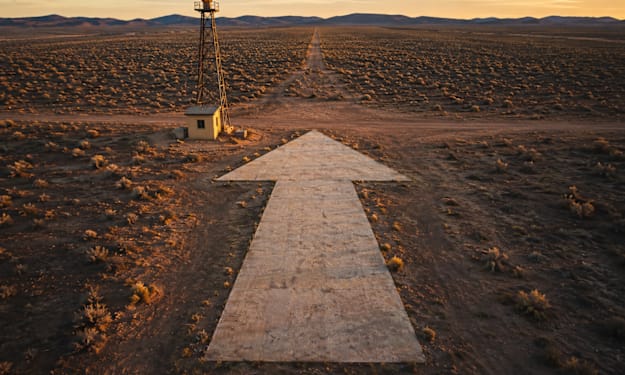
Imagine you're hiking through a lonely stretch of desert in the American West. The landscape is silent except for the wind; sagebrush sways in the distance, and the nearest highway is miles away. Then, without warning, you stumble across something that makes absolutely no sense: a gigantic concrete arrow. It stretches nearly seventy feet across the ground, pointing toward an empty horizon. There are no roads nearby, no signs explaining its purpose, no obvious destination. Just an enormous arrow, weathered by decades of sun and rain, as though some long-forgotten civilization left behind a monument no one bothered to explain. It sounds like the beginning of a mystery novel, but instead, it's one of the most fascinating chapters in American engineering history.
By The Iron Lighthouse4 months ago in History
How China Is Secretly Preparing for Cyberwar China Is Secretly Preparing
At first, Chinese hackers used to dominate global hacking competitions, often securing first place. But after 2017, their presence suddenly disappeared. No one understood why they stopped participating—until an incident in 2019 exposed a much deeper and more concerning story.
By Imran Ali Shah4 months ago in History
Year 1845: Fun Facts, Trivia, and History
This quick read presents a mix of fun facts, trivia, and history events from the year 1845. Discover the year’s top news stories, most influential people, historic firsts, noteworthy inventions, famous birthdays and deaths, retail prices, entertainment trivia, and much more.
By Gregory DeVictor4 months ago in History
Why Challenge Coins and Military Pins Continue to Tell America's Stories. AI-Generated.
Walk into the home of a veteran, an active-duty service member, a firefighter, or a proud military family, and you may notice something small displayed on a shelf or tucked safely inside a presentation case. It could be one of many challenge coins, a carefully preserved military pin, or another keepsake that represents years of service and sacrifice.
By Fallen Yet Not Forgotten4 months ago in History
The Palace Without a King: Power, Perception, and the Battle for Buckingham
For nearly two centuries, Buckingham Palace has stood as the beating heart of the British monarchy. It is more than a residence—it is a symbol. A place where history unfolds, where power is displayed with quiet precision, and where the identity of the Crown has long been anchored. But history, even the most enduring kind, is not immune to change. In a development that has sent ripples through royal watchers and commentators alike, it has been confirmed that King Charles III and Queen Camilla will not make Buckingham Palace their home. Nor, it seems, will the Prince and Princess of Wales choose to reside there in the future. The decision marks a profound shift. For the first time since Queen Victoria established the palace as the monarch’s primary residence in 1837, its role as a lived-in royal home appears to be fading. Yet as one chapter closes, another—far more controversial—threatens to open. Amid the transition, speculation has surged that Prince Harry and Meghan Markle could be granted access to an apartment within Buckingham Palace. The idea, once unthinkable, has ignited debate, disbelief, and no small amount of outrage. At its core, the controversy is not simply about property. It is about symbolism. Harry and Meghan famously stepped away from royal duties in 2020, citing a desire for independence and concerns over security and media intrusion. Their departure—often referred to as “Megxit”—was framed as a clean break from the institution. To now imagine them returning, even partially, to the very center of that institution raises uncomfortable questions. Could the couple who sought distance from royal life become the only ones residing in its most iconic building? The irony is striking. For critics, the notion represents a contradiction too large to ignore. How can those who distanced themselves from royal responsibility occupy a space so deeply tied to it? Would such a move blur the lines between private individuals and working royals, creating confusion about their role and status? For supporters, however, the issue may be more nuanced. Family, after all, exists alongside institution. King Charles is not only a monarch; he is a father and a grandfather. Reports suggest that any potential reconnection with Harry may be motivated less by strategy and more by a desire to maintain relationships with his grandchildren. This human dimension complicates what might otherwise be a straightforward institutional decision. Still, the monarchy does not operate purely on emotion. It functions within a framework where perception is paramount. Every decision, every gesture, carries meaning beyond the personal. And in this context, the possibility of Harry and Meghan residing at Buckingham Palace introduces a narrative that the monarchy may struggle to control. At the same time, a different dynamic is unfolding within the royal family itself. While King Charles appears open—at least in principle—to maintaining some level of connection, Prince William is said to have taken a firmer stance. Reports indicate that he has distanced himself from the ongoing situation, choosing not to engage publicly or privately with the narrative surrounding his brother. This contrast in approach highlights a deeper question about leadership within the monarchy. Should the institution prioritize reconciliation, even at the risk of mixed messaging? Or should it enforce clear boundaries to preserve its structure and public image? There is no easy answer. What is clear, however, is that the Sussexes continue to occupy a unique and often contentious position within the broader royal story. Their actions, from media projects to public statements, have ensured that they remain part of the conversation—even from across the Atlantic. At the same time, their attempts to shape narratives have not always been met with the response they may have hoped for. In the digital age, influence is measured not only by visibility but by engagement. Efforts to establish authority, whether through media ventures or public messaging, can quickly be tested by audience reaction. And in some cases, the results reveal a gap between intention and impact. This evolving media landscape adds yet another layer to the situation. The monarchy, once defined by tradition and controlled communication, now exists within a world of constant scrutiny and rapid response. Narratives are no longer dictated from a single source—they are contested, reshaped, and amplified across platforms. Against this backdrop, Buckingham Palace itself becomes more than a building. It becomes a stage upon which these tensions play out. If the palace is no longer a primary residence for senior working royals, its meaning inevitably shifts. It remains a site of ceremonies, state functions, and national identity—but its role as a lived symbol of monarchy changes. And in that space of transition, speculation thrives. The idea of Harry and Meghan returning, even temporarily, captures attention because it sits at the intersection of contradiction and possibility. It challenges assumptions about what the monarchy is—and what it might become. Ultimately, whether or not such a scenario materializes, the conversation it has sparked reveals something significant. The monarchy is in a period of redefinition. Traditions that once seemed fixed are being reconsidered. Roles that were once clearly defined are becoming more fluid. And the balance between personal relationships and institutional responsibility is being tested in new ways. For King Charles, the challenge lies in navigating these changes while maintaining stability. For Prince William, it may lie in shaping the future with clarity and consistency. And for Harry and Meghan, it lies in determining where they truly stand—both within and outside the royal world they left behind. As Buckingham Palace enters this new chapter, one thing is certain: Its walls may remain the same, but the story unfolding within them is changing. And in that story, every decision—whether made or merely imagined—carries the weight of history.
By Behind the Curtain4 months ago in History
Maria Tallchief: Ballet, Discipline, and an Enduring American Legacy
By Brian D'Ambrosio During the late 1940s and 1950s, Maria Tallchief was one of the central figures in the emergence of American ballet. Her technique—fast, exacting, and musically alert—fit naturally into the choreography of ballet master George Balanchine and helped define a new American standard for this classical dance.
By Brian D'Ambrosio 4 months ago in History
John Clare Voice of the English Countryside
Most people have never heard of John Clare, yet he wrote some of the most vivid nature poetry in English literature. John Clare emerged from rural England during the late eighteenth and early nineteenth centuries, bringing a voice shaped by farm life, seasonal work, and close observation of the natural world. Born in Helpston in Northamptonshire in 1793, he grew up in a family of agricultural laborers where daily survival depended on field work and local trade. This environment became the foundation of his poetic imagination.
By Tim Carmichael4 months ago in History