Fiction
Atomic Bomb
It was two days after the atomic bomb was dropped on Hiroshima, on August 6, 1945, that an extraordinary event unfolded. An American fighter pilot, Marcus McDilda, was captured by the Japanese. McDilda, a pilot of a P-51 Mustang bomber, had been part of the American bombing raids on Japan for months, contributing to the relentless attacks that killed thousands.
By Humara kalimabout a year ago in History
Lost Art of Atropos Radsla
“This next unit is the final unit of the day. Unit A09.4.01.003 in section TA98. You’ll have a thirty second preview of the contents and then the bidding will begin at three hundred and fifty dollars. If you cross the yellow line, you will be disqualified,” said Kooky Kevin of Kooky Kevin’s Storage Emporium. He twirled his el bandito mustache in one finger and started a timer as his mousy assistant slid open the unit.
By Amos Gladeabout a year ago in History
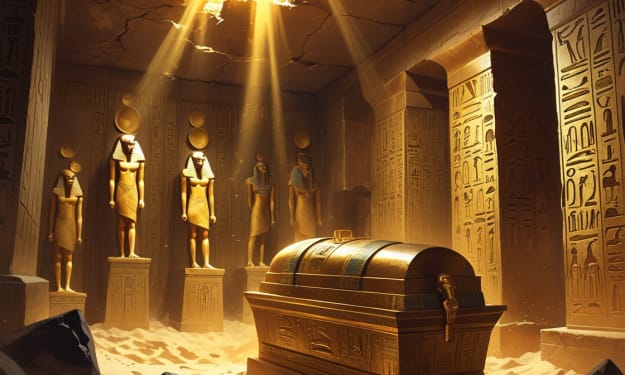
The Malediction of the Pharaoh’s Gold: Vanished Wealth of the Egyptian Desert
The Myth Commences In the core of ancient Egypt, during the reign of a formidable yet lesser-known pharaohNeferkare Djedkarea substantial quantity of gold was amassed. This was not merely opulence for royal extravagance; it was designated for a divine purpose: to assist the pharaoh in his voyage to the afterlife and to maintain the splendor of Egypt beyond existence. According to a now-missing segment of the Book of the Dead, Djedkare commanded the construction of a secret temple beneath the sands of the Western Desert, well removed from the Nile and beyond the reach of tomb infiltrators. There, gold effigies, gilded scrolls, and amulets were interreditems intended not for the gaze of mortals. The temple was secured with a malediction, cautioning that those who disturbed the resting place would invoke doom upon themselves. Pharaoh Djedkare and His Era Djedkare Isesi, a genuine historical pharaoh of the Fifth Dynasty, governed approximately 2414–2375 BCE. Though not as renowned as Ramses II or Tutankhamun, Djedkare was acknowledged for reorganizing the Egyptian state, expanding trade pathways, and fostering religious transformations. Under his sovereignty, Egypt attained new administrative peaks, while also beginning to shift focus from pyramid construction to concealed tombs and spiritual safeguarding. Djedkare’s tomb in Saqqara was recognized, but legends assert that he had another clandestine burial chamber created for the true treasures of his reignone that remains undiscovered to this day. The Malediction of the Pharaoh’s Gold Tales transmitted through generations recount the Malediction of the Pharaoh’s Gold. The curse was not merely a supernatural menace, but a series of lethal traps and natural perilities devised to protect the hallowed treasure. Ancient inscriptions, deciphered in the early 20th century, reportedly stated: “He who pursues the gold of the sun will consume sand and silence. The jackal will feast on the bones of the avaricious. Let the sacred repose remain undisturbed. ” Whether figurative or literal, the curse was believed to wield genuine power. Explorers who ventured in search of this lost tomb frequently vanished, descended into madness, or encountered tragic destinies. The Lost Expedition of 1898 In 1898, British Egyptologist Sir Edwin Brackley spearheaded an expedition into the Western Desert, motivated by recently uncovered scrolls pertaining to the Sanctuary of Eternal Light, thought to be Djedkare’s hidden temple. His team consisted of local guides, a photographer, and camel drivers. They departed from Dakhla Oasis and proceeded westward. According to Brackley’s journallast retrieved from a camel driver who returned alonethe group encountered peculiar ruins obscured beneath sand dunes. There were indications of an entombed structure, with shimmering fragments of gold leaf and hieroglyphs cautioning against divine retribution. The final entry in Brackley’s journal stated: “We discovered it. The sand quakes. Something observes. ” The entire team disappeared. No remains, no tents, no artifacts were ever unearthedonly scattered journals and a shattered camera lens located a year later. Modern Endeavors and Satellite Observations In recent decades, contemporary archaeology has introduced renewed optimism to the legend. Infrared satellite imaging and ground-penetrating radar have disclosed subterranean irregularities in remote desert locales, potentially artificial structures concealed beneath centuries of sand. A 2013 expedition financed by a European-Egyptian archaeology partnership reported a significant rectangular void northwest of the Black Desert, too symmetrical to be natural. However, extreme heat, shifting dunes, and governmental constraints have hindered comprehensive excavation. Several scholars contend that these irregularities may indicate a concealed burial sitepotentially the mythical Sanctuary of Eternal Light.
By Say the truth about a year ago in History
The Concealed Wealth of the Khmer Empire: Treasure of the Hidden Pagoda. AI-Generated.
The Splendor of the Khmer Empire At its zenith between the 9th and 15th centuries, the Khmer Empire governed vast territories that comprise present-day Cambodia, Thailand, Laos, and Vietnam. Its capital, Angkor, emerged as one of the most extensive and sophisticated urban centers in the pre-industrial era. The Khmer monarchs constructed grand temple complexes such as Angkor Wat and Bayon, fusing spiritual reverence with architectural excellence. Gold circulated abundantly within the empire, attributed to extensive trade routes connecting with India, China, and Arabia. The opulence of the Khmer was not merely for embellishmentit held religious significance. Gold was regarded as a divine material, frequently utilized to embellish statues, temple facades, and sacred artifacts. However, as the empire began to wane in the 15th century, whispers of a concealed pagodaan ultimate treasury intended to safeguard the kingdom’s spiritual and material wealthstarted to surface. The Tale of the Golden Pagoda Khmer oral traditions, transmitted through generations, recount the existence of a "Golden Pagoda" constructed during the empire's final years. Commissioned by a dying monarch, the pagoda was believed to be situated deep within an undisclosed jungle valley, encircled by moats and protected by sacred stone figures. This temple, referred to in local lore as Phnom Meas (Golden Hill), was purportedly adorned with gold leaf, its walls embedded with rubies and emeralds. Internally, the pagoda was said to contain: Enormous golden statues of Buddha and Hindu deities. Chests filled with royal jewels and ceremonial blades. Gold coins, trinkets, and relics from vanquished realms. To thwart foreign plunderers, the pagoda was rumored to be buried or concealed with traps and curses, safeguarded by monks who never departed the premises. Historical Indications and European Records As European explorers began to venture into Cambodia in the 16th and 17th centuries, they noted local tales of temples filled with gold hidden within the forest. Portuguese and French missionaries chronicled elusive ruins, distant golden towers visible from riverboats, and villagers murmuring about forbidden territories no outsider ought to pursue. In 1860, French naturalist Henri Mouhot famously "rediscovered" Angkor Wat for the Western audience. His accounts ignited a surge of interest in Cambodia’s lost civilizations. Nevertheless, Mouhot also documented peculiar reports from local guides about a golden sanctuary “deeper in the jungle than any man dared to venture. ” These accounts have never been substantiated, yet they have incited speculation over the centuries. Contemporary Expeditions and Search Efforts Since the 20th century, numerous expeditions have been initiated to locate the elusive Golden Pagoda. A significant number of these endeavors concentrated on remote locations adjacent to the Kulen Mountains and the Cardamom Rangeareas characterized by dense forests, rugged landscapes, and uncharted ruins. In 2007, a group of archaeologists employing LIDAR (Light Detection and Ranging) unearthed several previously unrecognized temples concealed beneath jungle undergrowth near Angkor. These included road systems and settlements long presumed to have vanished. Some scholars speculated that they were nearing the solution to the enigma of Phnom Meas. Despite these findings, no definitive proof of a gold-clad temple has ever been conclusively discovered. Theories and Discussions A variety of theories envelop the origin and authenticity of the Golden Pagoda legend: Symbolic Wealth: Some scholars contend that the pagoda signifies spiritual richesenlightenment or wisdomrather than actual gold. Vandalized by Invaders: Others propose that the treasure may have existed but was plundered or melted down by the Siamese (Thai) invaders who ravaged Angkor in the 15th century. Still Concealed: An increasing number of independent researchers and treasure seekers hold the belief that the Golden Pagoda remains hidden, buried beneath centuries of vegetation and protected by booby-trapped paths or unexploded munitions from Cambodia’s recent conflicts.
By Say the truth about a year ago in History
The Lost Golden Temple: Unraveling the Enigma of a Neglected Wonder
The Tale of the Golden Temple Throughout ancient societiesfrom the thick forests of Southeast Asia to the peaks of South Americamyths recount a splendid temple erected not from stone or timber, but from pure gold. According to various cultural narratives, this edifice served not only as a place of veneration but also as a treasury of unimaginable riches, sacred relics, and esoteric wisdom. While numerous locales assert to have sheltered such a temple, one narrative, in particular, stands outthe myth of the Golden Temple of the Sun, believed to have flourished within the ancient Incan Empire, near present-day Peru. The Temple of the Sun: A Neglected Marvel The most enduring legend revolves around the Coricancha (translated as “Golden Courtyard”), the hallowed temple dedicated to the sun deity Inti in the heart of Cusco, Peru. Initially constructed by the Inca and subsequently altered by Spanish colonizers, this sanctuary was once adorned with layers of gold, showcasing golden statues, altars, and even vegetation fashioned entirely from precious metal. According to Spanish conquistadors who arrived in the 16th century, the temple dazzled with its brilliance: Walls clad in gold. Golden effigies towering above visitors. Life-sized golden llamas, maize fields, and altars devoted to the sun. The Coricancha was not merely a site of worship; it was the spiritual and economic nucleus of the Inca Empire. Priests performed rituals, monitored celestial movements, and safeguarded royal treasure in subterranean vaults. The Conquest and Vanishing When Francisco Pizarro and his men reached the Andes, they were astonished by the wealth they encountered. However, their astonishment rapidly transformed into avarice. The Spanish plundered the Coricancha and other shrines, melting the gold and dispatching it back to Spain. Nevertheless, Incan chronicles and oral histories recount a divergent narrativeone of strategic defiance. As tidings of the Spanish incursion spread, Incan priests and nobles allegedly smuggled a significant portion of the treasure out of Cusco before it could be seized. The fate of this concealed gold has remained a mystery for centuries. Some accounts suggest it was taken deep into the jungles to the east of the Andes, to a clandestine temple constructed entirely of goldnever discovered by outsiders. El Dorado and the Temple Association The myth of a Golden Temple soon intertwined with another South American legend: El Dorado, the city of gold. Early explorers believed that within the unexplored interior, a city or temple shimmered in sunlight, its rooftops and spires adorned with pure gold. Numerous expeditions were undertaken: Spanish explorers such as Gonzalo Pizarro and Francisco de Orellana journeyed into the Amazon basin in pursuit of it. English navigators during the 17th century chased tales of a solar temple concealed within the Orinoco or Magdalena rivers. Throughout the 20th century, satellite imagery and archaeological assessments perpetuated the searchalbeit without achievement. Nonetheless, the legend of the temple persisted. Other Theories and Global Resonances Beyond South America, other cultural reflections of a golden temple exist: In India, the Golden Temple of Amritsar stands todayhowever, it is a subsequent creation from the 16th century CE and constructed more symbolically than mythically. Ancient Khmer folklore alludes to a golden shrine hidden within the Cambodian jungle, potentially predating Angkor Wat. In China, Taoist writings reference a mystical “Palace of the Golden Phoenix” situated in a mountain shrouded in mist, though historians have yet to validate its existence. Each narrative implies humanity’s fascination with sacred sites composed of the most enduring substancegold. Is the Golden Temple Authentic? Skeptics contend that the notion of a temple entirely fashioned from gold is logistically improbable, particularly in ancient epochs. Gold is pliable and dense, unsuitable for structural stability. Nevertheless, as a symbolic façade or ceremonial covering, its application is feasibleespecially in a culture where spiritual contributions were intertwined with material affluence. Archaeological excavations in Cusco have verified that Coricancha was indeed covered in gold prior to the Spanish incursion. Numerous Inca artifacts retrieved from cave systems and subterranean rivers bolster the hypothesis that substantial hoards of gold were deliberately concealed. Could the fabled Golden Temple have been an actual siteperhaps an extension or hidden sanctuary constructed by the Incas in exile? The Pursuit Persists Contemporary innovationsLIDAR, satellite imaging, and ground-penetrating radarhave unveiled new possibilities in the quest for the Golden Temple. Explorers continue to examine remote areas of the Andes and the Amazon, discovering ruins, pathways, and previously unidentified settlements. Yet, the temple itself remains elusive. Whether concealed beneath the soil, obscured by foliage, or merely a symbol of spiritual wealth lost to the annals of time, the Golden Temple endures as one of history’s most captivating enigmas. Conclusion The Golden Temple signifies more than mere architectural aspirationit embodies the zenith of ancient devotion, the human longing for immortality through prosperity, and the narratives that transcend even empires. Until it is discoveredor definitively established as a myththe legend will continue to illuminate, captivating the souls of treasure seekers and historians alike.
By Say the truth about a year ago in History
The Roux Where it Happened
James held the thick iron pan over the fire with practiced hands. As the butter melted, he mixed in the flour until the grainy texture gave way to a smooth paste. The deep, nutty aroma of the roux suffused the cramped kitchen and transported him back to the Champs-Élysées. James heaved a deep sigh. He never should have left Paris. There he was a free man. It was not an easy life, but at least it was his own.
By Alexander Not a Dumasabout a year ago in History
"One of the Most Powerful Empires in History: The Story of the Ottoman Sultanate"
History of the Sultanate of the Ottomans (Ottoman Empire) The Ottoman Empire, known in Arabic as الدولة العثمانية (al-Dawlah al-‘Uthmāniyyah) and in Turkish as Osmanlı Devleti, was one of the most powerful and enduring empires in world history. Founded at the end of the 13th century, it lasted for over 600 years until its official dissolution in 1922. The Ottoman Empire was a multi-ethnic, multi-religious empire that played a crucial role in the history of Europe, Asia, and Africa.
By Mushtaq Aliabout a year ago in History
The Abandoned Wealth of Emperor Nero: Gold Amidst Infernos. AI-Generated.
The Ascendance of a Golden Sovereign Nero Claudius Caesar Augustus Germanicus ascended to the throne in 54 CE at the tender age of 17. Although youthful, Nero wielded considerable authority, inherited from a complicated lineage of Julio-Claudian rulers tracing back to Augustus. With the Roman Empire at its zenith in terms of territory and commerce, Nero assumed the imperial position during a period of extraordinary affluence. His mother, Agrippina the Younger, facilitated his rise to power, manipulating court dynamics and eliminating adversaries. However, Nero would soon declare his autonomynot merely through absolute governance but by expending funds at a scale that astonished even the elite of Rome. The Origins of Nero’s Wealth Nero’s fortune was derived from various streams: Imperial Taxation: Provinces throughout Europe, North Africa, and Asia Minor rendered tribute to Rome. Taxes on agriculture, commerce, and property ownership flowed into the imperial treasury. Confiscations: Nero had a notorious proclivity for accusing senators and elites of treason or conspiracy. Their assets were appropriated and added to the state (or his personal) treasury. This strategy both enriched him and eliminated political dangers. Commerce and Tribute: The Roman Empire's extensive trading network, particularly in luxury commodities from the Eastsuch as spices, silk, and gemstonesproduced substantial profits. Conquered regions also presented valuable tributes including gold, silver, and enslaved individuals. Mining and Coinage: Nero oversaw the empire’s mining activities in Hispania (Spain), Gaul, and the Balkans. He adulterated the Roman currency by diminishing the silver content in coinsan expedient that enhanced imperial liquidity but compromised long-term economic stability. Nero’s Opulence: The Golden House One of Nero’s most renowned expenditures of imperial wealth was the creation of the Domus Aurea, or Golden House. Following the Great Fire of Rome in 64 CEwhich some accounts claim Nero instigated, although evidence remains ambiguoushe appropriated a substantial expanse of central Rome to construct his palace. The Golden House was a residence unlike any other in Roman annals: Its corridors were adorned with gold leaf and precious gemstones. Rooms boasted revolving ceilings that showered fragrances and rose petals. Artificial lakes and expansive gardens encircled the edifice. A colossal effigy of Nero, the Colossus Neronis, towered outsidesurpassing 100 feet in height. This architectural wonder epitomized both the pinnacle of Nero’s wealth and the extravagance that alienated Rome’s citizens and senators from him. Financing Extravagance: Performances and Campaigns Nero perceived himself not merely as an emperor but as a creator and entertainer. He financed extravagant games, theatrical productions, and musical competitionsmany of which showcased him as the main attraction. Audiences were frequently obligated to attend and applaud his performances. In 66 CE, Nero initiated an expensive expedition in Greecenot for conquest, but to tour cities and perform. He returned with thousands of accolades and trophies, though they were predominantly symbolic; the journey depleted the state treasury. The Decline of Nero and the Disappearance of His Wealth By 68 CE, public discontent, military uprisings, and political opposition reached a pinnacle. The Senate proclaimed Nero a public adversary. Confronted with arrest and execution, Nero took his own life on June 9, 68 CE, reportedly exclaiming, "What an artist dies in me! " What transpired with his extensive fortune after his demise? Theories and Historical Narratives: Confiscated by Successors: Galba, Otho, and Vitelliuswho succeeded Nero during the chaotic "Year of the Four Emperors"likely appropriated portions of the imperial treasury to support their own aspirations for authority. Concealed Reserves: Some speculate that Nero concealed portions of his wealth in subterranean vaults or private villas prior to his death. Treasure seekers have long conjectured about hidden troves beneath the remnants of the Golden House. Destroyed or Dispersed: With the conflagration of the palace and plundering by soldiers, a significant portion of Nero’s wealth may have been lost. Priceless artworks, manuscripts, and coins likely vanished amid the turmoil. Transformed into Public Structures: Emperor Vespasian, who ultimately restored stability, repurposed the area of Nero’s palace to construct the Colosseum, reclaiming the site for civic use. Some of Nero’s appropriated funds may have subsidized this transformation. The Quest for Nero’s Treasure Today Parts of the Domus Aurea have been unearthed in Rome, revealing frescoes, gilded ceilings, and intricate mosaics. However, no treasure troves have been discoveredleading many to surmise they were either looted or remain concealed.
By Say the truth about a year ago in History