Events
The Hyksos Invasion
More than 3,700 years ago, a significant transformation occurred in Egyptian history. The conclusion of the Middle Kingdom marked the beginning of a tumultuous phase characterized by political instability and social upheaval, now referred to as the Second Intermediate Period. This time was akin to a real-life Game of Thrones, with various factions vying for power until an unforeseen winner arose: the Hyksos, an outsider group that took control of Egypt. But who exactly were the Hyksos, and what strategies enabled them to conquer one of the ancient world's most formidable civilizations?
By A História2 years ago in History
The Hidden Treasure of the Mayan Pyramid
The Hidden Treasure of the Mayan Pyramids: Myths, Discoveries, and Wealth Introduction The Maya civilization, one of the most advanced and mysterious ancient cultures, flourished in Mesoamerica for thousands of years. Their towering pyramids, elaborate temples, and intricate cities have fascinated historians and archaeologists for centuries. Among the many enigmas surrounding the Maya, one of the most intriguing is the legend of their hidden treasures. Gold, jade, and sacred artifacts are believed to be buried beneath the massive pyramids, concealed within underground chambers and undiscovered tombs. But how much of this is legend, and how much is fact? This article explores the mystery of the Mayan hidden treasure, the wealth they accumulated, and ongoing efforts to uncover their secrets. The Mayan Civilization and Their Wealth The Maya civilization, which thrived from 2000 BCE to the Spanish conquest in the 16th century, was known for its wealth and trade. They did not use currency in the way we do today but relied on valuable goods such as cacao beans, jade, obsidian, and gold for trade. Some of their wealth came from extensive trading networks that stretched from present-day Mexico to Central America. Gold and silver, though not as highly valued by the Maya as jade, were still present in ceremonial objects and jewelry. These precious metals were often used in religious offerings and buried with the elite rulers and priests. Unlike the Aztecs and Incas, the Maya didn’t create large hoards of gold but instead distributed their wealth in temples, tombs, and hidden chambers. The Legend of the Mayan Treasure The belief in a hidden Mayan treasure stems from both historical accounts and local legends. Some Spanish conquistadors, after witnessing the wealth of the Maya, wrote about golden artifacts that were hidden deep within temple pyramids or underground caves. Unlike the Aztecs, who amassed large amounts of gold, the Maya often buried their treasures as part of their religious rituals. One of the most famous stories involves the legendary treasure of King Kʼinich Janaabʼ Pakal, the great ruler of Palenque. His tomb, discovered in the Temple of the Inscriptions in 1952, contained an exquisite jade mask, intricate jewelry, and a magnificent sarcophagus. However, many believe even greater treasures remain undiscovered in other pyramids across the region. Major Discoveries of Mayan Treasure 1. The Tomb of Pakal the Great In 1952, archaeologist Alberto Ruz Lhuillier uncovered the tomb of Kʼinich Janaabʼ Pakal in the Temple of the Inscriptions, located in Palenque, Mexico. Inside, he found a jade death mask, intricate carvings, and numerous artifacts. This discovery proved that the Maya buried their elite rulers with precious items. 2. The Cenote of Sacrifice – Chichén Itzá At the sacred cenote (sinkhole) of Chichén Itzá, divers have recovered gold disks, jade figurines, and other offerings thrown into the water as sacrifices to the gods. These findings suggest that more treasures may be hidden in other sacred water sources. 3. The Burial Chambers of Tikal Excavations at Tikal, one of the largest Mayan cities, have uncovered tombs filled with jade, gold, and ceremonial objects. Some pyramids remain unexplored, leading researchers to believe more hidden treasures may exist. Where Could the Hidden Treasure Be? Despite numerous discoveries, many archaeologists believe vast amounts of Mayan treasure are still hidden. Some possible locations include: Undiscovered chambers within pyramids – Many pyramids have not been fully excavated, and advanced scanning technology has recently revealed hidden chambers within structures such as the Temple of Kukulcán in Chichén Itzá. Underground caves and tunnels – The Maya considered caves as sacred places, often using them for religious rituals and burials. Some caves, such as the Balamku cave discovered in 2018, contained ancient offerings. Rainforest-covered ruins – Many Mayan cities remain buried beneath the dense jungles of Guatemala, Belize, and Mexico. New LiDAR (Light Detection and Ranging) technology has revealed hundreds of lost structures that could contain hidden artifacts. Estimated Net Worth of Mayan Treasure It is impossible to put an exact value on the hidden Mayan treasures, but based on discovered artifacts and historical trade, experts estimate their worth in the billions. Some factors contributing to this estimation include: Jade artifacts – Priceless due to their cultural significance and rarity. Gold and silver objects – Though not as abundant as in Aztec or Incan cultures, recovered Mayan gold objects suggest hidden hoards. Ancient manuscripts and carvings – Many Mayan codices and artworks are invaluable historical treasures. Conclusion The hidden treasures of the Mayan pyramids continue to captivate the world. While many artifacts have been discovered, vast riches likely remain buried within undiscovered tombs, sacred caves, and forgotten cities. With modern technology aiding archaeological exploration, it may only be a matter of time before new discoveries rewrite our understanding of Mayan wealth and history.
By Say the truth 2 years ago in History
Three Temples of Solomon - The Mysterious Story
The story of the Red Cow is well-known to everyone. It is a cow mentioned in the Old Testament. Perhaps you have seen the episode and witnessed the red cows, or maybe you already knew about them. But hasn’t curiosity struck you? What are they waiting for? Why would slaughtering it be a reason for the construction of their alleged Third Temple? And if the awaited temple is indeed the Third Temple, what is the story of the first and second temples? How did it all begin, and where? Those who are not informed about this topic today, which is considered the foundation of the existential conflict of the nation, are ignorant. If you wish to learn more about it, you must prepare yourself, as you will dive into a sea of shocking information that has been hidden from you. You will be surprised to find that this entire conflict might not truly belong here, and that major figures have been eliminated to prevent the leakage of this information. Then, you will face the most important question: Is the temple real to begin with? And if it is real, was it truly in the land of Palestine, or in a far, faraway place? Is the Ark of the Covenant, which was and still is the basis of this search, truly real? And the shocking secret you might be unaware of—is the term "temple" truly linked to Syria, Yemen, Ethiopia, and Yasser Arafat? The questions are many and complex, but I must try to connect them so that you can understand the truth and be informed of every detail in this battle. So, take a deep breath and stay focused, because today we will search anew for the Temple of Solomon.
By QuirkTales2 years ago in History
Witnessing History: Once-in-a Lifetime Experience
Witnessing History: A Once-in-a-Lifetime Experience Life is an unpredictable journey filled with experiences that shape our perspectives and memories. The image above encapsulates some of the most significant events that our generation has witnessed, each leaving a deep impact on society. From global crises to moments of national pride, these experiences have defined an era.
By Ramesh Mahato 2 years ago in History
The Eternal Shadow of War
Throughout history, humanity has encountered a myriad of governance systems, ideologies, beliefs, and languages, leading to the emergence of diverse civilizations worldwide. However, one enduring element has persisted across all cultures and eras: war. In contemporary times, we observe ongoing conflicts reported by various media, with the war in Ukraine, following Russia's invasion, standing out prominently. Other significant conflicts, such as the enduring civil war in Syria and escalating tensions involving nations like China and Taiwan, as well as Niger, Nigeria, and Ghana, serve as reminders that war remains a fundamental aspect of human existence.
By A História2 years ago in History
How Should Canines Stay Healthy?. Content Warning.
Canines are something past pets; they are unwavering companions, protectors, and family members. Ensuring that they stay strong is a commitment every canine owner should see in a serious manner. Particularly like individuals, canines require genuine thought, sustenance, work out, and clinical mindfulness in regards to continue with a long and euphoric presence. In this article, we will research various approaches to keeping canines strong and prospering.
By MD.NAIM MIAH2 years ago in History
Ancient Egypt Breakthrough Archaeologists Uncover Stunning Discovery.
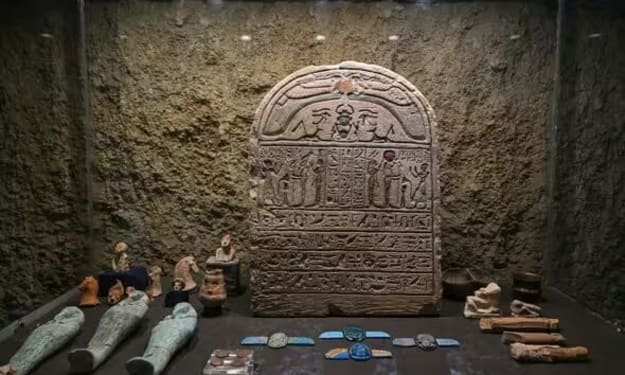
Ancient Egypt Breakthrough Archaeologists Uncover Stunning Discovery. A long lost world buried beneath the sands of time has once again emerged revealing secrets hidden for thousands of years. Egypt a land of mystery where every stone tells a tale, has become the center of global attention once more. In Luxor the very place where Pharaoh Tutankhamun’s tomb was uncovered in 1922 archaeologists have made a groundbreaking discovery one that is being hailed as a reconstruction of history. This remarkable find includes tombs coffins and artifacts that shed new light on ancient Egyptian life religious practices and funerary rituals opening doors to understanding one of the world’s oldest civilizations in a way never seen before. This is no ordinary excavation it is a glimpse into a civilization that thrived over 3,600 years ago now uncovered hundreds of feet beneath Luxor. Archaeologists have discovered 11 wooden coffins including one belonging to a child. These coffins were carefully placed within rock cut tombs and burial shafts, reflecting the ancient Egyptian belief that such burial sites provided spiritual protection for the deceased in the afterlife.
By Adnan Rasheed2 years ago in History
The Lionheart’s Legacy
You have likely encountered representations of Richard the Lionheart in various forms of media, including films, literature, and video games. Officially recognized as Richard I, he ascended to the throne of England on September 3, 1189, and is celebrated as one of the most esteemed rulers in English history. His legacy, however, is woven with threads of bravery, intrigue, and controversy, rendering him a figure as captivating as any from the realm of fantasy. This is the tale of Richard the Lionheart—the monarch who achieved legendary status.
By A História2 years ago in History
10 Historic Trade Wars That Shaped the World
Trade wars might sound like dry economic disputes, but history proves they can be as dramatic as actual battles. From bizarre tariffs on chickens to economic policies that deepened the Great Depression, here are ten historic trade wars that surprised the world.
By Only Incredible2 years ago in History
China’s Argent Empire: The Barter That Shaped the World
The Chinese Argent Trade: A Abundance of Empires Introduction The Chinese argent barter was one of the best affecting bread-and-butter armament in apple history, abstraction all-around business from the 16th to the 19th century. China became the world's better customer of silver, arch to all-inclusive barter networks that spanned Asia, Europe, and the Americas. This commodity explores the origins, scale, and appulse of China's argent trade, including estimates of its absolute worth, how argent was acquired, and area it ultimately went. Why Did China Barter in Silver? The Ming Dynasty’s Taxation System During the backward Ming Dynasty (1368–1644), China transitioned to a silver-based economy. The government alien a tax ameliorate accepted as the Single Whip Law, acute all taxes to be paid in argent instead of goods. This ameliorate created an astronomic appeal for silver, bidding merchants and adopted traders to seek ample food from across sources. Preference for Argent Over Gold Unlike abounding added nations that acclimated gold as their primary bill reserve, China had an affluence of appurtenances like silk, tea, and ceramics but lacked ample calm argent mines. This alterity led to China acceptable a above importer of silver.
By Say the truth 2 years ago in History
The Wealth and Power of the Greatest Land Empires in History
The Greatest Acreage Empires in History: Their Wealth, Acreage Area, and Rule Throughout history, all-inclusive empires accept risen and fallen, abstraction civilizations, trade, and cultural evolution. Some of these empires controlled massive acreage areas, accession abundant abundance and cardinal over assorted populations. This commodity explores the better acreage empires in history, estimates their net worth, and examines their babyminding methods. 1. Mongol Authority (1206–1368) - The Better Acreage Empire Land Area: ~24 actor aboveboard kilometers Estimated Net Worth: Trillions in today’s value How They Ruled: The Mongol Empire, founded by Genghis Khan, was the better abutting authority in history. The Mongols controlled acreage addition from China to Eastern Europe, utilizing aggressive tactics, cerebral warfare, and adept strategies. They accustomed the Pax Mongolica, a aeon of adherence that added barter forth the Cottony Road. Their taxation arrangement and annexation of baffled cities brought immense wealth. 2. British Authority (1583–1997) - The Better Overseas Empire Land Area: ~35.5 actor aboveboard kilometers at its peak Estimated Net Worth: $45 abundance (estimated by economists) How They Ruled: The British Empire, the better authority by absolute landmass, controlled colonies beyond Africa, Asia, and the Americas. It accumulated abundance through trade, industrialization, and ability exploitation. The British accustomed authoritative systems, railway networks, and acknowledged frameworks, admitting generally at the amount of bounded populations.
By Say the truth 2 years ago in History