Events
Slow White and the 7 Doughs
In a world where stories come and go, one tale has stood the test of time, captivating the hearts of children everywhere. "Slow White and the 7 Doughs" is more than just a story, it's a phenomenon that has been delighting kids for generations. Growing up as a child, this Animated story,was one of the stories that Inspired me. It captured my Heart in a way that I understood how to be gentle,lovely, peaceful and embarking on Adventure whether it is fearful or not. I understand that life with determination, grace, confidence fears no dark or threatening moments. The Story Begins In a small village nestled in the rolling hills of a far-off land, there lived a lovable character named Slow White. Slow White was a kind and gentle soul, with a heart of gold and a mind full of wonder. One day, while wandering through the village, Slow White stumbled upon a mysterious shop tucked away on a quiet street. The sign above the door read "The 7 Doughs." The Magical Doughs Inside the shop, Slow White met the enigmatic owner, a wise and witty baker named Doughy. Doughy introduced Slow White to the 7 Doughs, each with its own unique personality and magical properties. There was Fluffy, the soft and cuddly dough; Sparky, the lively and energetic dough; and Dreamy, the gentle and soothing dough, among others. Path of Exploration As Slow White spent more time with the 7 Doughs, they embarked on a series of thrilling adventures together. They explored enchanted forests, climbed towering mountains and even sailed across vast oceans. Along the way, Slow What learned valuable lessons about friendship, perseverance and the power of imagination. A Story for the Ages "Slow White and the 7 Doughs" has become a beloved tale, cherished by children and parents alike. The story's universal themes and lovable characters have transcended cultures and generations, making it a timeless classic. The tale has been translated into countless languages, adapted into films, plays and television shows and has inspired countless works of art and literature. Why It Endures So, what makes "Slow White and the 7 Doughs" so special? For one, the story's focus on empathy, kindness and self-discovery resonates deeply with children. The tale also celebrates the importance of imagination, creativity and exploration. Moreover, the story's gentle pace and whimsical tone make it an ideal bedtime read or a soothing distraction from the stresses of modern life. A Legacy That Continues Today, "Slow White and the 7 Doughs" remains a topic of conversation among parents, educators and child development experts. The story's impact on children's literature and popular culture is undeniable. As a testament to its enduring appeal, new adaptations and interpretations of the tale continue to emerge, introducing the beloved characters to fresh audiences around the world. Furthermore "Slow White and the 7 Doughs" is more than just a story – it's a cultural phenomenon that has captured the hearts of children everywhere. Its timeless themes, lovable characters and whimsical tone have made it a beloved classic, ensuring its place in the pantheon of children's literature for generations to come. The Impact on Children's Literature "Slow White and the 7 Doughs" has had a profound impact on children's literature, inspiring a new generation of authors and illustrators. The story's unique blend of imagination, adventure and emotional intelligence has raised the bar for children's storytelling. A Reflection of Childhood The tale's exploration of childhood emotions, from curiosity and wonder to fear and uncertainty, has resonated deeply with young readers. The story's ability to validate and normalize children's feelings has made it a valuable resource for parents and educators. A Cultural Phenomenon "Slow White and the 7 Doughs" has transcended the world of children's literature, becoming a cultural phenomenon that has inspired countless adaptations and interpretations. From films and television shows to stage plays and musicals, the story's beloved characters and timeless themes have captivated audiences worldwide. A Timeless Legacy As we look to the future, it's clear that "Slow White and the 7 Doughs" will continue to enchant children and families for generations to come. Its timeless legacy is a testament to the power of storytelling and the boundless imagination of childhood. Conclusion In conclusion, "Slow White and the 7 Doughs" is a story that has captured the hearts of children everywhere. Its timeless themes, lovable characters, and whimsical tone have made it a beloved classic, ensuring its place in the pantheon of children's literature for generations to come. Final Thoughts As we reflect on the enduring appeal of "Slow White and the 7 Doughs," we're reminded of the transformative power of storytelling. This beloved tale has inspired countless children to explore their imagination, to embrace their emotions, and to never stop wondering. As we look to the future, we can't wait to see what new adventures await Slow White and the 7 Dough’s
By Henry Lucyabout a year ago in History
Unveiling the Andronovo Enigma
The expansive and mysterious continent of Asia has historically served as a foundation for numerous civilizations, influenced by its varied landscapes and climates. Among the diverse groups that roamed its territories, the Andronovo culture is notable for its significant impact during the Bronze Age. Originating in the Eurasian steppes around 2000 BCE, this culture profoundly influenced the historical trajectory of the region, contributing to the evolution of both nomadic and settled communities. But who exactly were the Andronovo people? What was their way of life, and what enduring legacy did they create?
By A Históriaabout a year ago in History
The Perfidious Syndrome of Ethiopian Leaders
East Africa has long been a region of shifting alliances, colonial legacies, and geopolitical maneuvering. At the heart of this volatile region lies Ethiopia, a country with a history marked by internal power struggles, external interventions, and a recurring pattern of perfidy. This "betrayal syndrome" among Ethiopian leaders has shaped not only Ethiopia’s domestic politics but also its relationships with neighboring Eritrea and beyond.
By Mezengie Mezengieabout a year ago in History
The Ingenious Escapes of Yoshi Shiratori: Japan’s Unbreakable Anti-Hero
Picture a prison break, and your mind might conjure up scenes of a frantic inmate sawing through cell bars, a spotlight slicing through the night as fugitives scale a towering wall, or perhaps a secret tunnel concealed behind a vintage movie poster. What you probably wouldn’t imagine is a steaming bowl of miso soup as the key to freedom. Yet, that’s precisely how Yoshi Shiratori, a cunning Japanese escape artist, broke out of the infamous Abashiri Prison-an exploit that marked just one of his four daring escapes between 1936 and 1947. Each getaway was a testament to his resourcefulness, resilience, and sheer audacity.
By KWAO LEARNER WINFREDabout a year ago in History
The Rich History of Sri Lanka: A Land of Ancient Treasures and Cultural Marvels. AI-Generated.
The Affluent History of Sri Lanka: A Journey Through Time Sri Lanka, an island nation in the Indian Ocean, has a history that spans bags of years. From its age-old civilizations to colonial aphorism and independence, the country has accomplished arresting cultural and actual transformations. Its cardinal area fabricated it a hub for trade, a melting pot of assorted influences, and a acreage of abundant acceptation in South Asian history. Ancient Sri Lanka and Aboriginal Civilization The age-old affirmation of animal adjustment in Sri Lanka dates aback to about 125,000 years ago, with aged cavern citizenry accepted as the Balangoda Man. The island's recorded history begins with the accession of the Indo-Aryans from North India in the 6th aeon BCE, who accustomed the Sinhalese civilization. One of the age-old and best cogent kingdoms was Anuradhapura, founded in the 4th aeon BCE. This commonwealth flourished for over a millennium, acceptable a above centermost of Buddhism afterwards Emperor Ashoka of India beatific his son Mahinda and babe Sanghamitta to acquaint the adoration in the 3rd aeon BCE. The architecture of massive stupas, adult irrigation systems, and the angelic Bodhi Timberline (a filly from the aboriginal timberline beneath which Buddha accomplished enlightenment) caked Anuradhapura's religious and cultural importance. The Acceleration and Fall of Polonnaruwa After again South Indian invasions, the Anuradhapura Commonwealth fell in the 10th aeon CE, arch to the acceleration of Polonnaruwa as the abutting abundant kingdom. Polonnaruwa became a acceptable burghal with avant-garde infrastructure, including all-inclusive reservoirs, temples, and palaces. King Parakramabahu I (1153–1186 CE) is advised one of Sri Lanka's greatest rulers, accepted for his aggressive prowess, bread-and-butter policies, and irrigation projects that adapted the island into a affluent nation. Foreign Invasions and European Colonization Sri Lanka faced assorted invasions from South Indian kingdoms, decidedly the Chola Empire. The island saw alternate ascendancy by the Tamil Chola absolutism afore Sinhalese kings reclaimed the throne. However, centralized conflicts and alien threats connected to abate the built-in kingdoms. By the 16th century, Sri Lanka bent the absorption of European powers. The Portuguese accustomed in 1505, appearance the alpha of colonial rule. They controlled the littoral regions and adapted abounding locals to Christianity. The Dutch took over in the 17th century, advancement ascendancy over barter and administering while acceptance the absolute Kandyan Commonwealth to survive in the axial highlands. In 1796, the British accustomed and gradually took over the island, absolutely addition it in 1815 afterwards acquisition the aftermost Sinhalese kingdom, Kandy. The British renamed the island Ceylon, broadcast tea plantations, congenital anchorage and railways, and chip it into the all-around economy. However, they additionally brought socio-political changes that sowed the seeds of indigenous tensions. Sri Lanka’s Road to Independence The aboriginal 20th aeon saw ascent nationalist movements advocating for self-rule. Influential abstracts like Anagarika Dharmapala and political leaders such as D.S. Senanayake played key roles in the ability movement. On February 4, 1948, Sri Lanka (then Ceylon) acquired ability from Britain, with Senanayake acceptable the aboriginal Prime Minister. Post-independence Sri Lanka initially accomplished political adherence and bread-and-butter growth, but built-in indigenous tensions amid the Sinhalese majority and Tamil boyhood escalated over the years. Civil War and Modern Challenges From 1983 to 2009, Sri Lanka endured a barbarous civilian war amid the government and the Liberation Tigers of Tamil Eelam (LTTE), a agitator active accumulation angry for an absolute Tamil state. The war acquired immense suffering, bread-and-butter setbacks, and all-embracing apropos over animal rights violations. In 2009, the Sri Lankan aggressive defeated the LTTE, bringing an end to the conflict. Since then, the country has focused on rebuilding its economy, infrastructure, and all-embracing relations, admitting indigenous and political challenges remain. Sri Lanka Today: A Blend of Attitude and Progress Modern Sri Lanka is a advancing capitalism with a affluent cultural heritage. The island is acclaimed for its age-old cities, abundant tea plantations, beauteous beaches, and wildlife. Tourism, agriculture, and barter comedy key roles in its economy. While political and bread-and-butter challenges persist, Sri Lanka continues to antithesis attitude with modernization. Conclusion Sri Lanka’s history is a account of resilience, cultural richness, and cardinal importance. From the amplitude of age-old kingdoms to colonial struggles and post-independence challenges, the island has acquired while application its different identity. As Sri Lanka moves forward, it charcoal a nation acutely abiding in its accomplished yet bent to appearance a affluent future.
By Say the truth about a year ago in History
Why Did Michael and the Devil Dispute Over Moses’ Body? . AI-Generated.
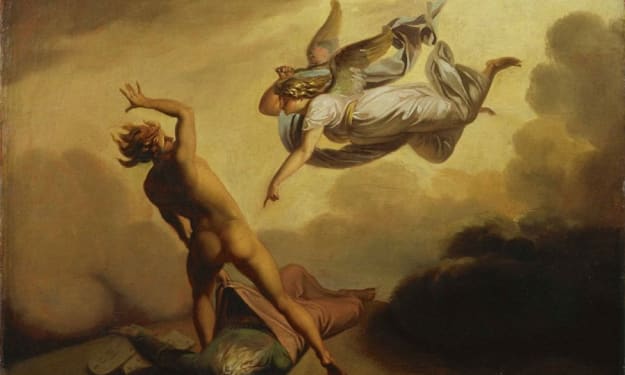
Introduction The account of Michael and the devil contending over the body of Moses, found in Jude 9, has long intrigued scholars, theologians, and biblical commentators. The passage presents a curious and enigmatic episode in which the archangel Michael disputes with Satan over the burial place of Moses, but does not engage in a blasphemous judgment. Instead, Michael says, "The Lord rebuke you." This event, though brief, raises significant questions regarding the nature of spiritual warfare, the roles of angels and demons, and the mysterious burial of Moses. To understand why this dispute occurred, we must first examine the context, the historical and theological background, and the symbolic implications of this confrontation.
By Kilama Apollo Ocholaabout a year ago in History
Trump Proposes to Assume Control of Ukraine's Nuclear Facilities During Conversation with Zelensky: A Daring Strategy or a Diplomatic Maneuver?
In an unexpected development, former U.S. President Donald Trump is said to have proposed assuming control of Ukraine's nuclear power facilities during a recent conversation with Ukrainian President Volodymyr Zelensky. This suggestion, which has ignited considerable discussion, arises as Ukraine faces the severe repercussions of Russia's persistent invasion. While some interpret Trump's offer as a daring initiative to bring stability to the area, others express skepticism regarding its practicality and the intentions behind it.
By Refayat Aminabout a year ago in History
The Secret Behind the Morning Fog
According to appearances, Ashford was a typical town. It was a small village in a valley, where everyone knew one another and life had a steady beat. However, Ashford had a strange quality: every morning, a dense, almost unnatural fog would sweep in from the river, engulfing the houses, covering the streets, and drowning out all sound. The town seemed like an other universe during those foggy hours, but it would vanish as soon as the sun rose high enough to burn it away.
By MD SHAMIM RANAabout a year ago in History
one accident is a lifetime of tears
An accident is a momentary event that can change the course of a person's life in the blink of an eye. While the impact may vary from person to person, the consequences are often far-reaching and long-lasting. When someone experiences a life-altering accident, the emotional toll is often far heavier than any physical injury. Though the body may heal with time, the heart and mind can carry scars that last a lifetime. A single accident can result in a lifetime of tears—tears of pain, grief, frustration, and even a sense of loss for the life that could have been. This essay will explore how an accident, both physically and emotionally, can alter a person’s life forever, shaping their future in ways they never anticipated.
By MD SHAMIM RANAabout a year ago in History
Göbekli Tepe
In the serene hills of southeastern Turkey, a groundbreaking discovery in 1994 transformed our perceptions of the origins of human civilization. Göbekli Tepe, an archaeological site dating back 12,000 years, exemplifies the creativity and spiritual aspirations of our ancient forebears. Frequently dubbed the world's first temple, this intriguing site compels us to rethink our views on prehistoric communities and their achievements. It serves as a crossroads of history, legend, and enigma, providing insight into an era when humanity was starting to define its connection with the divine.
By A Históriaabout a year ago in History
10 Plagues of Egypt. AI-Generated.
The Plagues of Egypt: Fact or Fable? Unraveling the Truth Behind the Exodus Story The story of Moses confronting Pharaoh and the subsequent ten plagues is one of the most dramatic and well-known narratives in the Bible. But how much of it is historical fact, and how much is embellished legend? Could these events have actually happened as described?
By Ihor Marchenkoabout a year ago in History