Events
Enver Hoxha. The Man Who Turned Albania Into a Hermit Kingdom.
Albania, a country not known to some, and not often thought about among those who are familiar. The South Balkan country bordering Montenegro to the North, Kosovo to the Northeast, North Macedonia to the East, and Greece to the South with the entirety of the Western border being a beautiful coastline stretching approximately 476 kilometres where the mouth of the Adriatic meets the Ionian sea. It is one of Europe’s most mountainous countries, yet roughly an eighth of the size of the UK. Ranking #3 among the poorest nations in the continent and suffering through years of political corruption that would later cause it to be the the third poorest country in the world, not the continent the small country had been apart of many empires.
By Jacob Newsonabout a year ago in History
The Remarkable Journey of the Estrella
In the bustling shipyards of Blackwall, London, a vessel destined for adventure took shape under the skilled hands of the Samuda Brothers. Launched on August 20, 1853, into the waters of the River Thames, the iron sidewheel paddle steamer Estrella emerged as a marvel of engineering for the newly established Magdalena Steam Navigation Company. Designed with a shallow draft of just 5 feet, she was tailor-made for river and coastal voyages. Stretching 176 feet long with a 26-foot beam, Estrella boasted a gross tonnage of 576 tons-later recorded at 438 tons displacement during her U.S. Navy service. With room for 60 to 90 passengers, she was powered by a 120-horsepower, two-cylinder oscillating steam engine crafted by Humphrys, Tennant, and Dykes at their New Deptford Engine Works. On October 27, official trials clocked her at an impressive 12 miles per hour.
By KWAO LEARNER WINFREDabout a year ago in History
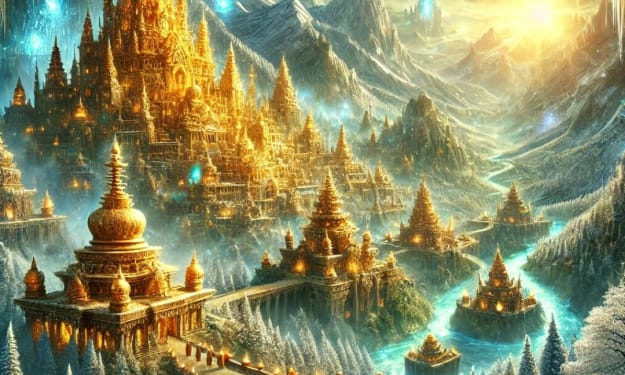
The Hidden Kingdom of Shambhala. AI-Generated.
The last Culture and Wealth of Shambhala: A Lost Treasure of Mystical Riches Throughout history, stories of concealed cities, forgotten kingdoms, and fantastical treasures have fascinated people. Among these narratives, few are as mysterious and long-lasting as the legend of Shambhala, a fabled kingdom believed to be concealed deep within the Himalayas. Esteemed in Buddhist, Hindu, and Tibetan traditions, Shambhala represents not only a physical location but also a symbol of spiritual awakening and material prosperity. According to the legend, this kingdom is filled with immense riches, ancient knowledge, and extraordinary treasures that have remained undiscovered by explorers, conquerors, and treasure hunters alike for ages. Origins of the Legend The roots of Shambhala are deeply embedded in ancient spiritual texts. The idea first surfaced in Hindu scriptures, specifically the Vishnu Purana, where it was mentioned as the birthplace of Kalki, Lord Vishnu's final incarnation, who will end the current age (Kali Yuga) and bring forth a new time of peace and abundance. However, the legend of Shambhala truly blossomed in Tibetan Buddhism. Tibetan writings portray Shambhala as a utopian realm, concealed in the snowy mountains, where enlightened beings coexist in harmony and prosperity. The Buddhist master Padmasambhava, active in the 8th century, is credited with disseminating teachings about Shambhala, highlighting its dual nature as both a tangible and spiritual domain. Shambhala’s Hidden Wealth Beyond its spiritual importance, Shambhala has long been connected to vast material wealth. Legends depict the kingdom as teeming with precious gems, gold, silver, and rare minerals. The leaders of Shambhala are said to safeguard these riches not out of greed, but as a representation of the kingdom’s abundance and integrity. It is believed that the treasures of Shambhala have remained untouched for ages, hidden from the outside world to protect them from those seeking power and profit.
By Say the truth about a year ago in History
The Lost Wealth of Submerged Dwaraka
The Net Worth of Dwaraka: A Hidden Treasure of Ancient India Dwaraka, a name deeply etched in Indian history and mythology, is renowned as the mythical kingdom of Lord Krishna. Considered one of the seven ancient cities (Sapta Puri), Dwaraka is believed to have been a thriving and prosperous city, brimming with opulence, trade, and cultural riches. Modern archaeological discoveries and ancient texts have fueled debates about the city's immense wealth, the legacy of its hidden treasures, and its estimated net worth. The Origins of Dwaraka According to the Mahabharata and Puranas, Dwaraka was established by Lord Krishna after he migrated from Mathura. The city was said to have been constructed by divine architects and adorned with gold, silver, precious gems, and intricate palaces. Dwaraka’s strategic location along the Arabian Sea also made it a bustling port city, contributing to its immense economic wealth. The Prosperity of Ancient Dwaraka Ancient texts describe Dwaraka as a city of unparalleled luxury and sophistication. The kingdom's economy flourished due to trade, agriculture, and its status as a cultural hub. Precious gems, spices, silk, and rare metals were traded, while palaces and temples were reportedly adorned with gold and rare jewels. The city’s opulence extended beyond material wealth. Dwaraka was known for its architectural marvels, grand temples, and advanced urban planning, including well-paved roads, drainage systems, and fortified walls. These attributes highlighted the kingdom's wealth and technological prowess. Submergence of Dwaraka One of the most intriguing aspects of Dwaraka is its mysterious disappearance. According to legend, after the death of Lord Krishna, the city was submerged in the Arabian Sea as foretold. This event, believed to have occurred over 5,000 years ago, has led to centuries of speculation about the treasures that might still lie beneath the ocean. Archaeological Discoveries In the 1980s, marine archaeologists discovered remnants of an underwater city near the modern city of Dwarka in Gujarat. These findings included stone structures, pottery, anchors, and remnants of walls, which provided compelling evidence that the mythical city might have been real. The archaeological site has been likened to an ancient Atlantis, with speculations about hidden treasures that could be buried beneath the sea. If these treasures were to be discovered, their historical and monetary value would be incalculable. Estimating the Net Worth of Dwaraka Calculating the net worth of a city like Dwaraka requires considering its historical wealth, trade connections, and the potential value of its submerged treasures. The following aspects contribute to an estimate of its ancient net worth: Gold and Jewels: Ancient texts describe Dwaraka’s palaces and temples as being adorned with gold, diamonds, and other precious gems. If these treasures remain submerged, their combined value could run into billions of dollars. Artifacts and Antiquities: The artifacts and relics discovered underwater have immense historical significance. If fully excavated and authenticated, these relics could fetch millions on the global antiquities market. Trade Wealth: Dwaraka’s strategic location as a trade hub would have added significantly to its wealth. The value of its trade in spices, textiles, and metals could be estimated in today’s terms to reflect a thriving economy. Tourism and Cultural Heritage: In modern times, Dwaraka continues to attract millions of pilgrims and tourists, contributing significantly to the local economy. Speculative Net Worth Considering these factors, it is plausible to estimate that the ancient city of Dwaraka, in today’s terms, could have had a net worth of several billion dollars. Its wealth would have been comparable to other ancient cities such as Babylon or Rome, given its prominence, trade connections, and the luxurious lifestyle described in ancient texts. The Legacy of Dwaraka Despite its submergence, the legacy of Dwaraka lives on. Modern Dwarka, located near the archaeological site, is a significant pilgrimage center, attracting visitors from across the globe. The city’s temples, particularly the Dwarkadhish Temple, continue to symbolize the ancient city’s religious and cultural heritage. The story of Dwaraka also raises important questions about the intersection of mythology and history. As archaeological techniques continue to improve, future discoveries may provide more concrete evidence about the city’s wealth, layout, and ultimate fate. Conclusion The net worth of ancient Dwaraka is a fascinating topic that combines history, mythology, and archaeology. While much of its wealth remains hidden beneath the sea, the city’s legacy as a symbol of prosperity, devotion, and architectural grandeur continues to inspire awe. Whether through further underwater excavations or the continued preservation of its cultural heritage, Dwaraka remains one of the most enigmatic and potentially richest lost cities in human history.
By Say the truth about a year ago in History
The Garden That Opened at Dawn
There was a garden renowned for its unearthly beauty, tucked away in the peaceful hills of an old village. The Garden That Bloomed at Sunrise was its name. As if the rising sun were whispering to them to get up, flowers would bloom in a stunning, coordinated display every day at the first light of morning. Many of the locals thought that this garden had a mystical power that could bring about healing and tranquility, and they spoke about it with wonder and devotion.
By MD SHAMIM RANAabout a year ago in History
Atlantis: The Lost City of Wealth and Splendor. AI-Generated.
The Lost Wealth of Atlantis: Estimating the Net Worth of a Legendary Civilization Atlantis, the fabled civilization described by the Greek philosopher Plato, has fascinated humanity for millennia. A tale shrouded in mystery, the story of Atlantis speaks of a utopian empire that vanished beneath the sea in a cataclysmic disaster. Despite debates over its actual existence, Atlantis has been portrayed as a land of unimaginable wealth, advanced technology, and sophisticated culture. This article explores the estimated net worth of Atlantis, based on historical accounts, theories, and modern interpretations. The Origins of Atlantis Plato first introduced Atlantis in his dialogues Timaeus and Critias around 360 BCE. According to him, Atlantis was a powerful island nation located beyond the Pillars of Hercules (believed to be the Strait of Gibraltar). It was said to have existed 9,000 years before Plato’s time and was ruled by kings who wielded immense wealth, power, and wisdom. Atlantis was described as a prosperous empire with advanced architecture, a strong military, and flourishing trade networks.
By Say the truth about a year ago in History
The Magnificence of Ancient African Empires. AI-Generated.
The Rich History and Resources of Ancient Africa: Part 1 Africa, often described as the cradle of humanity, has played a pivotal role in shaping world history. From the powerful empires of the past to its vast reserves of natural resources, Africa’s legacy is one of wealth, resilience, and cultural innovation. This article, the first in a nine-part series, delves into the ancient history, resources, and estimated economic impact of Africa's early civilizations, focusing on the period before European colonization.
By Say the truth about a year ago in History