Events
“Lasseter’s Reef: Australia’s Lost Treasure of Gold and Legend”. AI-Generated.
"The Hidden Wealth of Australia: Discovering the Continent’s Most Significant Concealed Treasure" Australia encompasses more than merely arid deserts and ancient terrainsit conceals narratives of substantial, undiscovered fortune. From the legendary Lasseter’s Reef, purported to be an unparalleled gold deposit buried deep within the outback, to the sunken Dutch vessels carrying silver and gold, as well as the loot of outlaw bushrangers hidden in the wilderness, this article delves into the most persistent and valuable treasure legends of the land down under. Join us as we investigate the history, enigma, and contemporary endeavors to reveal Australia’s greatest treasure. Image Prompt: A lifelike digital illustration of the Australian Outback featuring red sandstone cliffs, a group of adventurers examining maps and tools, alongside glimmering gold partially concealed in the desert ground. A spectral image of Harold Lasseter gesturing toward the horizon lingers in the background. Include camels, indigenous flora, and a radiant sunset sky. Title: The Myth of Lasseter’s Reef: Australia’s Most Significant Lost Treasure Introduction Nestled within the blistering core of the Australian Outback resides one of the most enduring and enigmatic legends in the nation's history: the narrative of Lasseter’s Reef. Alleged to be a considerable gold deposit concealed in the desert, this "reef" (a term utilized in mining to indicate a vein of gold-bearing rock) has fascinated prospectors, explorers, and treasure seekers for more than a century. Despite countless expeditions and relentless quests, the elusive treasure remains unlocateda spectral promise of immense wealth buried beneath limitless red sands. The Genesis of the Legend The tale commences with Harold Bell Lasseter, a man of intricate character and profound conviction. In 1929, Lasseter asserted he had discovered a colossal gold reef in Central Australia as a youth in 1897, at the age of 17. He recounted that his camel had fled during a solo expedition, and while searching for water and security, he encountered a lustrous, golden ridge extending for miles. Lacking the tools to extract it and driven by survival instinct, he memorized the site and subsequently returned to civilization. For many years, Lasseter clung to his secret, disheartened that nobody believed his account. However, as Australia grappled with the aftermath of the Great Depression in the 1930s, his narrative gained momentumproviding optimism to a desperate nation yearning for wealth and stability. The 1930 Expedition With governmental support and private investment, the Central Australian Gold Exploration Company (CAGE) was established, and an expedition was assembled to seek out the reef. Lasseter was designated as the guide and led a team of explorers, camels, provisions, and radio apparatus deep into the desert from Alice Springs. Nevertheless, conflicts rapidly intensified. Lasseter’s ambiguous instructions, secretive demeanor, and insistence on proceeding independently estranged his team. Ultimately, the group dissolved in exasperation, leaving Lasseter solitary in the desert. For several weeks, he endeavored to survive, reportedly assisted by Aboriginal individuals. His final journal entries, later discovered by rescuers, recount his ongoing pursuit of the reef, his solitude, and his gradual demise in a secluded cave near the Petermann Ranges in early 1931. His remains were located in a deteriorated state, yet his narrative endured. Reality or Fabrication? Since Lasseter’s demise, contention has erupted regarding the existence of his reef. Some theorize it was a figment of imaginationpossibly heat-induced hallucinationsor an elaborate deception. Conversely, others assert its authenticity, citing: Lasseter’s meticulous journal, in which he documented distances, sites, and details. Independent testimonies from other adventurers and Aboriginal oral histories that suggest gold in the same vicinity. The likelihood that Lasseter employed an alternative coordinate system or had forgotten the precise location after thirty years. While no conclusive physical proof has ever been discovered, numerous treasure seekers and explorers persist in exploring the myth. Contemporary Searches and Technology The evolution of satellite imaging, geological surveying, and GPS technology has rekindled interest in the quest for Lasseter’s Reef. Numerous expeditions in the 20th and 21st centuries have traversed the central Australian deserts, particularly around the Petermann and Rawlinson Ranges, yet the reef remains undiscovered. In 2005, a private exploration team asserted they had found “evidence” of a gold-rich area consistent with Lasseter’s account, but no commercial achievement ensued. Others continue to finance investigations, convinced that a concealed fortune lies beneath the crimson soil. Cultural Significance
By Say the truth about a year ago in History
"The Lost Riches of Australia: Uncovering the Continent’s Greatest Hidden Treasure" . AI-Generated.
"Australia’s Forgotten Fortune: The Legend of the Lasseter’s Reef and Other Lost Treasures" Australia may be best known for its rugged outback and gold rush towns, but hidden beneath its red earth lies a legend of unimaginable wealth — the tale of Lasseter’s Reef, a massive gold deposit supposedly buried in the heart of the desert. This article delves into the history of Australia's biggest rumored treasure discoveries, including gold rushes, sunken ships, outlaw loot, and the still-unfound fortunes that have lured explorers for over a century. Introduction: A Continent of Mystery and Riches Australia, the world’s sixth-largest country, has long held the reputation of being a land of natural wonders. But beneath its scorching deserts, tropical rainforests, and jagged coastlines lies a rich — and often hidden — history of buried treasure. From massive gold rushes in the 19th century to legends like Lasseter’s Reef, Australia’s search for fortune has fascinated adventurers, scholars, and treasure hunters for over 150 years. The Gold Rush Era: When Fortune Sparked a Nation Australia’s greatest tangible treasure boom began in the mid-1800s with the discovery of gold in New South Wales and Victoria. The 1851 gold rush in Ballarat and Bendigo triggered a wave of immigration, wealth, and global attention: Over 1 million kg of gold were extracted in the 19th century. The town of Ballarat became one of the richest places on Earth. The Welcome Stranger Nugget (1869), found in Victoria, remains the largest alluvial gold nugget ever discovered, weighing 72 kg and valued at over $4 million USD today. But while these documented finds changed the economy and culture of the young colony, other riches remained elusive — hidden in legend and myth. The Legend of Lasseter’s Reef The most famous lost treasure in Australian history is Lasseter’s Reef, a supposed vein of gold so rich that it would rival any mine on Earth. In 1929, Harold Bell Lasseter, an Australian explorer, claimed he had discovered a 30-kilometer-long gold reef in the central Australian desert as a young man in the 1890s. He mounted an expedition in 1930 to rediscover the reef, but was abandoned by his team, perished in the desert, and left behind only a diary describing the location. The exact location of Lasseter’s Reef was never found, and no one has definitively proven its existence. Despite numerous expeditions, satellite mapping, and even government-backed searches, the treasure remains lost. Some believe it was a fabrication; others insist it’s still hidden in the remote Petermann Ranges of the Northern Territory — just waiting to be found. Estimated Value: If real, Lasseter’s Reef could contain billions of dollars worth of gold — making it one of the largest lost treasures in modern history. The Wreck of the Gilt Dragon Not all treasure legends lie in the desert. Along Australia’s treacherous western coastline, dozens of Dutch East India Company (VOC) ships were wrecked during the 17th century on their way to Batavia (now Jakarta). The most famous among them, the Vergulde Draeck (Gilt Dragon), sank in 1656 with a cargo of silver coins, trade goods, and gold bullion. Modern estimates suggest the cargo was worth millions even in 17th-century value. Only fragments have been recovered off the coast of Western Australia. Many believe much of the treasure was buried or looted by survivors and remains hidden in the bushland. Bushranger Gold: Thunderbolt and Others Australia’s outlaw era also left behind tales of buried loot. The bushrangers, especially Captain Thunderbolt, Ben Hall, and Ned Kelly, were known to rob gold shipments and bank vaults. Captain Thunderbolt is rumored to have buried several caches of gold and coins in New South Wales. While some have been found, most treasure maps are considered lost or hoaxes.
By Say the truth about a year ago in History
Samsung Eligible device for oneUi7 . AI-Generated.
The official rollout of Samsung's One UI 7 update, which is based on Android 15 and brings a slew of new features and improvements to a wide range of Galaxy devices, has begun. The update began rolling out to various device series in phases in April 2025.📱 Eligible Devices for One UI 7
By Aprub Hasan Afifabout a year ago in History
120 Days Underwater
In an impressive achievement that embodies human perseverance, scientific ingenuity, and extreme exploration, Rudiger Koch, a German aerospace engineer, is the new record holder for the longest time living in a submerged underwater chamber without the use of depressurization. Koch surfaced from his submerged capsule on Friday off the coast of Panama after spending an astounding 120 days, 11 meters (36 feet) under the Caribbean Sea. The feat, verified by Guinness World Records adjudicator Susana Reyes, saw Koch break the previous record of 100 days, which was set by American Joseph Dituri, who resided in an underwater lodge in a Florida lagoon.
By Rohitha Lankaabout a year ago in History
How Close Was the Roman Empire to an Industrial Revolution? 🏛️⚙️
When we think about ancient Rome, we picture majestic architecture, powerful legions, and sophisticated roads. But one question often pops up among history lovers and alternative history fans alike: Could the Roman Empire have had its own Industrial Revolution? 🤔
By Toader Adelinabout a year ago in History
The Great Underground Pyramid of Alaska: Secrets Beneath the Frozen Tundra
Beneath the Frost, a Hidden Legacy Beneath the endless expanse of Alaska's tundra lies an enigma that has puzzled explorers, researchers, and conspiracy theorists for decades. For years, the whispers have circulated, tales of a massive underground pyramid, an ancient structure far older than anything recorded in history. Hidden deep within the wild, remote regions of the state, this pyramid is said to be a relic of an advanced civilization, one that predates all known ancient cultures.
By The Secret History Of The Worldabout a year ago in History
Jewish Soldiers from Palestine
In reviewing Pierre Van Paassen’s new book, “Forgotten Ally” the New York Times book reviewer, R.L. Duffus said in October of 1943, “While the French were holding Rommel at Bir Hacheim a tiny but indomitable band of Palestine Jews under Maj. Felix Liebman were holding him in the bloody dust of Mechili, without food, water or thought of surrender. “ Van Paassen’s story of Jewish engineers from Palestine laying a mine field in the Western Libyan desert has proven to be largely made up but even while Van Paassen was weaving his tale, designed to embarrass the British Mandate, Jews from Palestine were in fact fighting and dying in that very desert.
By Larry hartabout a year ago in History
"The Golden Empire: Inside the Wealth of the Mali Empire under Mansa Musa" . AI-Generated.
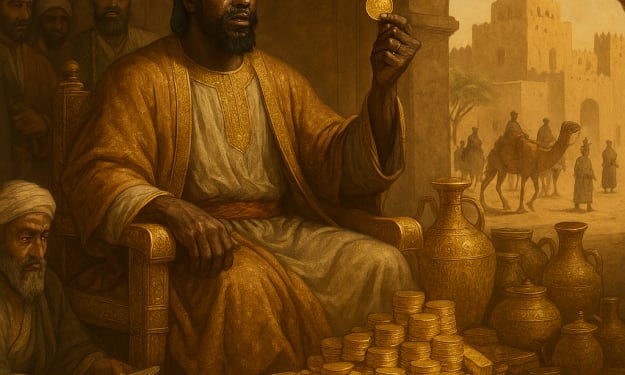
“The Gold Mines of Kings: The U"The Golden Empire: Inside the Wealth of the Mali Empire under Mansa Musa" nrevealed Treasures of the Mali Empire” The Mali Empire, during the governance of Mansa Musa, represented the most affluent empire in African heritage and potentially the globe. Founded upon substantial gold assets and trans-Saharan commerce, Mali's principal cities such as Timbuktu and Niani thrived with splendid palaces, mosques, and riches beyond comprehension. This article delves into the ascendance of the Mali Empire, its astounding net worth, and the legendary pilgrimage of Mansa Musa that amazed the world with its golden magnificence. Introduction: A Golden Era in West Africa While Europe was still recovering from the Dark Ages, a remarkable civilization emerged in the heart of West Africa the Mali Empire. Established in the 13th century, Mali evolved into one of the most prosperous empires in history, attaining its peak under the leadership of Mansa Musa, the 10th monarch. Mali’s wealth was so extensive that Mansa Musa’s name became emblematic of unimaginable affluence, and his 1324 pilgrimage to Mecca was so lavish that it induced inflation in Egypt for more than a decade. But what contributed to the Mali Empire’s opulence? From where did the riches originate, and what heritage does it leave for posterity? Gold: The Cornerstone of Empire The foundation of Mali’s economic strength resided beneath the ground: gold. West Africa housed some of the largest and most fruitful gold mines in the ancient world, particularly in Bambuk, Bure, and Galam. These mines supplied the empire’s coffers and established Mali as the foremost gold provider for the Mediterranean and Islamic civilizations for over 500 years. During a time when gold represented currency, Mali was perched atop a fortune. Scholars estimate that Mali may have controlled half of the global gold supply during its pinnacle. Trade and Commerce In addition to its mines, Mali prospered due to its strategic location along trans-Saharan trade routes. Caravans of camels occasionally numbering in the thousands transported: Gold, salt, and ivory northward Silks, spices, books, and textiles southward Cities such as Timbuktu, Gao, and Djenné evolved into hubs of wealth and culture. Timbuktu’s renowned market and libraries attracted scholars and merchants from as far as the Middle East and Europe. Taxes were imposed on traders, further enhancing the empire’s wealth. A merchant navigating through Mali was reportedly greeted by gates embellished with gold, silk-adorned pavilions, and marketplaces brimming with luxurious goods. The Pilgrimage of Mansa Musa: The Wealthiest Individual in History In 1324, Mansa Musa embarked on the Hajj pilgrimage to Mecca, traversing more than 4,000 miles accompanied by a retinue that astonished the world: 60,000 men, including 12,000 slaves 100 camels, each bearing up to 135 kg (300 lbs) of gold Countless horses, dancers, scholars, and attendants Musa distributed gold so generously in Cairo that he incited hyperinflation, diminishing the value of the metal for over a decade. Historians estimate that his personal net worth might surpass $400 billion in contemporary terms, establishing him as arguably the wealthiest individual in human history. Cultural Wealth and Legacy Mansa Musa didn’t merely utilize wealth he allocated resources towards education, architecture, and religion: Established Sankore University in Timbuktu, which rivaled Oxford and Al-Azhar. Constructed numerous mosques, palaces, and libraries. Financed educational institutions, scholars, and scribes to replicate thousands of manuscripts. These endeavors transformed Mali into a beacon of knowledge within the Islamic realm. At its zenith, Timbuktu boasted 25,000 students and housed over 700,000 manuscripts, many of which endure today in private collections. The Decline and Dispersal of Wealth Following Mansa Musa's demise in 1337, the empire's prominence gradually diminished. Political turmoil, internal conflicts, and pressure from emerging powers such as the Songhai Empire contributed to fragmentation. Many of Mali's riches were: Plundered during invasions. Concealed or hidden to evade confiscation. Exchanged by lesser rulers in times of desperation. Despite its decline, remnants of Mali’s wealth persist in oral traditions, Arabic manuscripts, and the dusty repositories of European collectors who once obtained African artifacts during colonial periods. Estimating the Wealth Contemporary economic historians assess: Annual gold exports at peak: 1–2 tons per annum. Mansa Musa's net worth: $400 billion+. Empire-wide wealth: Easily in the trillions by contemporary metrics, when accounting for trade income, land, and cultural capital. This positions Mali among the most affluent civilizations in world history, eclipsing many European kingdoms of the same era. Conclusion The narrative of the Mali Empire extends beyond mere gold. It encapsulates a civilization that intertwined commerce, culture, and faith into one of the greatest golden ages ever witnessed. While much of its wealth has been dispersed, Mali's legacy as a symbol of African magnificence remains formidable. And beneath the sands of West Africa, perhaps additional treasure still lies hiddenawaiting recognition from history.
By Say the truth about a year ago in History
"The Lost Treasure of Srivijaya: Southeast Asia’s Forgotten Maritime Empire". AI-Generated.
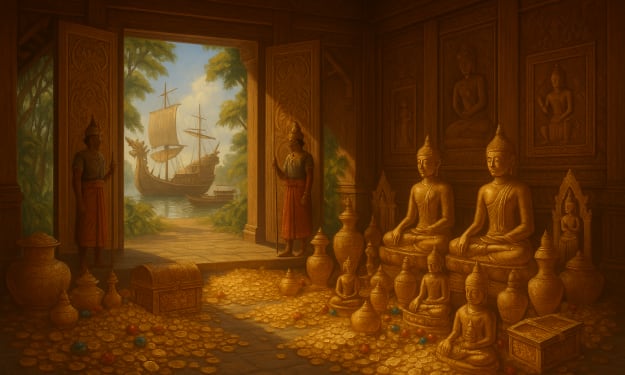
"The Golden Fortress of Srivijaya: Southeast Asia’s Forgotten Maritime Treasure" Summary: Long before the rise of modern global empires, the Srivijaya Empire ruled the waves of Southeast Asia, commanding trade routes, cultural influence, and immense wealth. Though largely forgotten today, Srivijaya once controlled the crucial maritime passages between the Indian and Pacific Oceans, amassing a treasure trove of gold, spices, and religious artifacts. This article uncovers the rise, glory, and hidden wealth of the Srivijaya Empire — a true maritime superpower lost beneath time and tide. The Rise of a Maritime Power The Srivijaya Empire emerged in the 7th century CE, centered around present-day Palembang, Sumatra in Indonesia. Unlike land-based empires, Srivijaya was a thalassocracy — a kingdom built on controlling the seas rather than territories. Its strategic location near the Strait of Malacca, one of the busiest maritime passages in the world, allowed Srivijaya to dominate global trade between China, India, and the Middle East for over six centuries. Sources of Wealth Srivijaya's treasure was built on multiple pillars: Maritime trade: Merchants from China, India, Arabia, and even Africa passed through Srivijayan ports. Goods included spices, gold, ivory, silk, porcelain, camphor, sandalwood, and textiles. Tributes: As a hub for Mahayana Buddhism, Srivijaya received religious tributes from powerful kingdoms like China and Tibet. Taxation and Tolls: All passing ships had to pay customs duties, contributing to royal coffers. One 10th-century Chinese record described the king of Srivijaya as owning ten thousand vessels and a treasury of pure gold bricks. The Royal Court and the Treasury The Srivijayan monarch, referred to as Maharaja, resided in a grand wooden palace decorated with gold-leafed ornaments, lacquerware, and foreign gifts. Archaeological evidence suggests that gold was abundant in the empire. Excavations in Sumatra have revealed: Gold jewelry weighing several kilograms Religious artifacts, including golden statues of Buddha Coinage used for trade and ceremonial offerings Gold was also used to plate royal palaces, religious shrines, and even the hulls of ships in elite fleets. Religious Treasures and Cultural Wealth Srivijaya was not just a political and commercial hub, but also a center for Buddhist learning. Monks from India and China — including the famous Yi Jing — visited and wrote about the empire’s grand monasteries and temples. These institutions were richly endowed: Temples adorned with golden stupas and relics Libraries with palm-leaf manuscripts and priceless religious texts Royal donations of jewels, incense, and spices to Buddhist communities The Srivijaya elite believed such donations earned spiritual merit and worldly prestige. Estimating the Wealth of Srivijaya Though exact records are scarce, modern historians and economists estimate the empire’s wealth by considering: Annual tribute and customs taxes from thousands of ships Gold reserves from Sumatra’s mines Trade profit margins on high-value goods like nutmeg, cloves, and camphor If valued in today’s terms, Srivijaya’s annual trade revenues could have exceeded $2 billion USD, with total stored treasure and assets reaching over $50–100 billion during its peak (8th–11th centuries CE). Naval Power and Maritime Control To protect this wealth, Srivijaya maintained a large naval fleet, including: Fast war canoes and ocean-going ships Merchant vessels with armed escorts Maritime garrisons stationed on key islands This control allowed the empire to deter piracy, enforce tolls, and maintain peace along thousands of kilometers of sea routes. Srivijaya also allied with pirate clans in the South China Sea, using them as both enforcers and intelligence agents. The Decline and the Lost Treasure In the 11th century, the Chola dynasty of South India launched devastating raids on Srivijayan ports, looting palaces and religious centers. Later, Srivijaya lost control over strategic ports to rivals like Majapahit and the Thai kingdoms. Eventually, the once-mighty empire collapsed, and its wealth disappeared into the jungles and sea. Treasure hunters, historians, and archaeologists believe that: Shipwrecks from Srivijaya’s fleet lie untouched beneath the South China Sea Buried vaults may still be hidden beneath modern Palembang Golden relics continue to be discovered — such as a golden Buddha unearthed in 2021 Legacy Today, Srivijaya’s legacy lives on in: The Malay and Indonesian languages, which carry influences from Sanskrit and Buddhism Religious monuments like Borobudur, which was funded partly through Srivijayan patronage Ongoing archaeological discoveries that continue to reveal a civilization of wealth, wisdom, and wonder Conclusion Srivijaya’s treasure wasn’t just gold and jewels — it was the wealth of ideas, trade, faith, and maritime brilliance. As modern technology uncovers more sunken ships and forgotten temples, the hidden fortune of Southeast Asia’s golden empire may still be waiting to emerge from beneath the sands and waves.
By Say the truth about a year ago in History
"The Empire Beneath the Sands: The Untold Wealth of the Persian Empire". AI-Generated.
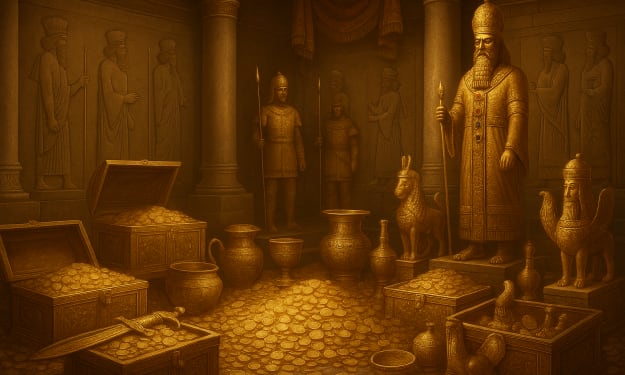
“The Empire Beneath the Sands: The Unrevealed Wealth of the Persian Empire” The Achaemenid Persian Empire, established by Cyrus the Great in the 6th century BCE, is frequently eclipsed by subsequent empires in conversations regarding ancient affluence. Nevertheless, this extensive empire, which extended from the Indus Valley to Greece and Egypt, amassed and administered one of the most significant concentrations of wealth ever witnessed. This article delves into the immense treasure reserves of the Persian monarchs, the sophisticated economic framework they devised, and an estimation of their net worth in contemporary terms. The Ascendancy of a Superpower The Achaemenid Persian Empire (circa 550–330 BCE) emerged as one of the earliest and largest global empires in human history. Under the leadership of figures such as Cyrus the Great, Darius I, and Xerxes I, it governed over 44% of the world’s population, a milestone unparalleled in historical records. Their affluence was derived from tributes, commerce, taxation, and the dominion over crucial regions abundant in gold, silver, and other valuable resources. At the zenith of the empire, the Persians had access to: Gold deposits in Armenia and Asia Minor Silver deposits in Central Asia Commerce from the Silk Road and maritime pathways Tributes from subdued territories, including Egypt, Babylon, Lydia, and India The Royal Treasuries of Persepolis and Susa One of the most intriguing aspects of the Persian Empire was its imperial treasuries, especially in Persepolis, Ecbatana, and Susa. These complexes were not merely ceremonial cities they were fortified repositories brimming with unimaginable wealth. Greek historians such as Herodotus and Ctesias documented that the Persian kings secured tens of thousands of talents (a unit of weight for gold or silver) within their palatial structures. Estimates: One talent ≈ 30 kg (66 pounds) A report during Alexander the Great's conquest indicated that the Persians had accumulated 180,000 talents of silver and gold in Persepolis alone This equates to over 5,400 metric tons of precious metals, appraised today at more than $300 billion. The Satrapy System: An Economic Engine Darius I transformed the empire's administration by instituting the satrapy system partitioning the empire into provinces, each overseen by a satrap (governor). Each satrapy was taxed according to its economic productivity. Annual tributes comprised: India: Paid in gold dust, valued at approximately 4680 talents of gold yearly Babylon: Contributed substantial quantities of grain and silver wealth Egypt: Provided gold, linen, and grain Lydia: Renowned for its gold mines and currency The empire’s yearly revenue from these tributes, converted to modern values, is estimated at $1–2 billion USD annually an extraordinary figure for the ancient world. Persian Coinage and Financial Innovation The Persians were also pioneers in finance. Darius introduced the Daric, a gold coin that became the benchmark of international commerce within the empire akin to the operational role of the U. S. dollar today. One Daric contained approximately 8. 4 grams of pure gold Minted alongside silver Sigloi for local circulation This stable currency system facilitated trade across extensive regions, from India to Macedonia. Wealth in Architecture and Art The Persians allocated their resources not solely towards grand treasuries but also towards monumental edifices. The establishment of Persepolis alone featuring its tiered platforms, ceremonial chambers, and elaborate reliefs is estimated to have incurred expenses amounting to hundreds of millions of dollars in labor and materials. The empire similarly expended considerable amounts on: Preserving imperial roadways such as the Royal Road (2,700 km in length) Sustaining extensive standing armies, including the prestigious Immortals Sponsoring artisans, stonemasons, and jewelers The Pillaging of Persia: Alexander’s Windfall When Alexander the Great invaded Persia in 330 BCE, one of his most significant rewards was not military but financial. Upon capturing Persepolis, it is reported that he seized: 180,000 talents of gold and silver Thrones and statues adorned with jewels Exotic tribute animals and scarce textiles This singular act of plunder provided Alexander with sufficient funds to: Finance his campaigns for over a decade Compensate his soldiers with bonuses Stabilize Greek economies for numerous years It was, arguably, the most substantial single appropriation of wealth in ancient history. Assessing the Net Worth Today While we cannot determine an exact figure for the wealth of the Persian Empire, cautious estimates derived from historical records and contemporary valuations indicate: Treasury Reserves: $300–500 billion (gold/silver alone) Annual Tribute Revenues: $1–2 billion in present-day terms Cultural and Artistic Wealth: Incalculable, but potentially tens of billions The total net worth of the Persian Empire at its zenith could range from $500 billion to over $1 trillion USD, considering inflation and current market conditions. Legacy of Wealth and Power The treasure of the Persian Empire encompassed more than just gold it embodied: The authority of structured governance The vigor of a diverse, multi-ethnic empire The impact of cultural patronage and acceptance Although looted and dispersed, the legacy of Persian wealth persists in archaeological discoveries, museum exhibits, and the historical framework it provided for subsequent empires.
By Say the truth about a year ago in History
"Empire of Gold: The Mughal Treasure – Asia’s Greatest Lost Fortune". AI-Generated.
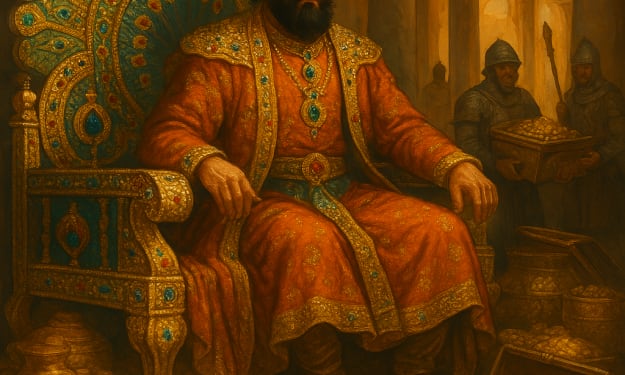
"The Golden Legacy: Revealing the Supreme Wealth in Asia's Historical Narrative" Asia, the origin of ancient societies, has been the residence of legendary affluence and overlooked fortunes. Among its numerous valuables, the treasure of the Great Mughal Empire distinguishes itself as the most lavish and historically crucial. Valued in billions at present, the Mughal treasure encompassing the Peacock Throne, the Koh-i-Noor diamond, and vaults filled with gold and gemstones epitomizes the pinnacle of imperial authority, craftsmanship, and political superiority in Asia. This article charts the ascent, magnificence, downfall, and heritage of Asia’s most significant historical treasure. The Wealthiest Empire in the East Within the chronicles of global history, few empires have gathered riches as vast and storied as the Mughal Empire of India. Established in 1526 by Babur, the empire reached its peak under rulers such as Akbar, Jahangir, and Shah Jahan. By the 17th century, the Mughal Empire governed an extensive area of South Asia and contributed nearly 25% of the world's GDP, as noted by historical economists. Its courts sparkled with gold, sapphires, diamonds, rubies, and emeralds. The Mughal emperors not only amassed wealth through military conquests and commerce but also preserved and exhibited it in the form of magnificent thrones, crowns, ornaments, palaces, and royal treasuries. The Peacock Throne: Gem of the Empire The most emblematic representation of Mughal opulence was indisputably the Peacock Throne, commissioned by Shah Jahan in the early 17th century. Constructed over seven years by master craftsmen and costing four times the value of the Taj Mahal, the throne was adorned with: The Koh-i-Noor diamond The Tavernier Blue (thought to be the precursor to the Hope Diamond) Rubies from Badakhshan Emeralds from Colombia Thousands of pearls and sapphires It is said that the throne’s richness astonished every foreign envoy who entered the Mughal court. The structure itself was designed like an expansive canopied bed supported by solid gold columns, embellished with peacocks inlaid with gemstones a representation of divine kingship. Estimated Modern Value: Over $1 billion, considering its composition and historical importance. The Koh-i-Noor Diamond: A Journey Through Empires The Koh-i-Noor, or “Mountain of Light,” is arguably the most renowned diamond globally. Weighing over 105 carats in its current state, the diamond has transitioned through the possession of various dynasties: Originally extracted from the Golconda region of India Held by the Kakatiya, Delhi Sultanate, and Mughals Seized by Persian ruler Nader Shah during his 1739 incursion into Delhi Ultimately came into British possession and became part of the British Crown Jewels Estimated Value: While invaluable historically, analysts estimate the diamond could be worth over $500 million if ever sold (though it is improbable to ever reach the market). Nader Shah’s Invasion: The Decline of a Wealth In 1739, Persian emperor Nader Shah invaded Delhi and plundered the Mughal treasury, including the Peacock Throne and the Koh-i-Noor. The enormous wealth transported back to Persia was so substantial that taxes were suspended for three years in Iran. Historians estimate that the Mughal treasure seized during this incursion was valued at: Over $1. 5 billion (in contemporary currency), encompassing: 700 elephants, 4,000 camels, and 12,000 horses laden with gold and jewels Countless ancient manuscripts, arms, and relics Dispersed and Dispersed Wealth Over the centuries, the riches of the Mughal Empire were dispersed across continents due to: British colonial annexation Persian pillaging Afghan raids (notably by Ahmad Shah Durrani) Localized uprisings and the decline of the empire Currently, portions of this once-enormous treasure reside in: The British Museum and the Tower of London The Iranian National Treasury in Tehran Private collections and auction houses globally Other Claimants Throughout Asia Although the Mughal treasure is frequently regarded as the most affluent in Asian history, other remarkable treasure troves include: Yamashita’s Gold: Allegedly seized by the Japanese military in Southeast Asia during WWII, potentially valued in the hundreds of billions Concealed treasures of the Khmer Empire in Cambodia Treasure caches of the Tang and Song Dynasties in China Nevertheless, none rival the verified historical magnificence of the Mughal wealth. Cultural and Political Heritage The legacy of Asia’s premier treasure extends beyond gold. It signifies: The apex of imperial artistry and patronage The interconnected trade and wealth pathways of Asia The susceptibility of even the wealthiest empires to invasions and colonization Presently, discussions regarding the restitution of treasures like the Koh-i-Noor reflect global calls for justice, historical acknowledgment, and the enduring echoes of imperial plunder. Final Thoughts The narrative of the Mughal treasure Asia’s most splendid historical wealth is a saga of glory, avarice, and magnificence. Although much of it is now lost or scattered, its influence persists in museums, royal jewels, and the annals of history. It serves as a potent reminder of the heights of imperial affluence and how even the most splendid treasures can disappear under the passage of time.
By Say the truth about a year ago in History