Events
Finance & Investing in America: A Pillar of Economic Strength
The United States of America is one of the most powerful and influential financial markets in the world. With a mature economic infrastructure, a robust regulatory framework, and a culture of entrepreneurship, America has become a global hub for finance and investing. From Wall Street to Silicon Valley, financial innovation and investment opportunities continue to shape the national and global economy.
By Afran Noorabout a year ago in History
Pakistan vs India: A History of Conflict, Power, and Religion
Introduction: Introduce the topic by highlighting the longstanding tension between India and Pakistan, which has its roots in the partition of British India in 1947. Set the tone by discussing how history, religion, and territorial disputes have played a significant role in shaping their current relationship.
By Umar Khattakabout a year ago in History
The Tale of Layla and Majnun . Content Warning. AI-Generated.
In the golden deserts of ancient Arabia, where the stars whispered secrets to the sands, lived a young poet named Qays ibn al-Mulawwah. He belonged to a noble tribe, known for his eloquence and devotion to poetry. But it was not just the music of words that filled his heart—it was a girl named Layla, whose beauty seemed woven from moonlight and whose soul echoed his own.
By Real life 🧬 stories about a year ago in History
The Billion-Dollar Backbone: Hidden Elements and Wealth of the Himalayan Mountains. AI-Generated.
The Concealed Affluence of the Himalayas: Elements, Minerals, and Projected Monetary Value The Himalayas, renowned worldwide for their grand summits and spiritual importance, also hide an extensive and frequently undervalued reservoir of natural resources beneath their ancient formations. From rare earth elements to precious minerals such as gold, uranium, and lithium, the Himalayan region represents a geological treasure trove. This article examines the principal elements found in the area, their industrial relevance, the geopolitical consequences of their discovery, and provides an estimated monetary value of this concealed Himalayan affluence. The Concealed Affluence of the Himalayas: Elements, Minerals, and Projected Monetary Value The Himalayas are broadly acknowledged as one of the most breathtaking natural phenomena globally, spanning five nationsIndia, Nepal, Bhutan, China, and Pakistan. While the towering summits have been venerated for centuries for their beauty and spirituality, what resides beneath them may be even more precious: an extensive and varied array of elements and minerals that could reshape global resource dynamics. 1. Geological Synopsis The Himalayan range was formed over 50 million years ago due to the collision of the Indian and Eurasian tectonic plates. This continuous geological activity has established fault lines, mineral-rich locales, and a complex topography ideal for the genesis and accumulation of a diverse selection of elements. The area is particularly abundant in granitic rocks, schists, and metamorphic formationssettings conducive to the formation of valuable minerals and ores. 2. Principal Elements and Minerals Available a. Gold and Silver: In areas like Ladakh and parts of Nepal, traces of gold have been located in riverbeds and mountainous rocks. The placer gold deposits in Himalayan rivers may be modest in scale yet significant in overall volume when assessed across the region. b. Uranium: Uranium deposits have been identified in the northeastern Himalayan belt, especially in Arunachal Pradesh and segments of Himachal Pradesh. This radioactive element is essential for nuclear energy and military uses. c. Lithium: Lithium, one of the most coveted elements for battery manufacturing and electric vehicles, has been detected in trace quantities in Ladakh. As global demand for lithium escalates, exploration within the Himalayan region is intensifying. d. Rare Earth Elements (REEs): Scandium, yttrium, lanthanum, and various other REEs are believed to be present in the northern Himalayan districts. These elements are pivotal for electronics, renewable energy technologies, and defense systems. e. Copper and Zinc: The mountainous landscape is rich in copper ore, particularly in regions like the Kumaon Himalayas of Uttarakhand. Zinc deposits are also distributed throughout northern Himachal and parts of Nepal. f. Beryl and Mica: Utilized in the electronics and defense industries, both beryl and mica are found plentifully in eastern Himalayan belts, particularly in areas adjacent to Assam and Arunachal Pradesh. g. Coal and Petroleum: Although not as significant as other elements, coal reserves and petroleum deposits exist in foothill regions, such as in Assam’s Digboi and Arunachal’s Pasighat. 3. Projected Monetary Value of Himalayan Mineral Wealth It is challenging to assess the precise net worth of all the components present due to the absence of thorough mining and geopolitical tensions. Nevertheless, based on geological assessments and prevailing market valuations, a rough approximation includes: Gold: Estimated 500–1000 metric tons – valued at $30–60 billion USD. Uranium: Several thousand tons – potential worth exceeding $100 billion USD. Lithium: In preliminary exploratory phases – estimated at $20–50 billion USD. Rare Earth Elements: May surpass $200 billion USD based on international prices. Copper and Zinc: Cumulative worth exceeding $30 billion USD. Other Minerals (Mica, Beryl, etc. ): Additional $10–20 billion USD. Estimated Total Net Worth: $400–500 billion USD. 4. Environmental and Political Challenges Although the potential is substantial, extracting these resources entails a significant environmental toll. The delicate ecosystem of the Himalayas is vulnerable to landslides, glacial melting, and biodiversity decline. Furthermore, cross-border tensions between India and China have obstructed collaborative exploration or sustainable extraction of resources in disputed areas like Aksai Chin and Arunachal Pradesh. 5. Future Prospects India has commenced substantial investments in mineral exploration within the Himalayan region through organizations such as the Geological Survey of India and the Atomic Minerals Directorate. Nepal and Bhutan are also gradually permitting regulated mining activities. With the global shift towards green energy, the demand for Himalayan lithium and rare earth elements is anticipated to increase significantly. Conclusion The Himalayas represent more than merely an awe-inspiring mountain range; they constitute a vast storehouse of unexploited natural resources that could transform the economic and strategic landscape of Asia. While environmental and political challenges persist, responsible and cooperative mining initiatives could herald a new era of prosperity for the nations that share this formidable range.
By Say the truth about a year ago in History
Raja Raja Chola: The Sea King and Warrior Emperor of Southern India
"Raja Raja Chola: The Maritime Sovereign and Warrior Emperor of Southern India" Raja Raja Chola I, the renowned sovereign of the Chola Dynasty, governed from 985 to 1014 CE and transformed military tactics in South India by establishing one of the most sophisticated and coordinated military and naval forces in ancient Asian history. His legacy is characterized by his prowess in terrestrial combat, strategic military campaigns, and the formation of a formidable navy that extended Chola influence far beyond the seasfrom the Maldives to Southeast Asia. This article examines the military genius, naval supremacy, and enduring accomplishments of a monarch who was not merely a ruler but a warrior-statesman who redefined the concept of empire. Raja Raja Chola: The Maritime Sovereign and Warrior Emperor of Southern India Within the illustrious chronicles of Indian history, the name Raja Raja Chola I stands out as one of the most remarkable kings to emerge from the Tamil regions. Referred to as “Raja Raja the Great,” he presided over the Chola Empire during an era of military evolution and significant territorial expansion. More than just a king, Raja Raja was an innovative military strategist who unified extensive territories through the strength of his army and the power of his navybecoming the first South Indian emperor to effectively project authority beyond the Indian subcontinent. Ascendancy to the Throne and Military Reforms Upon Raja Raja Chola’s rise to power in 985 CE, the Chola Empire was in a state of recovery from internal discord and regional disintegration. Acknowledging the necessity for a disciplined, professional army, he reorganized the military into structured regiments such as the Velaikkara and Uttama Chola Terinda Kaikola. These specialized units received training in infantry, cavalry, and elephant combat, with each regiment assigned specific responsibilities during military operations. Raja Raja reformed military administration by inscribing detailed records on temple walls that listed soldiers’ names, remuneration, and land endowmentsrendering the Chola military one of the earliest to be administered with bureaucratic accuracy. The Expanding Chola Military The size of the Chola military during Raja Raja’s rule is estimated to have surpassed 150,000 soldiers, reinforced by numerous war elephants and cavalry units. Chola war elephants, adorned in armor and bells, frequently led assaults that breached enemy formations. Raja Raja also dedicated resources to fortifying key cities and border regions, establishing strategic garrisons. His military endeavors included triumphs over the Pandyas, Cheras, and Gangas, as well as the annexation of the northern territories of Sri Lanka. Each military campaign exhibited exceptional strategy, swift mobilization, and the proficient integration of forces. Establishment of the Chola Navy Perhaps Raja Raja’s most revolutionary contribution to warfare was the establishment of the Chola Navythe first comprehensive naval force in Indian history. Prior to this, Indian empires were predominantly land-oriented. Raja Raja recognized the strategic significance of naval superiority in securing trade routes, protecting coastal areas, and extending influence throughout the Indian Ocean. He built colossal warships utilizing teak and iron-reinforced hulls, manned by archers and boarding crews. Ports such as Nagapattinam and Kaveripattinam evolved into naval headquarters. His fleet, estimated to comprise 300 to 500 vessels, facilitated long-range operations that competed with the naval forces of contemporary China and Arabia. Southeast Asian Campaigns and Naval Accomplishments In one of the most remarkable achievements in early Indian military history, Raja Raja initiated naval expeditions across the Bay of Bengal and seized territories in the Maldives, Sri Lanka, while also impacting coastal regions of present-day Malaysia, Indonesia, and Thailand. These campaigns not only yielded wealth and tribute but also propagated Tamil culture, commerce, and religion throughout Southeast Asia. The Chola navy secured merchant vessels, safeguarded temple riches, and upheld imperial authority on foreign shores. Through such endeavors, Raja Raja established a maritime empirean ambition centuries ahead of its era. Wealth, Resources, and Military Sustainability The expense of sustaining Raja Raja’s military apparatus was substantial. The empire’s economy was bolstered by fertile agrarian territories, regulated commerce, and tribute from subjugated regions. Temples served as financial centers, financing regiments and naval contingents. The annual defense budget, in contemporary terms, could be approximated at several billion dollars, accounting for ship construction, soldier compensation, armor, elephant enclosures, and logistical support. In spite of this, Raja Raja succeeded in maintaining the empire’s financial equilibrium, employing meticulous records and regional administrative divisions (nadus) for effective taxation and resource allocation.
By Say the truth about a year ago in History
White House still calling for confirmation of controversial US attorney nominee despite diminishing odds
Washington, D.C. — The Biden administration is continuing its push to confirm a controversial U.S. attorney nominee, even as support in the Senate appears to be eroding. The White House has reiterated its support for the candidate despite growing opposition from Republicans and some Democrats. This indicates that it will not withdraw the choice despite the ever-increasing likelihood that it will be successful. A Divisive Nomination
By Juwel Ranaabout a year ago in History
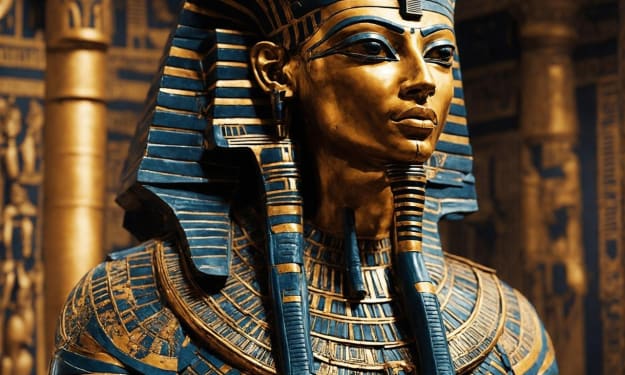
Akhenaten: Was He an Alien Pharaoh of Ancient Egypt?
The Mysterious Pharaoh In the heart of Egypt’s ancient history, one name stands out as an enigma: Akhenaten, the heretic king, the ruler who shattered the traditional religious order, and the architect of a radical transformation. He wasn’t just another Pharaoh; his reign brought forth a monotheistic vision centered on the sun god Aten, a stark departure from the traditional polytheistic worship of Egypt’s powerful pantheon of gods.
By The Secret History Of The Worldabout a year ago in History
“Vanished Galleons: The Lost Shipwrecks of the Dutch East India Company”
“Disappeared in the Abyss: The Catastrophic Shipwrecks of the VOC Fleet” The Dutch East India Company (VOC), once the most prosperous trading entity in history, presided over global maritime commerce for nearly two centuries. Yet beneath the splendor and fortune exists a lesser-known narrative the numerous VOC vessels that encountered disastrous fates in perilous waters. Stretching from the Indian Ocean to the rugged shorelines of Australia and the Cape of Good Hope, hundreds of VOC ships were lost to tempests, reefs, sabotage, and navigational mistakes. These wrecks not only transported commodities and riches but also embodied tales of aspiration, colonization, and sacrifice. This article examines the history, significant calamities, treasure recoveries, and the enduring enigma surrounding VOC shipwrecks. Article: The Dutch East India Company (VOC): A Nautical Titan Established in 1602, the Vereenigde Oostindische Compagnie (VOC), or Dutch East India Company, represented the world’s inaugural multinational corporation and the first to distribute shares. Charged with monopolizing the Dutch spice trade with Asia, the VOC developed extensive trade networks from Indonesia to Japan and South Africa. It commanded its military, minted currency, and deployed one of the most formidable naval fleets of its era. At the zenith of its influence in the 17th and 18th centuries, the VOC dispatched thousands of vessels on hazardous expeditions between Europe and Asia, transporting spices, silk, porcelain, gold, and silver. However, the perils were immense and the ocean, relentless. The Magnitude of VOC Shipwrecks Documentation reveals that over 1,600 vessels sailed under the VOC banner during its two-century lifespan. Of these, more than 250 ships were lost at sea due to tempests, shipwrecks, piracy, and navigational blunders. Many did not survive past the Cape of Good Hope, while others disappeared in the waters near Indonesia, Sri Lanka, India, and Australia. While some vessels were lost with all hands aboard, others left behind survivors who recounted stories of calamity, endurance, and treasure. The VOC’s meticulous record-keeping and archival resources preserved numerous tales, rendering VOC shipwrecks among the most extensively researched in maritime archaeology. Notable VOC Shipwrecks Batavia (1629) Possibly the most notorious VOC wreck, the Batavia served as a flagship en route to contemporary Jakarta (formerly Batavia). It ran aground on the Houtman Abrolhos islands off the western coast of Australia. What ensued was a harrowing saga of rebellion and homicide, wherein numerous survivors were murdered by fellow crew members. The wreck was uncovered in 1963, and artifacts retrieved unveiled invaluable cargo coins, silver, and ceramics. Vergulde Draeck (1656) Referred to as the Gilt Dragon, this VOC vessel struck a reef near present-day Western Australia. Of the 193 individuals aboard, merely 75 reached the shore. A rescue operation was initiated but was unsuccessful, and the fate of the survivors remains undetermined. The wreck was located in 1963, and divers recovered coins, cannons, and porcelain. Zuytdorp (1712) Transporting a fortune in silver coins, the Zuytdorp collided with cliffs north of Kalbarri, Western Australia. No survivors made it to civilization, and the wreck was largely overlooked until the 1920s. Theories persist that survivors may have intermarried with Indigenous communities. Amsterdam (1749) Wrecked on her inaugural voyage off the coast of England, the Amsterdam was a substantial VOC cargo vessel loaded with silver, spices, and textiles. Remarkably well preserved in the sand, the wreck is discernible at low tide near Hastings and remains a prominent archaeological site. Wealth Lost to the Ocean The VOC’s sunken vessels did not solely transport spices and provisions they frequently bore significant amounts of gold, silver, and valuable artifacts. Conservative estimates appraise the overall value of lost VOC cargo in contemporary currency at over $1 billion USD, although some estimates are considerably higher. With each maritime disaster, fortunes disappeared beneath the waves some yet to be recovered. For example, the Rooswijk, which sank in 1740 near England, was discovered to contain silver ingots and coins valued in the millions. Its recovery in 2004 constituted one of the largest VOC treasure discoveries of the modern era. Contemporary Archaeology and Recovery Initiatives Shipwrecks of the VOC are esteemed by archaeologists for their historical significance and by treasure seekers for their wealth. Numerous sites are safeguarded under national and international heritage regulations, particularly in Australian and Indonesian waters. Sophisticated technologies such as magnetometers, sonar, and underwater drones are employed to identify and excavate these submerged vessels. Teams must strike a balance between preservation and exploration, ensuring that artifacts are not plundered or damaged. Recovered items ranging from cannonballs to coins, porcelain, navigational instruments, and even preserved food are exhibited in museums throughout the Netherlands, Australia, and South Africa, providing insights into a golden era of trade and empire. Legacy of the VOC Shipwrecks Beyond the treasure and misfortune, the VOC shipwrecks narrate a broader tale one of global commerce, colonial aspiration, and maritime peril. They unveil the immense cost, both human and material, associated with the VOC’s supremacy in world trade.
By Say the truth about a year ago in History