Biographies
Cuba Takes Center Stage in Rome: A Cultural Event in Memory of José Martí
by Maddalena Celano The event featured Professor Pasquale Amato, a distinguished historian and scholar of relations between Europe and Latin America, who delivered a lecture titled:
By Maddalena Celanoabout a year ago in History
2024 Election Fallout: Supreme Court Rules on Trump’s Immunity Case
Introduction In a historic decision that could reshape the future of U.S. presidential accountability, the Supreme Court ruled on former President Donald Trump’s immunity case in 2024. The case, Trump v. United States, centered on whether a former president enjoys absolute immunity from criminal prosecution for actions taken while in office. The ruling not only impacts Trump’s multiple legal battles but also sets a precedent for the limits of executive power. This article examines the Court’s decision, its legal and political implications, and the potential consequences for the 2024 election and beyond. Background: The Legal Battle Over Presidential Immunity
By Silas Blackwoodabout a year ago in History
World’s Oldest Pyramid Built 25,000 Years Ago Was Not Made by Humans Archaeologists Claim
World’s Oldest Pyramid Built 25,000 Years Ago Was Not Made by Humans Archaeologists Claim In a groundbreaking claim that challenges everything we thought we knew about ancient civilizations and the timeline of human history archaeologists have unearthed what they believe could be the world’s oldest pyramid predating Egypt’s iconic pyramids by over 20,000 years. But what’s truly shocking is not just its age but the belief that it was not constructed by human hands. The site located in the heart of Indonesia’s Java island and referred to as Gunung Padang has long been a source of mystery and legend. For years local folklore spoke of a sacred mountain with unexplained energies and ancient secrets. Now with extensive carbon dating ground penetrating radar and 3D imaging researchers have uncovered a massive structure hidden beneath what was once believed to be a natural hill. And their findings are rewriting the pages of prehistory.
By Adnan Rasheedabout a year ago in History
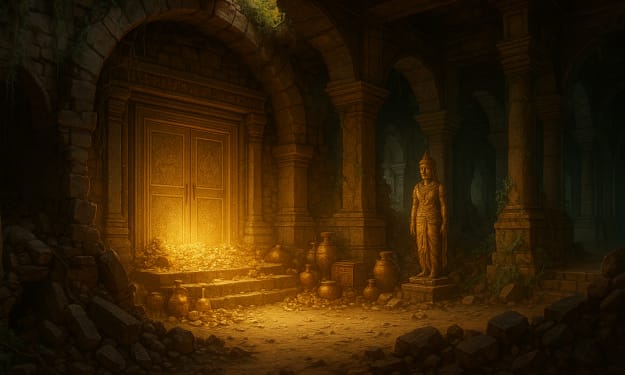
The Golden Vault of the Maharaja: India’s Overlooked Regal Fortune
The Narrative of the Golden Vault India, with its rich mosaic of kingdoms, empires, and dynasties, has long been a land of myths and opulence. Among its most timeless narratives is that of the Golden Vault of the Maharaja, a treasure hoard believed to be concealed beneath a now-decrepit palace in southern India. The narrative alleges a secret vault that was sealed during the early 18th century, brimming with gilded thrones, ivory-carved figures, invaluable jewels, and sacred manuscripts. The treasure was not solely emblematic of royal dominance but also regarded as a divine offering for the kingdom's protection. As colonial forces started encroaching on Indian territories, the last ruling Maharaja allegedly instructed that the treasure be sealed, hidden eternally from foreign hands. The Realm of Kaliganj The narrative focuses on the once-mighty yet now obscure realm of Kaliganj, situated between the boundaries of contemporary Karnataka and Tamil Nadu. Governed by a dynasty claiming descent from the Chola monarchs, Kaliganj thrived for nearly three centuries owing to its control over trade routes linking the Bay of Bengal with the Arabian Sea. Maharaja Virendra Dev, the last distinguished sovereign of Kaliganj, was a profoundly spiritual individual, renowned for his wisdom and architectural patronage. Under his administration, the kingdom’s temples were embellished with gold, and its treasury flourished from profits derived from silk trading and gemstone mining. However, Virendra Dev anticipated the decline of Kaliganj. With the Marathas ascending in the north and the British East India Company tightening its hold, the Maharaja commenced devising a strategy to safeguard the essence of his kingdomits treasure. The Sealing of the Vault According to preserved manuscripts and oral traditions transmitted through temple priests, Maharaja Virendra Dev commissioned his craftsmen to create an underground vault within the innermost part of his palace complex. With the assistance of master architects and priests, the vault was consecrated through ancient Vedic ceremonies and sealed employing a blend of mechanical locks and mystical mantras. The vault, according to some accounts, was distinguished by a lotus emblem and shielded by inscriptions cautioning of severe repercussions for those who entered with impure intentions. It was purported that only a genuine descendant of the Maharaja, wielding the sacred key and the knowledge of ancient chants, could safely unlock it. Colonial Incursion and Vanishing In 1765, British forces invaded Kaliganj and demolished the palace during their conquest. The royal family was displaced, and many members either fled or perished. However, the vault remained untouched, entombed beneath the debris of the palace ruins. British authorities recorded hearsay regarding concealed wealth, and numerous failed endeavors were undertaken to unearth it. Nevertheless, enigmatic collapses, the abrupt sickness of workers, and unusual natural phenomena caused the British to cease their pursuit. Some even inscribed in their diaries about “a celestial force” safeguarding the treasure. Rediscovery in the 20th Century During the 1930s, archaeologists encountered partially buried temple remnants close to Kaliganj, sparking renewed fascination in the myth. Locals recounted tales of subterranean chambers and “murmurs within the earth. ” A British-Indian archaeologist, Dr. Rudranath Bose, performed excavations and asserted that he had discovered the outer boundary of the original palace framework, comprising the foundations of a substantial square chamber that aligned with ancient accounts. However, World War II interrupted the excavation process. Dr. Bose’s records and discoveries mysteriously vanished following his demise in 1951, adding yet another layer of intrigue. Modern Speculation and Theories In contemporary times, satellite imagery and ground-penetrating radar have unveiled peculiar subterranean formations beneath the ruins of Kaliganj. A square configuration with adjacent corridors and sealed passageways suggests that a vault may indeed exist. Some theorists assert that the treasure was relocated prior to the British arrival, potentially transported to a clandestine Himalayan monastery. Others contend that it remains concealed, safeguarded by spiritual entities. The Indian government has imposed restrictions on extensive excavation in the vicinity due to its religious and historical significance, further intensifying speculation. In 2021, a collective of historians and spiritual researchers proposed a hypothesis that the vault’s lock was not merely mechanical but symbolicnecessitating a spiritual “key” in the form of ancient incantations performed by a living descendant. The Cultural Impact Whether factual or legendary, the Golden Vault of the Maharaja has integrated itself into local folklore. Artists, poets, and filmmakers have found inspiration in the narrative, portraying the treasure as both a tangible hoard of riches and a metaphor for lost wisdom, cultural pride, and divine heritage. Temples in the area still host annual celebrations honoring Maharaja Virendra Dev, and prayers are offered to the vaultregarded not simply as a repository, but as a sacred domain encompassing the spirit of a lost kingdom. Conclusion The legend of the Golden Vault of the Maharaja transcends a mere tale of concealed riches; it encapsulates India’s tumultuous history, spiritual depth, and the enduring human aspiration for what lies beneath the surface. Whether buried in gold or enshrined in myth, Kaliganj's secret continues to allure the inquisitive and the intrepid.
By Say the truth about a year ago in History
The Memory Garden
Once, the lot on the corner of Elm and Fourth was an eyesore—a tangle of weeds, broken bottles, and forgotten dreams. Kids avoided it, neighbors ignored it, and the town seemed content to let it fade into oblivion. But today, that same lot is a thriving oasis called the Memory Garden, where every flower, stone, and bench tells a story of our town’s past and its unbreakable spirit. This is the tale of how a patch of dirt became a place of healing, connection, and hope.
By Shohel Ranaabout a year ago in History
The Time Capsule Tapes
Tucked away in the dusty basement of the Willow Creek Library, behind a stack of moldy encyclopedias, a rusted metal box was about to change our town forever. When librarian Ellie Harper stumbled across it during a routine inventory last spring, she thought it was just another forgotten relic. But inside that unassuming time capsule, buried 50 years ago, was a treasure trove of cassette tapes—recordings of our town’s long-lost music scene that have sparked a joyous, toe-tapping revival.
By Shohel Ranaabout a year ago in History
The Concealed Wealth of the Khmer Empire: Treasure of the Hidden Pagoda. AI-Generated.
The Splendor of the Khmer Empire At its zenith between the 9th and 15th centuries, the Khmer Empire governed vast territories that comprise present-day Cambodia, Thailand, Laos, and Vietnam. Its capital, Angkor, emerged as one of the most extensive and sophisticated urban centers in the pre-industrial era. The Khmer monarchs constructed grand temple complexes such as Angkor Wat and Bayon, fusing spiritual reverence with architectural excellence. Gold circulated abundantly within the empire, attributed to extensive trade routes connecting with India, China, and Arabia. The opulence of the Khmer was not merely for embellishmentit held religious significance. Gold was regarded as a divine material, frequently utilized to embellish statues, temple facades, and sacred artifacts. However, as the empire began to wane in the 15th century, whispers of a concealed pagodaan ultimate treasury intended to safeguard the kingdom’s spiritual and material wealthstarted to surface. The Tale of the Golden Pagoda Khmer oral traditions, transmitted through generations, recount the existence of a "Golden Pagoda" constructed during the empire's final years. Commissioned by a dying monarch, the pagoda was believed to be situated deep within an undisclosed jungle valley, encircled by moats and protected by sacred stone figures. This temple, referred to in local lore as Phnom Meas (Golden Hill), was purportedly adorned with gold leaf, its walls embedded with rubies and emeralds. Internally, the pagoda was said to contain: Enormous golden statues of Buddha and Hindu deities. Chests filled with royal jewels and ceremonial blades. Gold coins, trinkets, and relics from vanquished realms. To thwart foreign plunderers, the pagoda was rumored to be buried or concealed with traps and curses, safeguarded by monks who never departed the premises. Historical Indications and European Records As European explorers began to venture into Cambodia in the 16th and 17th centuries, they noted local tales of temples filled with gold hidden within the forest. Portuguese and French missionaries chronicled elusive ruins, distant golden towers visible from riverboats, and villagers murmuring about forbidden territories no outsider ought to pursue. In 1860, French naturalist Henri Mouhot famously "rediscovered" Angkor Wat for the Western audience. His accounts ignited a surge of interest in Cambodia’s lost civilizations. Nevertheless, Mouhot also documented peculiar reports from local guides about a golden sanctuary “deeper in the jungle than any man dared to venture. ” These accounts have never been substantiated, yet they have incited speculation over the centuries. Contemporary Expeditions and Search Efforts Since the 20th century, numerous expeditions have been initiated to locate the elusive Golden Pagoda. A significant number of these endeavors concentrated on remote locations adjacent to the Kulen Mountains and the Cardamom Rangeareas characterized by dense forests, rugged landscapes, and uncharted ruins. In 2007, a group of archaeologists employing LIDAR (Light Detection and Ranging) unearthed several previously unrecognized temples concealed beneath jungle undergrowth near Angkor. These included road systems and settlements long presumed to have vanished. Some scholars speculated that they were nearing the solution to the enigma of Phnom Meas. Despite these findings, no definitive proof of a gold-clad temple has ever been conclusively discovered. Theories and Discussions A variety of theories envelop the origin and authenticity of the Golden Pagoda legend: Symbolic Wealth: Some scholars contend that the pagoda signifies spiritual richesenlightenment or wisdomrather than actual gold. Vandalized by Invaders: Others propose that the treasure may have existed but was plundered or melted down by the Siamese (Thai) invaders who ravaged Angkor in the 15th century. Still Concealed: An increasing number of independent researchers and treasure seekers hold the belief that the Golden Pagoda remains hidden, buried beneath centuries of vegetation and protected by booby-trapped paths or unexploded munitions from Cambodia’s recent conflicts.
By Say the truth about a year ago in History
Have We Misunderstood Our Past? 12,000-Year-Old Calendar Found in Turkey Rewrites Human History
Have We Misunderstood Our Past? 12,000-Year-Old Calendar Found in Turkey Rewrites Human History Imagine standing in front of a towering stone carved by hands that lived 12,000 years ago. No cities no written language no smartphones just a community of early humans looking up at the sky and trying to understand their place in the universe. In southern Turkey near the city of Şanlıurfa lies Göbekli Tepe an ancient archaeological site that continues to puzzle and fascinate scientists. But now a recent discovery at this site may shake the very foundations of our understanding of history a calendar older than any known system of timekeeping in the world.
By Adnan Rasheedabout a year ago in History
Emirates Algiers Office
For travelers and residents in Algeria looking for reliable assistance with Emirates Airlines, the Emirates Algiers Office offers dedicated services to ensure smooth travel experiences. Whether you want to book a ticket, get flight information, or need help with your booking, the Emirates Office in Algiers is the official hub to turn to. In this guide, we provide detailed information about the Emirates Office location, contact details, services offered, and useful tips to help you make the most of your visit.
By Offices Expertsabout a year ago in History
"We’re Not Trying to Recreate a Species from Ancient DNA Scraps": One of Earth’s Rarest Animals Could Be Brought Back from the Edge of Extinction.. AI-Generated.
"We’re Not Trying to Recreate a Species from Ancient DNA Scraps": One of Earth’s Rarest Animals Could Be Brought Back from the Edge of Extinction.
By Sayeed Ahmedabout a year ago in History