Biographies
Everest: The Cost of Glory
🌬️ Into Thin Air: The Day Everest Took Lives and Left Scars A True Story of Courage, Survival, and Tragedy on the World’s Highest Peak On May 10, 1996, the sky above Mount Everest—silent, vast, and sparkling with snow—hid no warning signs. At 29,029 feet above sea level, where oxygen is so thin you can hardly breathe, a group of climbers stood triumphantly on the summit of the world’s highest mountain. They had made it. The dream of a lifetime had come true. But they had no idea they were standing at the edge of death. Jon Krakauer, an American journalist and mountaineer, was one of those climbers. He had come to Everest on assignment from Outside magazine to document the growing commercialization of Everest expeditions. He was climbing with a well-respected guide, Rob Hall, from New Zealand. Another team, led by the charismatic American Scott Fischer, was also aiming for the summit the same day. These were not amateurs. They were experienced climbers, guided by professionals. They had trained for months. They had paid up to $65,000 for the chance to stand on the roof of the world. And yet, none of them—not even the experts—were prepared for what was coming. 🚨 The Perfect Storm of Mistakes Everything seemed in place. But Everest is not a place of mercy. At those heights, every step is agony, every breath burns your lungs, and the human brain starts to shut down. The climbers were already exhausted when they reached the summit—hours later than planned. A strict rule in mountaineering is: turn around by 2:00 PM, summit or not. That rule was broken. Why? Because ambition is louder than fear. And Everest tempts the soul. As climbers descended, a sudden blizzard rolled in—fierce winds, blinding snow, and freezing temperatures below minus 30°C. The path disappeared. Ropes were buried. Visibility dropped to nothing. It was chaos. People became lost. Some collapsed. Some wandered off cliffs. Some simply sat down and never stood up again. 🧗♂️ The Heroes and the Heartbreak Rob Hall stayed with a client, Doug Hansen, who was too weak to move. Despite radio calls begging Rob to come down alone and save himself, he refused to leave Doug. “We’re fine,” he said over the radio. “Just a bit slow.” Hours later, the radio crackled again. “Please tell Jan I love her,” Rob said. Jan Arnold—his pregnant wife—was listening from New Zealand. It was the last time she would ever hear his voice. Scott Fischer, the second team leader, was found later—dead, frozen near the summit. He had pushed himself too hard and collapsed on the way down. He refused help. Everest swallowed him. And yet… there were survivors. Some miraculous, impossible survivors. ❄️ The Woman Who Came Back from the Dead One of the most stunning parts of the story is Beck Weathers, a Texan climber who was left for dead—twice. Left in the cold after losing consciousness, his face and hands were frostbitten beyond recognition. His teammates assumed he had died. But the next morning, he woke up. Alone. Half-blind. Barely able to walk. He staggered through the snowstorm back to camp. His nose was black. His fingers frozen stiff. But he was alive. He survived against all odds—and was rescued by helicopter from a near-impossible altitude the next day. He would later lose his right hand, left fingers, and most of his nose, but he lived to tell the tale. 😢 Survivors' Guilt and the Weight of Memory Jon Krakauer, though alive, was shattered. As he descended to base camp, past the frozen bodies of friends he had spoken with just hours before, guilt consumed him. He had written the story for a magazine—but it had become the most painful experience of his life. He later turned his article into the now-famous book, Into Thin Air, not to glorify Everest, but to tell the truth: Everest is not just a dream. It is a death zone. A place where nature always wins. The book doesn’t just document facts—it aches with emotion. It carries the weight of real voices lost to snow. It is not a story about how far humans can go—it’s a warning of what happens when we go too far. 💔 Why This Story Still Matters More than 200 bodies still remain on Everest, too dangerous to recover. The 1996 disaster became one of the most studied tragedies in mountaineering history. It changed the rules, exposed the risks of commercial climbs, and forced climbers to respect the mountain in new ways. But beyond the statistics, it’s a story of love, loyalty, and human will. Rob Hall stayed to the end for a client. Beck Weathers returned from the dead for his family. People helped each other, even when help meant dying too. In the coldest place on Earth, warmth came not from gear, but from human connection. 🕯️ Final Words Into Thin Air is more than just a book. It’s a haunting echo from the heights. It’s a call to remember those who reached for the sky—and paid the price. It’s a reminder that sometimes, the most dangerous thing about climbing Everest isn’t the height—it’s the belief that we’re invincible. > “There’s no such thing as fair or unfair on a mountain. There is only the mountain. And it does not care.” — Jon Krakauer
By Khan Afzalabout a year ago in History
Bacha Khan: A Forgotten Beacon of Nonviolence and Nationhood"
Those who choose to work for humanity on the level of nation, society, and homeland live in a different world. The question arises—how do such thoughts arise in their hearts? While it’s difficult to provide a definitive answer, one can say that there is something in their personality, temperament, and sensitivity that is not satisfied by nurturing just the “self.” Their hearts and minds beat not just for the well-being of their own household, but for a greater collective humanity.
By Hamza khanabout a year ago in History
The Middle East: A Tinderbox of Empires, Wars, and Unending Conflict. AI-Generated.
The Middle East: A Tinderbox of Empires, Wars, and Unending Conflict The Middle East has always been more than just a geographical region—it’s a crucible of civilizations, a battleground of empires, and a vortex of geopolitical rivalries that have shaped world history. From the ancient wars of Mesopotamia to the modern-day clashes between Israel and Iran, this land has rarely known lasting peace. Today, as tensions escalate once again, the Middle East stands at the brink of another catastrophic conflict, threatening not just regional stability but global security.
By Muhammad Salman Akbarabout a year ago in History
The Boy King’s Secret (Egypt)
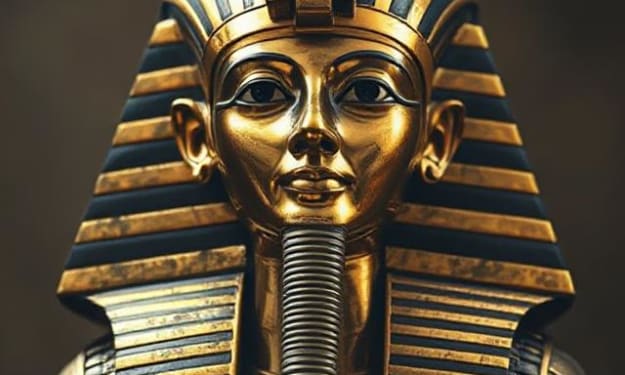
In the dry heart of ancient Egypt, under the golden sun and endless sky, a boy once sat on a throne too large for his feet to reach the floor. His name was Tutankhamun. He was only nine years old when he became Pharaoh of Egypt, the most powerful kingdom in the world. In his hands rested a scepter and a flail—symbols of power he barely understood. Around him stood priests, advisors, and generals—each bowing low, each whispering plans behind his back. But to his people, he was divine. The living son of the gods. Yet Tutankhamun was not born to rule. --- 👑 The Shadow of Akhenaten Tutankhamun’s father was the controversial pharaoh Akhenaten, a ruler who shattered traditions by replacing Egypt’s gods with just one: Aten, the sun disk. Under his rule, temples were destroyed, priests cast out, and a new capital city—Amarna—was built from dust. But Akhenaten’s reign left Egypt weak and fractured. When he died, his revolution died with him. His son, Tutankhaten (“Living Image of Aten”), was placed on the throne as a child king. But Egypt’s elders had a plan. They restored the old gods, moved the capital back to Thebes, and changed the boy’s name from Tutankhaten to Tutankhamun—“Living Image of Amun,” god of kings. He was a symbol of healing. Of return. Of tradition. But he was also a child caught in a game of power. --- 💔 A Short Life in Golden Silence Tutankhamun was married young, to his half-sister Ankhesenamun. Their love was real, but their time was brief. Together, they suffered tragedy—two daughters, both stillborn, buried in tiny coffins beside their father. The young king had health issues—he walked with a cane, had a curved spine, and likely suffered from genetic disorders due to royal inbreeding. Despite this, he tried to rule. Records show he ordered the restoration of temples and participated in rituals to please the gods. But behind the scenes, the real power belonged to his advisors—Ay, the grand vizier, and Horemheb, the general. At just 18 or 19 years old, Tutankhamun died suddenly. The cause is still debated: Was it malaria? A broken leg that led to infection? Or… was it murder? Some theories suggest Ay or Horemheb wanted the throne. After Tutankhamun’s death, Ay married his widow and declared himself Pharaoh. The boy king’s name was erased from records, as if he had never existed. His tomb, too, was forgotten. But history has a strange way of remembering the forgotten. --- ⚱️ The Tomb That Changed the World Over 3,000 years later, in 1922, a British archaeologist named Howard Carter discovered a sealed doorway buried beneath rubble in the Valley of the Kings. Inscribed with Tutankhamun’s name. Carter and his team opened the tomb in awe. Inside was a miracle: over 5,000 treasures, untouched for millennia. Golden chariots, ivory statues, perfumes, weapons, games, jewelry—and at the center, a series of nested shrines and coffins, ending in a solid gold sarcophagus. Within it, lay Tutankhamun, wearing a golden mask that became the face of ancient Egypt itself. The discovery shocked the world. Never before had a pharaoh’s tomb been found intact. Newspapers called it the “Greatest Archaeological Find in History.” But the tomb brought more than riches. --- ☠️ The Curse of the Pharaoh? Soon after the tomb was opened, rumors of a curse began to spread. Lord Carnarvon, the financier of the dig, died mysteriously after an infected mosquito bite. Other team members suffered accidents, illnesses, or deaths. Some believed Tutankhamun had cursed those who disturbed his rest. Others called it coincidence. Or ancient mold in the tomb. But the myth stuck. It added to Tutankhamun’s mystery. A boy once forgotten had become immortal in legend. --- 🌍 His Legacy Lives On Today, Tutankhamun is one of the most famous pharaohs in history—not because of what he did in life, but because of what his tomb revealed in death. His story teaches us that: Even the briefest lives can echo through time. Power doesn’t guarantee legacy—memory does. History hides treasures—not just gold, but truth. Tutankhamun never built pyramids. He never conquered lands. But he left behind something more valuable: a window into the soul of ancient Egypt. --- ✨ The Final Note In 2019, Tutankhamun’s treasures began a world tour, drawing millions of visitors. The fragile artifacts were returned to Egypt and will rest in the Grand Egyptian Museum—not far from where the boy king once ruled. And somewhere, under the hot Egyptian sun, in the dust of the past and the gold of memory, Tutankhamun sleeps on… Not forgotten.
By Soul Draftsabout a year ago in History
“From Allies to Adversaries:
his y Introduction Once allies in a complex and unstable Middle East, Iran and Israel’s relationship has shifted dramatically over the past several decades. From covert military cooperation and oil deals during the reign of Iran’s Shah to today's deadly standoffs, cyberattacks, and proxy wars — their history is one of trust shattered, secrets unearthed, and a silent war that has shaped the very structure of the region.
By Qaisar iqbal about a year ago in History
The history of human settlement in North America is altered by footprints.
At White Sands, New Mexico, researchers found human footprints preserved in prehistoric mud. These footprints seem to be from the Last Glacial Maximum (LGM), which occurred around 23,000 years ago during the last Ice Age, when glaciers were at their greatest.
By Francis Damiabout a year ago in History