Biographies
The Evolution of Military Technology Between WWI and WWII
The Evolution of Military Technology Between WWI and WWII The period between World War I and World War II was one of profound transformation in military technology, strategy, and global power dynamics. While World War I had introduced the world to mechanized warfare on an unprecedented scale, the interwar years saw nations around the globe rushing to analyze lessons learned, innovate, and prepare for the conflicts they feared would erupt again. This era was marked by rapid technological advancements that fundamentally reshaped the way wars were fought, laying the groundwork for the devastating battles of World War II.
By Ali Asad Ullahabout a year ago in History
Is World War III Really Coming in 2025? Analyzing Global Tensions
Is World War III Really Coming in 2025? Analyzing Global Tensions In the ever-shifting landscape of international relations, the specter of a third world war looms as a persistent, albeit nebulous, possibility. The year 2025 has surfaced in geopolitical discourse as a critical juncture, fueled by escalating tensions among global powers, intensifying proxy conflicts, and rapid technological advancements in warfare. Yet, amid the cacophony of speculation and alarmism, it is imperative to dissect the underpinnings of these tensions with rigor and nuance, moving beyond sensationalism to understand whether a full-scale global conflagration is indeed imminent or merely an extrapolation of contemporary anxieties.
By Ali Asad Ullahabout a year ago in History
The Beauty of New York: A City of Timeless Wonders and Endless Change
The Beauty of New York: A City of Timeless Wonders and Endless Change By Ali Asad Ullah I still remember the first time I stepped onto the streets of New York City. The air buzzed with a strange energy — a mix of hope, chaos, and possibility that you could feel pulsing beneath every footstep. Coming from a quieter place, it was overwhelming at first. The towering skyscrapers seemed to touch the clouds, the cacophony of voices, horns, and footsteps merged into a strange kind of music, and every corner seemed to whisper a story.
By Ali Asad Ullahabout a year ago in History
From Blockbuster to Netflix: Why Marketing Has Moved from Loud to Smart
Let’s be honest: Most people still think marketing is just about ads, logos, and making noise. But in today’s AI-powered world, marketing is something else entirely. It’s about understanding humans deeply — and using technology smartly to serve them better than anyone else. It’s not about who can shout the loudest, but about who listens the best.
By Waqas Ahmadabout a year ago in History
Cleopatra: Queen of the Nile, Mistress of Empires
Cleopatra: The Last Pharaoh of Egypt and the Woman Who Defied an Empire Long before the fall of Rome or the rise of modern empires, there was a woman who defied the expectations of her world. Her name was Cleopatra VII Philopator — the last pharaoh of Egypt, the seductress of two of Rome’s most powerful men, and a queen whose life has become legend. Born in 69 BCE into the Ptolemaic dynasty, Cleopatra wasn’t fully Egyptian by blood. Her family descended from Ptolemy I Soter, one of Alexander the Great’s generals, who took control of Egypt after Alexander’s death. The Ptolemies were Greek by heritage, yet Cleopatra did something revolutionary: she embraced the culture of the Egyptian people, even learning their language — something none of her predecessors had done in over 250 years of Ptolemaic rule. From the beginning, Cleopatra's life was shaped by politics, betrayal, and ambition. After the death of her father, Ptolemy XII, Cleopatra ascended to the throne at just 18 years old. But she wasn’t alone. In accordance with Egyptian tradition, she co-ruled with her younger brother, Ptolemy XIII, who was only 10 at the time — and who would soon become her enemy. The royal court was a place of conspiracy and tension. Cleopatra was quickly pushed out of power by her brother's advisors. Forced into exile, she regrouped in Syria, raising an army to reclaim her throne. But fate, as history often reminds us, would bring an even more powerful ally into her story. In 48 BCE, Julius Caesar arrived in Egypt, pursuing his rival, Pompey. Cleopatra saw an opportunity. According to legend, she had herself smuggled into Caesar’s quarters rolled up in a carpet (or perhaps a linen sack). When unwrapped, she appeared before him — radiant, confident, and politically astute. Caesar was captivated. Their alliance wasn’t just romantic; it was strategic. With Caesar’s backing, Cleopatra defeated her brother’s forces in a brutal civil war. Ptolemy XIII drowned in the Nile while trying to escape. Cleopatra returned to power, now co-ruling with another younger brother, Ptolemy XIV, though the true power rested with her alone. In 47 BCE, Cleopatra gave birth to Caesar’s son, Caesarion. She traveled to Rome to visit Caesar — and was there when he was assassinated in 44 BCE. With her protector gone and Rome thrown into chaos, Cleopatra returned to Egypt, navigating the deadly ripples of Roman politics from afar. Her next great love — and political alliance — came with Mark Antony, a general and member of the Second Triumvirate that ruled Rome after Caesar’s death. Their story would ignite both passions and wars. Mark Antony summoned Cleopatra to Tarsus (modern-day Turkey), ostensibly to question her loyalty. But Cleopatra arrived in a spectacle: dressed as the goddess Isis, sailing up the Cydnus River in a golden barge, surrounded by incense, music, and dancers. Antony, a man of action and appetite, was enthralled. They became lovers and allies. Cleopatra bore him three children. Together, they envisioned a new world — one where East and West could coexist, where Rome and Egypt could rule in harmony. But this dream made them dangerous in the eyes of Rome. Octavian, Caesar’s adopted heir (and later Augustus), saw Antony and Cleopatra as threats to his rising power. He launched a campaign of propaganda, painting Cleopatra as a temptress who had bewitched Antony and stolen him from Roman virtue. In truth, Antony had his own ambitions — but Cleopatra’s presence made him vulnerable to Rome’s suspicion and fury. In 31 BCE, the conflict came to a head at the naval Battle of Actium. Cleopatra and Antony’s forces were defeated by Octavian’s fleet. They fled back to Egypt, where their last stand would unfold. As Octavian approached Alexandria, Cleopatra prepared for the end. Antony, wrongly informed that Cleopatra had died, fell on his own sword. Mortally wounded, he was brought to Cleopatra, dying in her arms — a scene Shakespeare would later immortalize. Cleopatra, left alone, attempted to negotiate with Octavian. But realizing she would be paraded through Rome in chains, she chose death. According to tradition, she arranged to be bitten by a poisonous asp — though some historians believe she used a toxic ointment instead. She died at age 39, a queen to the end. With her death, the Ptolemaic dynasty — and pharaonic Egypt — came to an end. Egypt became a province of the Roman Empire, ruled not by its own blood, but by foreign governors. Yet Cleopatra’s story didn’t fade. She became legend — vilified by some, romanticized by others. Roman historians called her manipulative and dangerous. Renaissance painters portrayed her as a tragic beauty. Modern scholars have sought to understand the real woman behind the myths: a brilliant linguist, a skilled diplomat, a woman who wielded power in a man’s world. Cleopatra was more than just the lover of Caesar or Antony. She was a monarch who fought for her nation’s independence, a strategist who understood the tides of empire, and a woman who dared to define her own destiny. Her story is not just history — it is a reminder of how powerful women have always shaped the world, even when history tries to silence them.
By Soul Draftsabout a year ago in History
The Solitude and the Discipline of Poet Sylvia Plath
People have looked at Sylvia Plath in a warped way for a long time. More often than not, she’s seen as a tragic figure instead of as a serious author. For decades, popular imagination has stuck to the image of the suicidal, confessional poet, pouring her pain onto the page. But if you dig into the archives, her drafts, her letters, lecture notes, her marked-up books, a different picture starts to form. What you see is a sharp, self-driven writer who knew that imagination alone wasn’t enough. She understood that inspiration comes when habit and intellect meet. If you go to the Lilly Library at Indiana University, where her calendars and notebooks are stored, you don’t find chaos. You find a careful, professional writer.
By Tim Carmichaelabout a year ago in History
The Martyrdom of Hazrat Umar ibn al-Khattab (RA)
In the year 23 AH, the second Caliph of Islam, Ameer al-Mu’mineen Hazrat Umar ibn al-Khattab (RA), was returning to Madinah after performing Hajj. Along the journey, he halted at a place, dismounted his camel, and sat on the ground, clearing away the pebbles with his hands to make a small space for himself to rest. Spreading his cloak, he lay down, gazed up at the sky, and immediately raised both hands towards it. In a moment of deep spiritual connection, he supplicated to his Lord: > “O Allah! My age has advanced, my strength has weakened, and my people have spread far and wide—so take me back to You.” (اللّھُمَّ كَبُرَتْ سِنِّي، وَضَعُفَتْ قُوَّتِي، وَانتَشَرَتْ رَعِیَّتِي، فَاقبِضنِي اِلَیکَ) Upon reaching Madinah, during a sermon in Masjid al-Nabawi, he prayed to Allah for martyrdom and then immediately questioned: > "How can I attain martyrdom while living in Madinah?" (أَنَّیٰ لِي الشَّھَادَۃ؟) He reasoned that all the battlefronts where Islamic armies were engaged in jihad were far from Madinah—hundreds, even thousands of miles away—so how could he hope for martyrdom while residing in the city? But then, with firm belief, he said: > “The One who brought me from Makkah to Madinah is surely capable of bringing martyrdom to me even here in Madinah.” (إِنَّ الَّذِي سَاقَنِي مِن مَكَّۃَ إِلَی المَدِينَۃِ قَادِرٌ عَلَیٰ أَن یَسُوقَ لِي الشَّهَادَۃَ إِلَی المَدِينَۃِ) Just a few days after this, in the last days of Dhul-Hijjah, a Persian fire-worshipping slave named Abu Lu’lu’ah Firoz plotted his assassination. He prepared a large, double-edged dagger soaked in poison. One early morning before Fajr prayer, he hid in a corner of the mosque under the cover of darkness. As Hazrat Umar (RA) stepped forward to lead the prayer, and just as he said the opening Takbeer, the assassin attacked with multiple blows from the poisoned dagger. In the ensuing chaos, many worshipers tried to stop the attacker, but being unarmed, they faced difficulty. The assassin wounded thirteen individuals, six of whom later succumbed to their injuries. When finally overpowered—thanks to Hazrat Abdur Rahman ibn Awf (RA) throwing a cloak over him—Abu Lu’lu’ah stabbed himself and died on the spot, taking the secrets behind the conspiracy with him. Though severely wounded, Hazrat Umar (RA) indicated to Hazrat Abdur Rahman (RA) to continue leading the prayer, and was immediately carried home. Later, regaining consciousness, he asked Hazrat Abdullah ibn Abbas (RA): > “My dear nephew, who was the attacker and what became of him?” On hearing that the attacker was the fire-worshipping slave Abu Lu’lu’ah who had killed himself, Hazrat Umar (RA) said: > “Praise be to Allah, who did not make my killer one who bows to Him in prayer.” As his condition worsened, the senior companions advised him to appoint a successor to avoid division among the Muslims. Hazrat Umar (RA) named six individuals and instructed that they should mutually choose one among themselves within three days. These were: 1. Hazrat Uthman ibn Affan (RA) 2. Hazrat Ali ibn Abi Talib (RA) 3. Hazrat Abdur Rahman ibn Awf (RA) 4. Hazrat Sa’d ibn Abi Waqqas (RA) 5. Hazrat Talha ibn Ubaidullah (RA) 6. Hazrat Zubair ibn al-Awwam (RA) He also instructed that until a new Caliph was chosen, Hazrat Suhaib ar-Rumi (RA) should lead the prayers in Masjid al-Nabawi. Before his passing, Hazrat Umar (RA) gathered the six and advised them with heartfelt words: > “Whoever among you is chosen as Caliph, I advise him to show kindness to the Ansar. They supported the Prophet ﷺ and welcomed the Muhajirun into their homes. Forgive their mistakes and honor their virtues.” He further said: > “Treat the Muhajirun with gentleness and good character.” Finally, he sent his son, Hazrat Abdullah ibn Umar (RA), to seek permission from Umm al-Mu’mineen Hazrat Aisha Siddiqa (RA) to be buried beside the Prophet ﷺ and Hazrat Abu Bakr (RA). Upon hearing the request, her eyes filled with tears, and she said: > “I had reserved this place for myself, but today, I give preference to Umar over myself.” After being wounded on the 26th of Dhul-Hijjah, Hazrat Umar (RA) passed away four days later on 1st Muharram, 24 AH (Sunday) at the age of 63. His funeral prayer was led by Hazrat Suhaib ar-Rumi (RA), and he was laid to rest beside the Prophet ﷺ and Hazrat Abu Bakr (RA) in the blessed chamber of Masjid al-Nabawi. May Allah elevate the ranks of Hazrat Umar ibn al-Khattab (RA) in Jannat al-Firdaws, and may He bless us with the honor of the company of the Prophet ﷺ and his noble companions. Ameen. (Please react to the post so we can bring more such stories to you soon, inshaAllah.) ❤️
By 🇲 🇮 🇳 🇩 🇺 🇳 🇫 🇴 🇱 🇩 🇪 🇩 about a year ago in History
The Mind That Split the World: J. Robert Oppenheimer's Atomic Legacy
In the vast landscape of 20th-century history, few individuals left as deep and morally complex a legacy as J. Robert Oppenheimer. Known to many as the “Father of the Atomic Bomb,” his story stretches far beyond that of a scientist creating a powerful weapon—it is the journey of a man wrestling with brilliance, ambition, responsibility, and ultimately, regret.
By Sadaa-e-Lamakanabout a year ago in History
The Eternal Smile: A Story of the Mona Lisa
In the echoing halls of the Louvre Museum in Paris, behind a thick pane of bulletproof glass, hangs the most famous smile the world has ever known. The Mona Lisa—silent, mysterious, and immortal—is more than just a portrait. She is a story, a riddle wrapped in oil and wood, whose journey from the hands of a Renaissance genius to global icon status is nothing short of extraordinary. It all began in Florence, Italy, in the early 1500s. Leonardo da Vinci, the quintessential Renaissance man, had returned to his homeland after years spent in Milan. Amidst commissions for churches, scientific sketches, and engineering blueprints, he accepted a humble portrait commission—one that would defy time. The woman was Lisa Gherardini, the wife of a wealthy Florentine silk merchant, Francesco del Giocondo. By all accounts, Lisa was not famous, royal, or extraordinary. Yet Leonardo, known for infusing soul into his art, saw something in her that others might have missed. He began the portrait around 1503. But, unlike other commissions, Leonardo didn’t let this one go. He carried it with him for years—through cities, countries, even as he crossed the Alps into France. This begs the question: why? Some say Leonardo saw it as more than a portrait. It became a lifelong project, a personal obsession. The Mona Lisa was his laboratory—a place where he experimented with techniques like sfumato, the delicate blending of tones that gives her face its lifelike softness. Her smile—subtle, elusive—was a marvel of optical illusion. Depending on the viewer’s angle, it seemed to change: now amused, now distant, now knowing. The painting was alive. Leonardo never delivered the portrait to Francesco del Giocondo. Instead, he took it with him to France in 1516 when he accepted an invitation from King Francis I. After Leonardo’s death in 1519, the painting became part of the French royal collection, admired behind palace walls but not yet the cultural titan she would become. For centuries, the Mona Lisa was respected but relatively obscure. That all changed in 1911. On a quiet August morning, the Louvre’s guards discovered an empty space on the wall where the Mona Lisa had hung. Panic spread. Paris was stunned. The police interrogated everyone—even Pablo Picasso. But the real thief was Vincenzo Peruggia, an Italian handyman who believed the painting belonged in Italy and had simply walked out with it hidden under his smock. For over two years, the Mona Lisa was missing. Newspapers around the world printed her image, and the public obsession began. When she was finally recovered in 1913, in a hotel room in Florence, the Mona Lisa returned to France not just as a masterpiece—but as a legend. From then on, her fame soared. Tourists flocked to see her. Writers and poets wrote about her. Scholars debated her secrets. Was she smiling or sad? Was she truly Lisa Gherardini—or someone else entirely? Some claimed she was a vision of femininity; others suspected hidden messages and codes. Through it all, she never said a word. In World War II, the Mona Lisa was hidden in various secret locations to protect her from the Nazis. She traveled in padded crates, watched over like royalty, always returning to the Louvre once peace was restored. In the modern age, she has traveled less—but her image has gone everywhere. She has been parodied by Dali, adored by Warhol, and replicated on mugs, t-shirts, and memes. She has starred in Hollywood films, inspired novels like The Da Vinci Code, and graced textbooks in classrooms across continents. Yet despite the fame, the real Mona Lisa remains as she always has: quiet, serene, unknowable. She watches the world through her glass, never aging, never changing. Her fame may be modern, but her soul is timeless. Perhaps that is the secret to her power. Leonardo, with all his genius, painted not just a woman, but a moment suspended in eternity. He captured not only the softness of skin and the glint in the eye, but something deeper—the quiet grace of human presence. A feeling that even five centuries later, draws millions to stand in silence before her. In a world driven by noise and speed, the Mona Lisa reminds us that mystery has its own magnetism. That some stories are more powerful for being incomplete. That a single, subtle smile can captivate the world—forever.
By Soul Draftsabout a year ago in History
45th President of the United States: Donald J. Trump
Few presidencies in American history have commanded as much global attention, stirred as much domestic division, or rewritten as many political rules as that of Donald John Trump, the 45th President of the United States. His time in office — from January 2017 to January 2021 — represented a profound departure from traditional presidential norms, and his influence on the American political landscape remains deeply consequential years after he left the White House.
By Hissam khanabout a year ago in History
The Justice of Hazrat Umar (RA)
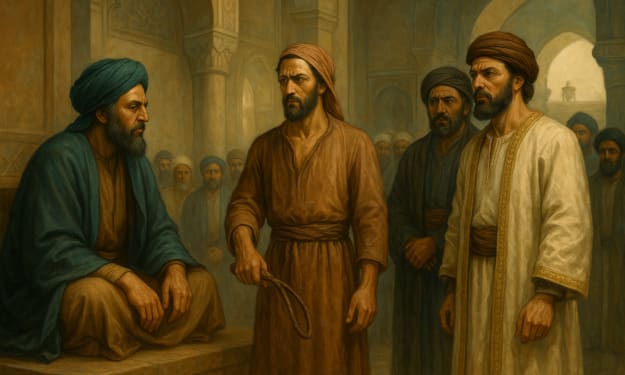
Hazrat Umar ibn al-Khattab (RA), the second Caliph of Islam, is remembered as one of the most just rulers in human history. His legacy is filled with stories of deep piety, unwavering justice, and commitment to the welfare of his people. Among the many stories attributed to his life, one incident stands out as a powerful reflection of his leadership and moral integrity. This is the true story of how Hazrat Umar (RA), as the leader of a vast empire, held himself accountable before a humble citizen of his realm. The Complaint of the Egyptian During Hazrat Umar’s caliphate, the Islamic empire had expanded rapidly, stretching from the Arabian Peninsula into parts of the Byzantine and Persian empires. Egypt had been recently conquered and was governed by ‘Amr ibn al-‘As (RA), a respected companion of the Prophet Muhammad (PBUH). One day, a young Coptic Christian from Egypt arrived in Madinah with a plea for justice. He was tired, dusty, and clearly from a distant land. He sought an audience with the Caliph and was granted permission to present his case. Standing in front of Hazrat Umar (RA), the young man recounted an incident that had left him humiliated. He explained that he had been racing with the son of the governor of Egypt, Muhammad ibn ‘Amr ibn al-‘As, and had won the race. Angered by his loss, the governor’s son struck the Coptic youth with a whip and arrogantly declared, “How dare you beat me? I am the son of a nobleman!” The Coptic youth’s voice trembled as he concluded his account. He had traveled all the way from Egypt, through the deserts, not for revenge—but for justice. He believed, in the Islamic system, even a non-Muslim could expect fairness. Hazrat Umar (RA), upon hearing the complaint, was deeply moved—and furious at the injustice. He immediately sent a letter to ‘Amr ibn al-‘As (RA), summoning both the governor and his son to Madinah. The message was clear: no one, not even the children of high-ranking officials, was above the law. Justice in the Masjid Within days, ‘Amr ibn al-‘As (RA) and his son arrived in Madinah. The people gathered in the Prophet’s Mosque, curious and eager to see how the Caliph would handle such a sensitive matter. Here was a non-Muslim accusing a Muslim official’s son in the heart of the Islamic state. Hazrat Umar (RA) turned to the young Coptic man and said, “Here is the whip. Take it, and strike the one who struck you.” The crowd gasped. It was unheard of—a Christian being given the right to strike a Muslim, and not just any Muslim, but the son of a powerful governor. Yet this was the justice of Islam. The Coptic youth hesitated but then struck Muhammad ibn ‘Amr ibn al-‘As as he had been struck. Hazrat Umar (RA) then said, “Strike the father too, for it was his power and arrogance that allowed his son to behave like this.” The Coptic youth declined. “O Commander of the Faithful,” he said, “I have received justice. I am satisfied. The one who hit me has been punished. I need no more.” Hazrat Umar (RA) turned to ‘Amr ibn al-‘As and delivered words that would be echoed through history: “Since when have you enslaved the people, when their mothers bore them free?” A Lesson for the Ages This incident became a landmark in the history of justice—not only in Islam but in the annals of human governance. Hazrat Umar (RA) made it clear that there was no place for classism, racism, or favoritism in an Islamic society. Regardless of faith, race, or social standing, every person was equal before the law. It also displayed Hazrat Umar’s deep understanding of leadership. For him, being a Caliph did not mean ruling with an iron fist or accumulating wealth and luxury. Instead, it meant serving the people, being accessible to them, and upholding justice at all costs. The Coptic youth returned to Egypt, not just with a sense of personal justice, but with a renewed admiration for the fairness of Islamic rule. His story spread among the people, enhancing their trust in the Islamic administration. Humility of Hazrat Umar (RA) This story also highlights the humility of Hazrat Umar (RA). Here was a man ruling over a territory stretching thousands of miles, yet he wore patched clothes, slept on a simple mat, and walked the streets at night to check on his people. He did not hide behind palaces or armies. He answered directly to the people—and, more importantly, to God. In another narration, when a man once approached Hazrat Umar (RA) with a complaint about poverty, the Caliph offered to carry a sack of food on his own back to the man’s house. When his companions offered to help, Umar (RA) refused, saying, “Will you carry my burden on the Day of Judgment?” His sense of responsibility was not confined to legal cases but extended to every aspect of his role as a leader. Whether it was feeding the poor, resolving disputes, or ensuring fairness for non-Muslims, Hazrat Umar (RA) saw himself as a shepherd accountable for every single one of his flock. Conclusion The story of Hazrat Umar (RA), the Coptic Christian, and the governor’s son is not just a tale from history. It is a timeless reminder of what true justice looks like—impartial, fearless, and rooted in accountability. In a world often plagued by tyranny and privilege, Hazrat Umar’s example continues to inspire leaders and individuals alike. He was not just a ruler; he was a servant of his people, a guardian of justice, and a man who feared God more than he craved power. His legacy, preserved through stories like this, remains a beacon of moral leadership for generations to come.
By 🇲 🇮 🇳 🇩 🇺 🇳 🇫 🇴 🇱 🇩 🇪 🇩 about a year ago in History