Biographies
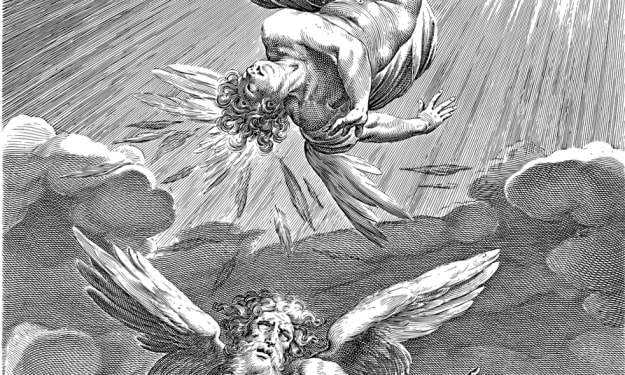
The Greek Mythology; Icarus and Daedalus - The mythical inventor.
"Wings of Ambition: The Tragic Flight of Icarus and Daedalus" In the age of myth, ensconced within the labyrinthine heart of Crete, there dwelled Daedalus—a peerless craftsman, an alchemist of artistry, whose gifts knew no equal. But with genius came a beguiling curse, as the keen eye of King Minos fell upon him. In the convoluted embrace of the very maze he had conjured, Daedalus languished, his soul yearning for liberation. And in this tale of destiny intertwined, his son, Icarus, shared that fervent longing.
By The Must-Read 3 years ago in History
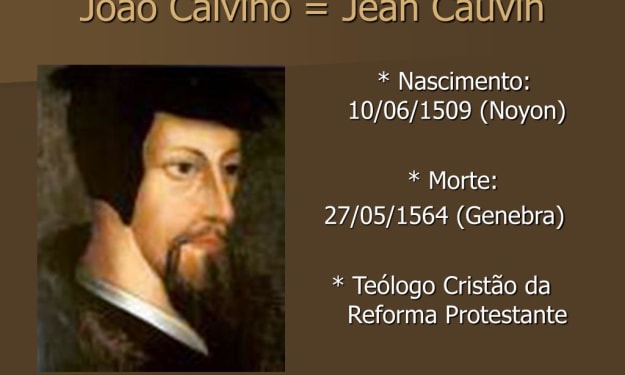
John Calvin: French theologian and founder of Calvinism.. Content Warning.
John Calvin: French theologian and founder of Calvinism. John Calvin was a French theologian, born in Noyon, in the north of France, in 1509. He is considered the founder of Calvinism, a branch of Protestantism that spread throughout Europe and America.
By josias alves3 years ago in History
From Dusty Streets to Football's Summit
Chapter 1: A Village Called Bambali In the heart of Senegal, nestled amidst the lush greenery of the Casamance region, lies the small village of Bambali. With its red earth roads and simple thatched huts, Bambali is a place where time seems to stand still. It was here, in this picturesque but impoverished village, that a young boy named Sadio Mané began his incredible journey.
By Abdullahi Abubakar3 years ago in History
The Ancient City of Machu Picchu, Peru
the Ancient City of Machu Picchu, Peru: Hidden amidst the breathtaking peaks of the Andes Mountains in Peru lies the mystical and awe-inspiring Ancient City of Machu Picchu. This UNESCO World Heritage Site is not just an archaeological wonder but also a testament to the architectural genius of the Inca civilization, shrouded in mystery and intrigue. Perched at an altitude of over 2,400 meters above sea level, Machu Picchu is often referred to as the "Lost City of the Incas." It was built during the 15th century under the reign of the Inca Emperor Pachacuti. The city was constructed using massive stone blocks, carefully fitted together without the use of mortar, a testament to the engineering prowess of the Inca people. Machu Picchu's purpose remains a subject of debate among historians and archaeologists. Some believe it was a royal estate or a retreat for Inca nobility, while others suggest it might have had religious significance. Regardless of its original purpose, its remote location and remarkable construction have made it a symbol of Inca achievement and a pilgrimage site for travelers seeking to connect with the past. To reach Machu Picchu, one must embark on a journey through the Sacred Valley of the Incas, a lush and picturesque region that was once the heartland of the Inca Empire. The journey itself is an adventure, winding through dramatic landscapes and ancient ruins before arriving at the base of the mountain where the city is situated. The final leg of the journey involves ascending the steep slopes of Machu Picchu Mountain or Huayna Picchu for a more panoramic view. As you climb the stone steps, a sense of anticipation builds, and the reward is nothing short of awe-inspiring. The first sight of Machu Picchu from above is an unforgettable moment, as the city emerges from the mist like a mirage, surrounded by lush green terraces and cradled by towering peaks. Walking through the intricate network of stone buildings, plazas, and terraces, one can't help but marvel at the ingenuity of the Inca architects. The precision with which the stones were cut and placed, the advanced drainage systems, and the alignment of buildings with astronomical phenomena are all indicative of a highly sophisticated society. One of the most iconic structures at Machu Picchu is the Intihuatana stone, often referred to as the "Hitching Post of the Sun." It is believed to have served as an astronomical and ritualistic device, connecting the Inca civilization with the celestial world. Standing beside it, you can't help but feel a connection to the past and a sense of wonder about the knowledge and beliefs of the people who once inhabited this city. As you explore the city, the Temple of the Sun with its curved stone walls and the Room of the Three Windows with its breathtaking view of the surrounding landscape stand out as testaments to Inca craftsmanship. The agricultural terraces that cascade down the slopes of the mountain showcase their mastery of farming techniques in a challenging environment. Machu Picchu also offers a glimpse into the spiritual world of the Inca people. The presence of temples, shrines, and ritualistic stones hints at the importance of religion in their lives. The whole city seems to be designed in harmony with the natural environment, with the mountain peaks and the Urubamba River forming a sacred backdrop. Perhaps one of the most enchanting aspects of Machu Picchu is the resident llamas that roam freely among the ruins. These gentle creatures add a touch of charm to the already magical setting, and watching them graze in this ancient city creates a unique and endearing experience. While Machu Picchu has been a site of wonder for centuries, it was largely unknown to the outside world until its rediscovery by American historian and explorer Hiram Bingham in 1911. Since then, it has become one of the most visited and revered archaeological sites on the planet, drawing travelers and scholars alike to unravel its secrets and bask in its beauty. In recent years, efforts have been made to preserve and protect Machu Picchu from the impacts of tourism and environmental factors. Visitor numbers are controlled, and strict regulations are in place to ensure the site's sustainability for future generations. In conclusion, the Ancient City of Machu Picchu is a place of wonder, a testament to human achievement, and a window into the rich history of the Inca civilization. Its breathtaking beauty, intricate architecture, and mystical aura continue to captivate all who have the privilege to set foot in this remote and enchanting corner of the world. As you stand amidst the ruins and gaze upon the majestic peaks of the Andes, you can't help but feel a profound connection to the past and a deep appreciation for the enduring legacy of the Inca people. Machu Picchu truly is a treasure of human history and a marvel of the ancient world.
By Raymark Marcos3 years ago in History
History of Harappa
The historical backdrop of the Harappa development, otherwise called the Indus Valley progress, is an entrancing excursion that requires us back millennia to one of the world's most old and secretive societies. While I will not have the option to cover every one of the subtleties in a solitary passage, I'll give an outline of the central issues and improvements throughout the entire existence of Harappa.
By Mr perfect3 years ago in History
Cosmic Shadow!!!
Dark Matter and Dark Energy: Unveiling the Cosmic Shadows In the vast cosmic tapestry that envelops our universe, there exists a profound enigma—an enigma of shadowy proportions that has captivated the minds of scientists and astronomers for decades. This enigma goes by two names: dark matter and dark energy. Together, they comprise the vast majority of the cosmos, yet their true nature remains shrouded in mystery, challenging the very foundations of our understanding of the universe. The story of dark matter and dark energy begins with a quest to comprehend the gravitational forces at play in the cosmos. As early as the 1930s, astronomers observed the movement of galaxies within galaxy clusters, and something perplexing emerged. The visible matter, the stars, gas, and dust we could detect with telescopes, couldn't account for the gravitational forces needed to hold these galaxies together within their clusters. It was as if something invisible was at work—an unseen cosmic hand guiding the fate of galaxies. The term "dark matter" was coined in the 1970s to describe this mysterious, invisible substance that was affecting the dynamics of galaxies and galaxy clusters. Dark matter doesn't interact with light or electromagnetic forces, rendering it virtually undetectable by traditional observational methods. Yet, it exerts a gravitational pull, holding galaxies together and sculpting the cosmic web of the universe. The discovery of dark energy, however, added another layer to the cosmic puzzle. In the late 1990s, astronomers studying distant supernovae made an astonishing revelation—the universe's expansion wasn't slowing down as previously thought; it was accelerating. This unexpected cosmic acceleration was attributed to "dark energy," a mysterious force that opposes gravity and appears to be driving the universe apart at an ever-increasing rate. The implications of dark matter and dark energy are profound. Dark matter acts as the cosmic scaffolding, underpinning the formation of galaxies and galaxy clusters. Without it, the universe as we know it would look drastically different. Dark energy, on the other hand, defies gravity, challenging our understanding of the fundamental forces that govern the cosmos. The quest to unravel the nature of dark matter and dark energy has spawned a host of ambitious experiments and missions. Particle physicists search for elusive dark matter particles deep underground, hoping to catch a glimpse of these ghostly entities. Meanwhile, astronomers employ a multitude of observational tools, from cosmic microwave background measurements to large-scale galaxy surveys, to probe the cosmic expansion driven by dark energy. Yet, despite decades of research and groundbreaking discoveries, the true nature of dark matter and dark energy remains elusive. The search for dark matter particles continues, and alternative theories of gravity have been proposed to explain the cosmic acceleration attributed to dark energy. The enigma persists, inviting scientists to explore the frontiers of physics and cosmology. The mysteries of dark matter and dark energy are not merely scientific puzzles; they are cosmic questions that touch the essence of our universe's existence. Understanding these enigmas could redefine our understanding of the universe's fate, from its birth in the Big Bang to its eventual destiny. The story of dark matter and dark energy is a testament to the boundless curiosity of humanity and our relentless quest to understand the cosmos. As we peer deeper into the shadows of the universe, we are confronted with profound questions that challenge our most fundamental beliefs about the nature of space, time, and the very fabric of reality. The enigma of dark matter and dark energy reminds us that the universe is far more mysterious and complex than we can fathom. It beckons us to venture further into the unknown, to explore the cosmic shadows, and to seek answers to the most profound questions that lie at the heart of our existence.
By Raymark Marcos3 years ago in History
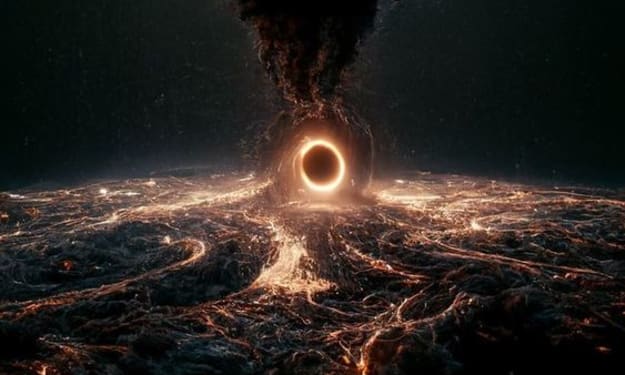
Black Holes!!!
Black Holes: Cosmic Enigmas Unveiled In the vast expanse of the cosmos, where gravity weaves the fabric of space and time, there exist cosmic entities so enigmatic and powerful that they defy our understanding of the universe itself. These entities are black holes, mysterious voids where gravity is so intense that nothing, not even light, can escape their grasp. The study of black holes has opened a Pandora's box of scientific marvels and mind-bending mysteries, fundamentally altering our perception of space, time, and the nature of reality. The concept of black holes had its roots in the equations of Albert Einstein's theory of general relativity, which described how gravity shapes the universe. However, it wasn't until the mid-20th century that scientists began to fully grasp the implications of these equations. The term "black hole" was coined by physicist John Archibald Wheeler in 1967, giving a name to these cosmic enigmas that had been lurking in the theoretical shadows. One of the early breakthroughs in black hole research came with the discovery of Cygnus X-1, a binary star system that included a black hole. Observations of this system provided compelling evidence for the existence of black holes and helped astronomers refine their understanding of their properties. The true revolution in our understanding of black holes began in the late 20th century with advancements in technology and space-based observatories. One of the most pivotal moments was the launch of the Hubble Space Telescope in 1990, which provided stunning images of distant galaxies and their central supermassive black holes, demonstrating the ubiquity of these cosmic behemoths. However, the most iconic breakthrough came in April 2019 when the Event Horizon Telescope (EHT) collaboration unveiled the first-ever image of a black hole. Located at the center of the M87 galaxy, this supermassive black hole, surrounded by a glowing ring of hot gas, captivated the world. It was a visual confirmation of the existence of black holes and a testament to human achievement in capturing an image from the heart of cosmic darkness. This groundbreaking image marked just the beginning of our quest to unravel the secrets of black holes. Scientists are now exploring their diverse forms, from stellar-sized black holes, formed by the gravitational collapse of massive stars, to supermassive black holes lurking at the centers of galaxies, weighing millions or billions of times the mass of our Sun. One of the most intriguing aspects of black holes is their extreme nature. Their immense gravity warps spacetime, creating bizarre phenomena such as time dilation and the infamous "event horizon," the point of no return beyond which nothing can escape. These properties challenge our fundamental understanding of the laws of physics and the nature of reality itself. Black holes also play a fundamental role in the life cycle of galaxies. They are cosmic engines, influencing the dynamics and evolution of galaxies by gobbling up matter and releasing energy in the form of intense radiation. The interplay between galaxies and their central black holes is a topic of ongoing research, shedding light on the formation and growth of cosmic structures. Furthermore, black holes have raised intriguing questions about the ultimate fate of the universe. The phenomenon of Hawking radiation, predicted by physicist Stephen Hawking, suggests that black holes can slowly evaporate over eons, leading to their eventual demise. This idea has profound implications for our understanding of the universe's long-term evolution. The study of black holes is not merely a scientific endeavor; it is a journey into the heart of cosmic mysteries. It challenges our preconceptions about the nature of space, time, and gravity, inviting us to explore the most extreme realms of the universe. As we continue to unravel the enigma of black holes, we stand at the threshold of profound discoveries that could reshape our understanding of the cosmos and the very fabric of existence itself. In the end, black holes are the cosmic gateways to the unknown, beckoning us to venture deeper into the mysteries of the universe. Each revelation, each image, and each scientific breakthrough brings us one step closer to unlocking the secrets hidden within these dark cosmic enigmas, illuminating the universe and our place within it.
By Raymark Marcos3 years ago in History
Mr. Bean (Rowan Atkinson) History & Life
Mr. Bean is a fictional character created by British comedian and actor Rowan Atkinson. His life, as portrayed in the various television series and films featuring the character, revolves around a series of comedic misadventures and everyday situations. Here are some key aspects of Mr. Bean's "life". The character of Mr. Bean first appeared in a British television sitcom of the same name, which aired from 1990 to 1995.
By Adil ASlam3 years ago in History
The Franks
The Franks, a Germanic ethnic group, emerged from the lower reaches of the Rhine River. During the period of mass migration, they migrated into Gaul, where they successfully established a kingdom of considerable magnitude and influence in Europe subsequent to the collapse of the Western Roman Empire. The zenith of their impact was witnessed under the reign of Charlemagne (742-814), whose rule played a pivotal role in shaping the course of Europe during the Middle Ages and beyond.The Roman conquest of Gaul, which was successfully carried out by Julius Caesar during the 1st century BCE, established the Rhine River as the definitive boundary of the Roman world. Consequently, the river assumed the role of a political demarcation line between 'civilization' (namely, Rome) and the 'barbaric' Germans who resided beyond its banks. In the Roman perception, these Germans were commonly depicted as being tall, fair-haired, unclean, and predisposed to acts of violence. Over the course of several centuries, the Roman legions stationed along the Rhine frontier effectively deterred the incursions of the Germanic tribes, until the gradual erosion of Roman authority, exemplified by events such as the Crisis of the Third Century, facilitated the infiltration of certain Germanic peoples into Roman territory. There exist various accounts regarding the origins of the Franks. The historian Gregory of Tours, writing in the 6th century, posits that the Franks originated in Pannonia and subsequently migrated to the Rhineland before settling in Thuringia and Belgium. In contrast, the Chronicle of Fredegar and the Liber Historiae Francorum, both of which are of uncertain authorship, offer more legendary accounts that trace Frankish origins back to the Trojan War. According to these myths, King Priam led 12,000 Trojan refugees to Pannonia, where they established the city of Sicambria. Some remained there, while others followed a leader named Francio to the Rhine, where they became known as the 'Franks'. The connection to Troy was likely an attempt by the Franks to establish a lineage on par with that of the Romans, who also claimed descent from the Trojans. While this origin story is undoubtedly mythical, some contemporary scholars, such as Ian Wood, contend that there is little evidence to support the notion that the Franks undertook any significant migration and instead propose that they originated in the Rhineland. During the reign of King Clovis I (r. 481-511), the Franks underwent a well-known conversion to Christianity. Prior to this, however, it is believed that they adhered to a form of ancient Germanic paganism. This particular belief system was characterized by a pantheon of multiple deities, each of which was associated with specific local cult centers. Additionally, forests were considered to be sacred spaces within this mythology. Prior to their unification, each Frankish tribe adhered to its own distinct set of laws, which were orally transmitted and recited by a designated law speaker. However, during the reign of Clovis between 507 and 511, a comprehensive civil law code was formulated to govern the newly established Frankish kingdom. This legal code, known as Salic Law, derived its name from the influential Salian tribe. Primarily composed in Latin, Salic Law primarily addressed matters pertaining to inheritance and criminal justice, thereby serving as a foundational framework for subsequent legal systems across Europe. Subsequently, another Frankish law code, known as the Ripuarian Law, was compiled circa 630, coinciding with the ascendance of the Ripuarians within the Kingdom of Austrasia. The Franks were initially recognized by a contemporary Roman source in 289 CE, although it is likely that the Franks had been involved in conflicts with the Romans for several decades prior. A Roman marching song from the 260s mentions the unfortunate deaths of many Franks, while archaeological evidence suggests that the Franks began their attacks on Roman Gaul as early as the 250s. By the end of the 3rd century, the Franks had launched multiple invasions into Roman territory, utilizing both land and sea strategies. Historical records indicate that Frankish pirates ventured into the Mediterranean, conducting raids as far as North Africa. In 486, Clovis initiated his conquest of Gaul by defeating Syagrius, the final major Roman official in Gaul, and capturing the city of Soissons. Utilizing this power base, he launched campaigns against the Alemanni, the Burgundians, and the Visigoths, thereby expanding Frankish influence throughout Gaul and Aquitaine. Clovis' conversion to Nicene Christianity (Catholicism) in approximately 496 marked the beginning of the gradual Christianization of the Franks. This conversion was significant in establishing Frankish Gaul as a stronghold for Catholicism, as opposed to Arianism, a competing Christian sect that was favored by other barbarian kingdoms. In the latter part of his reign, Clovis ruthlessly annexed the other Frankish kingdoms and executed their leaders, thereby unifying the Franks as a single people for the first time. At the time of his death in 511, Clovis reigned as "King of All the Franks" and held dominion over all of Gaul, with the exception of Burgundy, Provence, and Septimania. Following the passing of Clovis, the Merovingian kingdom underwent a division among his four sons, which may have set a precedent for future successions. Initially, the sons worked collaboratively to build upon their father's conquests, successfully expanding their territory by conquering Burgundy, Provence, and Thuringia in the 530s. Additionally, the sons of Clovis campaigned against the Visigoths in northern Spain, sent armies into Italy, expanded Frankish influence into Bavaria, and secured an annual tribute of 500 cows from the Saxons. With the passing of the Ostrogothic king Theodoric the Great in 526, the Merovingian kingdom emerged as the largest and most powerful barbarian successor state to have replaced Rome in western Europe. Despite their achievements, the Merovingian rulers frequently engaged in conflicts and consistently sought ways to undermine and conspire against one another. In the year 558, Chlothar I, the youngest son of Clovis and reigning from 511 to 561, emerged as the triumphant figure. This victory came after enduring decades of rivalry with his siblings, which involved the heinous acts of murdering his nephews and executing his own son. By outliving his brothers and inheriting their territories, Chlothar I successfully reunited the Frankish kingdom under his sole authority. Regrettably, his reign was short-lived, lasting less than three years before his demise in 561. Consequently, the kingdom was once again divided among his four sons, leading to the formation of three distinct Merovingian realms: Neustria, Austrasia, and Burgundy. The demise of Chlothar I instigated a fresh wave of machinations, internal conflicts, and targeted killings, driven by the intense rivalry between Queen Brunhilda of Austrasia (l. c. 543-613) and Queen Fredegund of Neustria (d. 597). This protracted confrontation endured for several decades and escalated into proxy wars waged by the offspring and descendants of these queens, until its culmination in 613 when Queen Brunhilda was ultimately vanquished and executed by King Chlothar II (r. 584-629), who happened to be the son of Fredegund. Chlothar II successfully reunited Francia and assumed the prestigious title of "King of All the Franks," yet his triumph came at a considerable cost. In order to consolidate his position, he was compelled to make substantial concessions to the nobility. The 614 Edict of Paris formalized the customary privileges of the aristocracy and decentralized authority, placing it in the hands of regional elites. Dagobert I, the son of Chlothar II, reigned as the final Merovingian monarch to exercise substantial royal power during his tenure from 623 to 639. Despite the Merovingian dynasty's continued reign for over a century following Dagobert's demise, their authority gradually waned as the mayors of the palace emerged as the de facto powers behind the throne. The decline of Merovingian influence prompted the chronicler Einhard to label subsequent Merovingian rulers as "rois fainéants" or "idle kings". In the year 687, the Kingdom of Austrasia achieved a significant victory over Neustria and Burgundy at the Battle of Tetry, thereby establishing itself as the predominant kingdom in Francia. This triumph resulted in an increase in power for the esteemed aristocratic family, commonly referred to as the Pippinids or the Arnulfings, who had long served as mayors of the palace of Austrasia since the reign of Dagobert I. Despite their newfound influence over the entire realm of Francia, the Pippinids did not seek to claim the throne for themselves, instead choosing to govern through their Merovingian puppets. The Franks, at that time, were not yet willing to accept any other dynasty to rule over them. However, this sentiment would eventually shift following the dynamic reign of Charles Martel (l. c. 688-741), a member of the Pippinid clan who assumed the position of mayor of the palace of Austrasia in 715. Charles, the great leader of the Franks, achieved a momentous victory over the Umayyad Caliphate at the Battle of Tours in 732. This triumph solidified his position as the de facto ruler of Francia, showcasing his exceptional prowess and strategic brilliance. By 737, Charles' personal influence had grown to such an extent that he no longer felt the need to appoint a new ruler after the death of his puppet king, Theuderic IV. The throne remained vacant, a testament to Charles' unrivaled power and authority, until his own demise in 741.
By A História3 years ago in History