Biographies
Why Japanese Education Became a Role Model for the World
How Discipline, Innovation, and Cultural Values Shaped Japan’s Exceptional Learning System When the world thinks of educational excellence, Japan often stands out. With high-performing students, orderly classrooms, and impressive literacy rates, Japan’s education system is widely admired. But what lies behind this success? The answer is a powerful blend of cultural tradition, post-war reform, and an unwavering commitment to continuous improvement.
By MystiTech Hub2 years ago in History
NASA Curiosity Rover Finds Largest Organic Molecules on Mars Major Breakthrough in Search for Life.
NASA Curiosity Rover Finds Largest Organic Molecules on Mars Major Breakthrough in Search for Life. In a groundbreaking discovery that reignites the question of life beyond Earth NASA's Curiosity rover has detected the largest organic molecules ever found on Mars. These complex carbon based compounds considered essential building blocks of life were discovered in rock samples analyzed by Curiosity’s onboard instruments in the Gale Crater an area long suspected to have once hosted liquid water.
By Adnan Rasheed2 years ago in History
Houston Stuns Duke in Final Four Comeback to Reach NCAA Championship
SAN ANTONIO — In a thrilling Final Four showdown, Houston pulled off an incredible comeback to defeat Duke 70-67, overcoming a 14-point deficit in the final eight minutes. With this stunning victory, the Cougars are now set to face Florida in the NCAA Championship game on Monday night.
By Muhammad Hayat2 years ago in History
Harlow's End: Echoes of the Nameless Stranger
The Nameless Stranger The stranger came into town just after the rain. He didn't say a word as he passed the broken town sign that read "Welcome to Harlow's End." His boots were wet, his coat was covered in road dust, and there was silence. Population: crossed out in black spray paint. He came to a stop at the diner because the neon sign was flickering, as if it was trying to decide if it was still going to glow. Inside, the usual suspects—farmers, wanderers, and a disheveled waitress with too many secrets—shut down. Not because he looked dangerous, but because he looked like he didn’t belong anywhere. Tall. Pale. Eyes the color of river stone. No bags. No ID. No name. He sat at the counter and ordered coffee. Black. When the waitress asked his name for the tab, he just said, “No need.” And smiled like it was the saddest joke in the world. That night, strange things started happening. The dogs howled without a reason. Power flickered. The old church bell rang once—though the rope had snapped years ago. By morning, the mayor’s son was missing. They remembered the stranger, of course. How could they forget him? But when they checked the booth he’d sat in, the seat was bone-dry—untouched. The coffee cup was still full. Still warm.
By Al Amin Islam 2 years ago in History
The Island That Appears and Disappears”
🌊 The Island That Appears and Disappears: Nature’s Ultimate Magic Trick. . You might be surprised to learn that even in the vast expanse of our blue planet, where satellite imaging has charted every corner and Google Maps appears to know every inch of terrain, there are still places that are unknown. The story of a landmass that vanished from maps for over a century only to be discovered to be nonexistent is one of the most intriguing. This is the bizarre and fascinating tale of Sandy Island, a cartographic ghost that piqued the interest of explorers and scientists alike. The Strange Story of Sandy Island Sandy Island was believed to exist in the Coral Sea, nestled between Australia and New Caledonia. It was depicted as a narrow strip of land approximately 15 miles long and 3 miles wide on world maps for more than a century. Ships navigated around it. Mapmakers included it in atlases. Even in the early 2010s, it was visible on Google Earth. However, despite everything, no one had ever set foot on it. That changed in 2012, when a team of Australian scientists aboard the RV Southern Surveyor set out to investigate the island while studying tectonic activity in the region. They found... nothing when they got to the location where Sandy Island was supposed to be. nothing but open ocean, with depths of more than 1,400 meters. The team double-checked their data. They looked through old logs. Analysts in satellite imagery were contacted. The absence of Sandy Island became abundantly clear. It never had. The world of cartography was astonished. How Did This Happen?
By Tamim Ahamed2 years ago in History
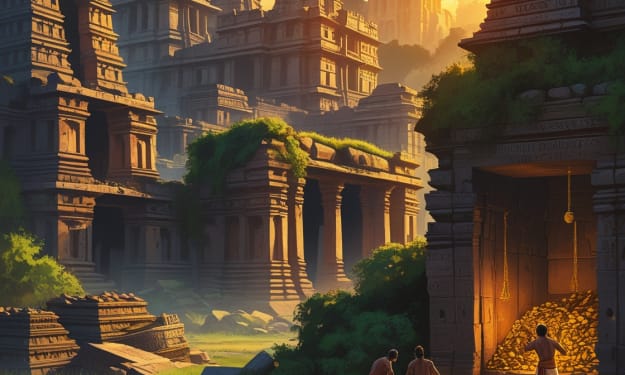
The Enigma of the Vijayanagara Vaults: India’s Lost Imperial Treasure . AI-Generated.
The Riddle of the Vijayanagara Vaults Deciphering the Enigma of South India’s Abandoned Imperial Wealth At the core of South India resides a narrative of grandeur, destruction, and lingering intriguethe account of the Vijayanagara Empire and its concealed vaults. Once regarded as one of the most affluent and influential kingdoms on the Indian subcontinent, the Vijayanagara Empire emerged in the 14th century and thrived until the 16th century. Centered around its splendid capital city of Hampi in contemporary Karnataka, the empire became a symbol of commerce, culture, and architectural excellence. However, its wealth, believed to be immeasurable, disappeared following a singular calamitous eventleaving behind murmurs of concealed vaults, lost fortunes, and enigmas still obscured beneath the remnants. A Metropolis of Unfathomable Affluence The Vijayanagara Empire attained its zenith during the reign of Emperor Krishnadevaraya (ruled 1509–1529), a sagacious and formidable sovereign. Hampi, the capital of the empire, transformed into a lively center of trade, artistry, and spirituality. Foreign visitors, including the Portuguese Domingo Paes and Fernão Nunes, documented vivid accounts of a city brimming with rubies, diamonds, pearls, silk, and spices. Gold was purportedly weighed rather than counted. The monarchs of Vijayanagara controlled trade routes that extended across the Indian Ocean, with vessels exchanging commodities and precious metals with Arabia, Africa, China, and Southeast Asia. Temple complexes within Hampisuch as the Virupaksha and Vittala templesfunctioned not only as sites of worship but also as financial institutions. Devotees presented gold idols, coins, jewelry, and ornaments in reverence to the divinities. These temples evolved into de facto treasuries for the empire. Scholars hypothesize that substantial subterranean vaults, many still undiscovered, were constructed to securely house these riches. The Decline of Vijayanagara The fortunes of the Vijayanagara Empire irrevocably shifted on January 23, 1565, when the empire's forces clashed with a coalition of Deccan Sultanates at the Battle of Talikota. The Vijayanagara army, despite its numbers and valor, suffered a devastating defeat. The victorious sultanates descended upon Hampi, laying waste to the city. What ensued was a cataclysmic eventtemples were plundered, palaces ignited, and sculptures obliterated. The once-flourishing capital was deserted within weeks, left to be engulfed by the passage of time. Nevertheless, not all was seized by the invaders. Folklore and fragmented records allude to treasure vaults concealed deep beneath the city’s temples and fortificationsvaults that were securely sealed amidst the turmoil and never reopened. The Enigmatic Vaults Legends abound regarding numerous undiscovered chambers and clandestine subterranean passages that remain buried beneath the ruins of Hampi. Locals recount tales of temple entrances sealed with ancient codes and concealed access points leading to treasure troves hidden during the siege. While some of these narratives may be embellished, contemporary archaeologists and historians contend that there is an element of truth within them. Archaeological investigations conducted by the Archaeological Survey of India (ASI) have validated the presence of numerous subterranean chambers beneath the temple complexes. Many of these areas are inaccessible due to structural fragility or religious sensitivities. Nevertheless, discoveries of gold coins, exquisite jewelry, and temple artifacts in and around the ruins lend credence to the narratives of concealed treasure. Some individuals contend that the immense wealth was intentionally concealed by the fleeing royal family and temple priests, sealed through religious ceremonies to avert desecration. The architecture of the period corroborates this notion; hidden passageways, camouflaged entrances, and crypt-like storage areas were not unusual. Estimating the Wealth Although precise valuations are conjectural, historians suggest that the Vijayanagara vaults may have contained treasures worth billions in contemporary currency. Inscriptions reference substantial quantities of gold coins (varahas), diamond-encrusted crowns, solid gold idols, and donation records for temples that encompass hundreds of kilograms of precious metals. To illustrate this, a single gold idol unearthed from a temple site in Karnataka, originating from the Vijayanagara era, weighed nearly 30 kg. Extrapolated across hundreds of temples and royal treasuries, the figures imply an empire whose wealth could rival even the treasures of Padmanabhaswamy Temple or ancient Egypt. Myth or Reality? Thus, what became of the treasures of Vijayanagara? Were they appropriated by the sultanates? Interred forever beneath the remnants of the city? Or clandestinely transported and safeguarded by loyalists? These inquiries persistently captivate historians, archaeologists, and adventurers alike.
By Say the truth 2 years ago in History
Is Heavenly Jerusalem Still a Bride?
The Prophecy of Heavenly Jerusalem and the Order of Revelation The discussion surrounding Heavenly Jerusalem and the New Name has long been a topic of theological reflection. In honoring the prophetic fulfillment of God's Holy Feasts in Christianity, it is important to consider the order in which divine revelation unfolds. As believers in prophecy, we must strive for clarity and discernment when interpreting Scripture, ensuring that we align with the original intent of Christ’s teachings.
By Emali Rose Co2 years ago in History
India’s Greatest Undiscovered Treasures: Legends of Hidden Wealth
The Pursuit of India's Hidden Wealth: The Unresolved Enigmas of Concealed Riches India has historically been a territory of immense affluence, mythical wealth, and concealed riches that continue to intrigue both scholars and treasure seekers alike. Although some valuables have been discovered throughout the years, numerous treasures remain elusive, buried deep within the annals of history. This article explores some of the most significant undiscovered treasures of India that await revelation. 1. The Concealed Fortune of the Nizam The Nizams of Hyderabad were among the most affluent royal households globally, possessing wealth beyond comprehension. Accounts indicate that a segment of their vast riches is still concealed to this day. It is believed that when Hyderabad was incorporated into India in 1948, the last reigning Nizam, Osman Ali Khan, hid large quantities of gold, jewels, and adornments in covert underground safes. Speculation continues that some of these valuables are still undiscovered, scattered across ancient palaces and concealed chambers. 2. The Enigma of Raja Raja Chola’s Concealed Wealth Raja Raja Chola I, the formidable monarch of the Chola dynasty, is reputed to have amassed considerable treasures through his victorious campaigns. His wealth was said to have been stored in hidden vaults underneath the temples he constructed, especially in the Brihadeeswarar Temple in Tamil Nadu. While some artifacts and gold have been unearthed, many assert that the true cache remains hidden beneath temple floors and secret passageways. 3. The Wealth of the Nawabs of Oudh The Nawabs of Oudh, recognized for their lavish lifestyle, governed from the 18th century until the British annexed their realm in 1856. As their reign drew to a close, it is believed that a substantial portion of their wealth was concealed across various sites. Some theorize that subterranean tunnels and hidden chambers in Lucknow still harbor untold riches, waiting to be revealed. 4. The Krishnadevaraya Fortune Krishnadevaraya, the renowned sovereign of the Vijayanagara Empire, accrued immense wealth through commerce and military triumphs. The empire, known for its splendor, succumbed to invaders in 1565 during the Battle of Talikota. Numerous accounts suggest that the empire’s riches were hidden in secret locations prior to the conflict. Some contend that gold coins, diamonds, and invaluable artifacts remain buried within the ruins of Hampi, a UNESCO World Heritage site. 5. The Mystery of the Padmanabhaswamy Temple Vault B One of the most notable findings of hidden treasure in contemporary history occurred at the Padmanabhaswamy Temple in Kerala. In 2011, a series of underground vaults were opened, disclosing an estimated $22 billion worth of gold, jewels, and artifacts. However, one vaultVault Bremains sealed due to religious and supernatural beliefs. Many speculate that this final vault contains even greater riches, but its contents are still unknown. 6. The Vanished Gold of Tipu Sultan Tipu Sultan, the sovereign of Mysore, battled tenaciously against the British during the 18th century. He was recognized for his affluence, a substantial part of which was concealed to prevent it from being seized by adversaries. Following his demise in 1799, British troops plundered his treasury; however, numerous historians contend that a considerable fraction of his gold and artifacts remains concealed in clandestine subterranean passages in Karnataka. 7. The Koh-i-Noor and Other Missing Crown Jewels The Koh-i-Noor diamond, one of the most renowned gems in history, was acquired from India and currently resides within the British Crown Jewels. Nevertheless, historians assert that various other valuable gemstones and artifacts from India were appropriated over the centuries and remain concealed in private collections or buried treasure locations, awaiting rediscovery. 8. The Hidden Wealth of Vijayanagara The Vijayanagara Empire, which flourished between the 14th and 16th centuries, was one of India’s most affluent states. Following its collapse, treasure seekers and archaeologists have endeavored to locate its concealed gold reserves, rumored to be interred beneath temple ruins or hidden within ancient fortifications.
By Say the truth 2 years ago in History
Alexander the Great and Tutankhamun: Legends of Power and Mystery
Alexander the Great and Tutankhamun: A Chronicle of Two Icons in History Alexander the Great and Pharaoh Tutankhamun emerge as two of history’s most intriguing personalities. Although they existed over a millennium apart and governed in distinct regions of the world, their names persist in captivating the imagination due to their extraordinary legacies, enigmatic demises, and substantial impact on ancient civilization. While Alexander was a conqueror who established one of the largest empires in history, Tutankhamun was a youthful monarch whose tomb’s unearthing redefined contemporary Egyptology. This article delves into their lives, reigns, and the legends that envelop them. Tutankhamun: The Young Monarch of Egypt Early Life and Ascendancy Tutankhamun, frequently referred to as "King Tut," was born circa 1341 BCE during the 18th Dynasty of Ancient Egypt. He assumed the throne at the tender age of nine following the demise of his presumed father, Pharaoh Akhenaten, whose religious reforms unsettled Egyptian society. Under Tutankhamun’s governance, Egypt initiated the restoration of the ancient deities and temples after Akhenaten’s controversial singular worship of the sun god Aten. Despite his brief reign, which endured for approximately ten years (1332–1323 BCE), Tutankhamun is renowned today not for his accomplishments as a sovereign but for the finding of his nearly undisturbed tomb in 1922 by Howard Carter. The Enigma of His Passing Tutankhamun’s passing at around 19 years of age remains one of the most profound enigmas in Egyptology. Scholars have speculated whether he perished due to illness, a chariot mishap, or even foul play. CT scans of his mummy indicate a fractured leg, which may have led to an infection, yet no conclusive cause has been determined. Tutankhamun’s Tomb and Riches King Tut’s tomb in the Valley of the Kings housed over 5,000 artifacts, comprising a solid gold coffin, a renowned golden death mask, chariots, weaponry, and jewelry. The vast wealth entombed with him provides historians with unparalleled insight into Ancient Egypt’s funerary customs and royal affluence. Alexander the Great: The Conqueror of the World Early Life and Military Acumen Born in 356 BCE in Macedonia, Alexander received tutelage from the philosopher Aristotle and was groomed to be a warrior from an early age. At the mere age of 20, he ascended to kingship following the assassination of his father, King Philip II. Alexander promptly embarked on an endeavor to expand his empire, initiating a series of military campaigns that would render him one of history’s most formidable military strategists. The Conquest of Egypt and Establishment of Alexandria In 332 BCE, Alexander invaded Egypt, where he was embraced as a liberator from Persian domination. The Egyptians hailed him as Pharaoh, and he established Alexandria, which would evolve into a significant hub of learning, trade, and culture in the ancient world. His deference to Egyptian customs enabled him to earn the allegiance of the populace. The Most Extensive Empire of the Ancient World Alexander's dominion extended from Greece to Egypt, Persia, and India, encompassing over 2 million square miles. His capacity to adjust to diverse cultures facilitated his governance over his extensive conquests. However, after more than a decade of military campaigns, his forces became fatigued, and he was compelled to retreat from further advancement into India. The Enigma of Alexander’s Demise In 323 BCE, at merely 32 years of age, Alexander became ill and passed away in the palace of Nebuchadnezzar II in Babylon. Speculations range from malaria, typhoid fever, poisoning, or an autoimmune illness. His remains were subsequently interred in a splendid golden sarcophagus and transported to Alexandria, where it was exhibited for centuries before vanishingcontributing to the narrative surrounding his death. Connections Between Alexander and Tutankhamun Despite their disparities in chronological era and governance, Alexander and Tutankhamun possess numerous fascinating parallels: Both perished young (Tutankhamun at 19, Alexander at 32). Both bequeathed significant treasures, with King Tut’s tomb being the most affluent ancient burial ever uncovered and Alexander’s lost tomb still regarded as one of history’s profound enigmas. Both were associated with Egypt, with Tutankhamun being one of its indigenous pharaohs and Alexander ruling Egypt as an external conqueror. Both experienced ambiguous deaths, inciting centuries of discourse. Legacy and Influence The discovery of Tutankhamun’s tomb in 1922 sparked global intrigue in Ancient Egypt, impacting art, literature, and popular culture. Conversely, Alexander’s conquests influenced the trajectory of history, disseminating Greek culture and ideas across extensive territories, culminating in the Hellenistic period. His influence can still be observed in the numerous cities named in his honor, including Alexandria, Egypt. Conclusion Although Alexander the Great and Tutankhamun existed in distinct eras and had markedly different effects, both left behind lasting legacies that continue to enthrall historians and the general public alike. Whether through Tutankhamun’s golden artifacts or Alexander’s military achievements, these two leaders remain timeless emblems of authority, enigma, and magnificence.
By Say the truth 2 years ago in History