Ancient
How Constantine XI Faced the Fall of Constantinople
📖 The Last Emperor’s Choice The night of May 28, 1453, was heavy with silence inside Constantinople. The once-great capital of the Byzantine Empire stood on the edge of ruin. For nearly two months, Sultan Mehmed’s army had encircled the city, hammering its ancient walls with cannons and cutting off every hope of rescue. By dawn, the final assault would begin.
By Muhammad Anas about a year ago in History
AI in Archaeology: Stanislav Kondrashov on Discovery
For a long time the image of archaeology was simple. A dig in the desert. Brushes removing dust from a pot. Shovels hitting dry ground. But now, in 2025, a different picture comes into focus. Algorithms, satellites, artificial intelligence. Stanislav Kondrashov writes that this new era is not about replacing the past, but about seeing it in ways never imagined before. The old fragments are still there, but the methods are changing.
By Stanislav Kondrashov about a year ago in History
The Parachute Wedding Dress: How Ruth Hensinger Turned WWII Survival Silk into Bridal Magic
The Parachute Wedding Dress: How Ruth Hensinger Turned WWII Survival Silk into Bridal Magic Imagine a pilot drifting down from a burning plane, his parachute the only thing between him and certain death. That same parachute, once a tool of survival in World War II, becomes the fabric of a bride's dream gown. In 1947, Ruth Hensinger sewed her wedding dress by hand from the nylon parachute that saved her fiancé's life, turning a symbol of war into one of love and hope.
By Story silver book about a year ago in History
📖 The Forgotten Prince: The Story of Alexander IV
Son of the man who conquered half the known world, Alexander IV often wondered, “Will I too command empires? Will the shadow of my father ever fade, or will I forever walk beneath it?” History promised him greatness, but fate had written a harsher truth. For in the ruthless game of power, crowns are heavy, and even a child of destiny can be crushed before his time.
By Muhammad Anas about a year ago in History
Unearthing Secrets: An Archaeologist’s Journey
Archaeology is often described as the science of discovery, but in truth, it is far more than that. It is a bridge between the present and the past, a discipline that allows us to understand the roots of human civilization and the mysteries that time has long concealed. An archaeologist’s journey is not simply about digging up artifacts; it is about piecing together forgotten stories, reconstructing ancient cultures, and breathing life into civilizations that once thrived.
By Nizam Archaeologistabout a year ago in History
The World Mourns Jane Goodall: The Woman Who Redefined Humanity Through the Eyes of Chimpanzees
The Passing of a Giant in Science On October 1, 2025, the world awoke to heartbreaking news: Dame Jane Goodall, the legendary primatologist, ethologist, and conservationist, had died at age 91. According to a statement released by the Jane Goodall Institute, she passed away of natural causes while in California, where she had been continuing her tireless speaking engagements even in her ninth decade.
By Lynn Myersabout a year ago in History
The Laboratory of the Sacred:
The laboratory of the sacred: merging spirituality, science, and technology under a larger sky There’s an old story that sets spirituality and science on opposite sides of a courtroom. In that story, facts prosecute, faith defends, and technology is the unpredictable witness. But the world we actually inhabit is far richer. We are meaning-making, tool-making, wonder-making creatures. We measure galaxies and whisper prayers; we write code and cradle newborns. And if God is the author of reality’s intelligible order, the one whose wisdom breathes through every law of nature, then God is the most powerful scientist of all: the primal inquirer, the maker of methods, the fountain of discovery.
By Julie O'Hara - Author, Poet and Spiritual Warriorabout a year ago in History
Heightened Tensions & Conflict in Gaza / Israel. AI-Generated.
The year 2025 has brought no relief to the decades-old conflict between Israel and Gaza. Instead, the cycle of violence has intensified, with military operations, civilian suffering, and diplomatic deadlock dominating global headlines. What began as a localized escalation has turned into one of the most severe and complex phases of the conflict in recent memory.
By shakir hamidabout a year ago in History
Must-Visit Historic Landmarks
INTRODUCTION Throughout human history, civilizations have left behind breathtaking landmarks that stand as timeless witnesses to culture, faith, power, and ingenuity. These historic places are more than just ruins or monuments; they are living legacies that connect us to the achievements and struggles of those who came before. From ancient temples carved in stone to mighty walls stretching across continents, every landmark tells a story of resilience, artistry, and identity.
By Nizam Archaeologistabout a year ago in History
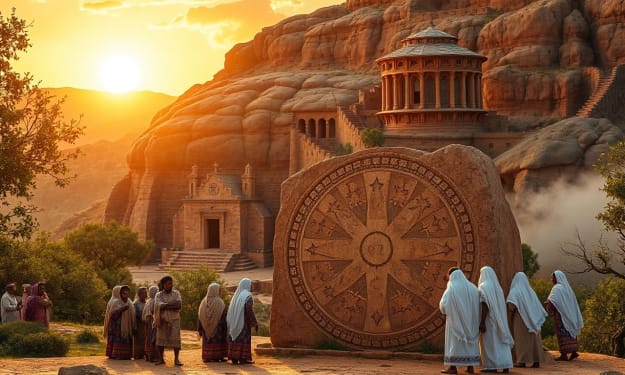
The Ethiopian Calendar: Why It's Seven Years Behind the Rest of the World. AI-Generated.
The Ethiopian Calendar: Why It's Seven Years Behind the Rest of the World Have you ever wondered why some people celebrate New Year's in September? Or how a simple date could make you feel younger overnight? Calendars do more than mark days—they tie us to history and culture in ways that shape our world.
By Story silver book about a year ago in History
Alone Above the Moon
The Loneliest Man in History A Mission That Changed Humanity On July 16, 1969, Apollo 11 launched from Kennedy Space Center in Florida. Aboard were three men—Neil Armstrong, Buzz Aldrin, and Michael Collins. Their mission was bold: to land on the Moon and return safely. The world held its breath, watching as the Saturn V rocket thundered into the sky, carrying the dreams of millions.
By Be The Bestabout a year ago in History
The Loneliest Man in History
The Silent Orbit On July 20, 1969, as Neil Armstrong and Buzz Aldrin prepared to make their historic descent to the surface of the Moon, one man remained behind in lunar orbit, circling endlessly above the gray wasteland. His name was Michael Collins, the command module pilot of Apollo 11. While his crewmates prepared to take mankind’s first steps on another world, Collins drifted alone in the Columbia module, 60 miles above the Moon’s surface.
By Be The Bestabout a year ago in History