Ancient
The Titanic’s Sister Ship: The Disaster Nobody Talks About
Everyone knows the story of the Titanic — the unsinkable ship that sank. But almost no one talks about her older sister, the Britannic, a ship built with the same luxury, the same pride, and the same destiny.
By OWOYELE JEREMIAHabout a year ago in History
“The Night the Empire Fell”
They said the thunder that night was the sound of heaven cursing Bengal. Rain hammered the tents, lightning tore open the sky — and in the heart of the storm, Nawab Siraj-ud-Daulah learned that a throne can fall not by war, but by betrayal.
By Muhammad Anas about a year ago in History
Over Mountains and Chains: Sultan Mehmed II’s Impossible Conquest
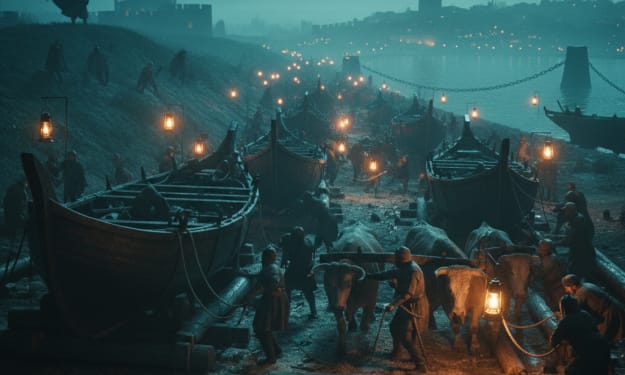
In the dead of night, under a sky pierced by flickering torches, 70 colossal warships—each a behemoth of timber and iron—groaned like wounded giants. Not on waves, but on rollers of greased logs, dragged by 10,000 sweating men over a mile of rugged hills. This was no myth. This was 1453. This was the moment a 21-year-old sultan turned the impossible into legend, sailing an armada across dry land to shatter an empire's heart.
By Muhammad Anas about a year ago in History
“The Flames of Two Tribes”
For generations, the mountains of Arden Valley echoed with the war cries of two tribes — the Korrans and the Valens. They shared the same river, the same soil, and even the same stars above, but their hearts were divided by centuries of hatred. No one remembered how their conflict began. Some said it was over stolen land; others whispered it started because of a betrayal between two brothers long forgotten. Whatever the reason, their swords had tasted enough blood to drown the valley in sorrow.
By Rafi Ullahabout a year ago in History
Vesna Vulović: The Woman Who Cheated Death
Imagine this: you’re 22, living your dream job as a flight attendant, excited to visit Denmark for the first time. The world feels wide open, full of possibility. Then, in a split second, everything changes. Your plane explodes at 33,333 feet, and you’re plummeting to earth-no parachute, no protection, just you and the laws of physics. Sounds like the end, right? But for Vesna Vulović, it was just the beginning of a story so wild it feels like it belongs in a movie. Her survival is a tale of miracles, mysteries, and a touch of human stubbornness that makes you wonder: how does someone walk away from the impossible?
By KWAO LEARNER WINFREDabout a year ago in History
The Beginnings of the Ottoman Empire
The Ottoman Empire originated in the late 13th century in Anatolia (Asia Minor), where various Turkic emirates emerged after the decline of the Seljuk Sultanate of Rum. The tribe led by Osman I (hence the name "Ottoman") began to expand, taking advantage of the weakness of its Byzantine neighbors and the lack of cohesion among other Turkic tribes.Under successors like Orhan I and Murad I, the Ottomans crossed from Asia into Europe, conquering vast territories in the Balkans. They developed a formidable army, including the famous elite unit of the Janissaries, soldiers recruited from Christian children in conquered provinces, raised and trained to serve only the Sultan. This army was modern, well-disciplined, and effectively used artillery, long before many European armies.
By alin butucabout a year ago in History
The Dog That Didn't Turn
This incident sheds light on a very thought-provoking detail in Surah Al-Kahf Question: Why is the dog mentioned as "spreading its forelegs" in Surah Al-Kahf? And when the Companions of the Cave were turning to their right and left sides, why wasn't the dog turning?
By Article Writing Masterabout a year ago in History
Anarcha Westcott
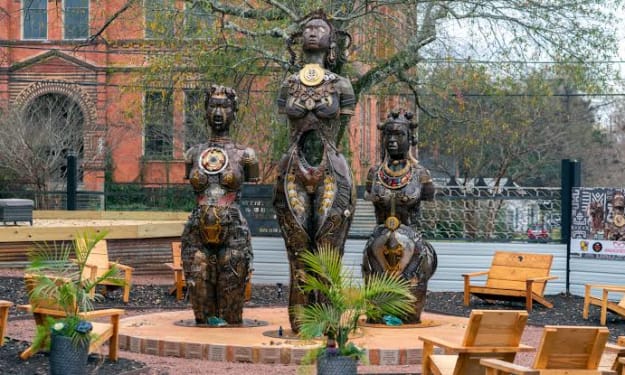
In the dusty medical archives of the 19th century, the name Anarcha Westcott appears quietly, not in headlines, but buried in surgical reports and footnotes. She was not a doctor. She was not a nurse. She was a young enslaved Black woman on a plantation in Montgomery, Alabama. Her body became the unwilling stage for a series of surgical experiments that would transform the field of medicine, at a devastating human cost. Anarcha suffered from a condition called vesicovaginal fistula, a severe childbirth injury that caused uncontrollable leakage of urine, chronic infections, and deep social stigma. In the 1840s, there was no known cure in America. Enter Dr. James Marion Sims, a physician who would later be celebrated as “the father of modern gynecology.” But before the accolades and fame, there was Anarcha. Sims saw in Anarcha and other enslaved women a chance to experiment and develop new surgical methods. These women had no choice; their bodies were controlled by their owners and by Sims himself. Between 1845 and 1849, Sims performed around 30 experimental surgeries on Anarcha in an effort to treat her fistula. He did this without anesthesia. Although ether anesthesia was already available during that period, Sims chose not to use it, driven by the racist belief that Black women did not feel pain in the same way white women did. The surgeries were brutal. Anarcha was fully conscious as Sims operated on her repeatedly. She screamed in pain while other enslaved women held her down. Surgery after surgery failed, leaving her in agony, but Sims persisted, not for her comfort, but for medical discovery. She wasn’t alone. Sims also experimented on at least ten other enslaved women, including Lucy and Betsy, whose names survive through fragments of historical records. But Anarcha became his most frequent subject, enduring four long years of procedures. Eventually, Sims developed a successful surgical technique to repair the fistula, a technique that would go on to revolutionize women’s healthcare. He published his methods, built a hospital for women, and was honored by the medical community. Statues were raised in his name. But Anarcha’s name was almost erased. Her suffering was the foundation on which Sims built his legacy, yet she received no recognition, no honor, and no freedom for her ordeal. Her body carried the weight of history, and her pain paved the way for modern gynecology. For decades, the world celebrated Sims while forgetting the women whose bodies he used. But history began to reckon with the truth. Activists, historians, and communities brought Anarcha’s story back into the light. In 2018, after public outcry, the statue of Sims in New York’s Central Park was removed. In its place, new voices began to speak the names of Anarcha, Lucy, Betsy, and the other women, acknowledging their pain and their forced contribution to medical history. Anarcha Westcott’s story is not one of medical glory. It is a story of injustice, survival, and truth. She endured unimaginable pain, not by choice but by force. Her body carried the weight of experiments that would go on to save countless lives, yet she remained voiceless for more than a century. Today, the world is beginning to remember her, not as a footnote, but as a central figure in the painful birth of modern gynecology. History remembered the doctor. But the world is finally beginning to remember the woman.
By Stories You Never Heardabout a year ago in History